Hussaarts Koen G A M, Hurkmans Daan P, Oomen-de Hoop Esther, van Harten Leonie J, Berghuis Stan, van Alphen Robbert J, Spierings Leontine E A, van Rossum-Schornagel Quirine C, Vastbinder Mijntje B, van Schaik Ron H N, van Gelder Teun, Jager Agnes, van Leeuwen Roelof W F, Mathijssen Ron H J
Department of Medical Oncology, Erasmus MC Cancer Institute, Dr. Molewaterplein 40, 3015 GD Rotterdam, The Netherlands.
Department of Internal Medicine, Elisabeth Tweesteden Hospital, Hilvarenbeekseweg 60, 5022 GC Tilburg, The Netherlands.
Cancers (Basel). 2019 Mar 22;11(3):403. doi: 10.3390/cancers11030403.
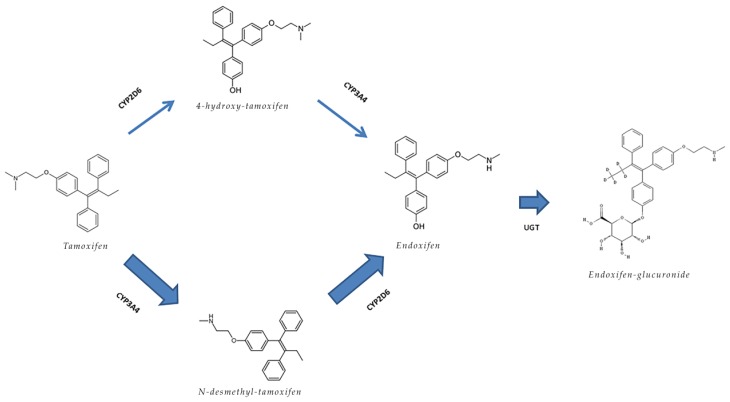
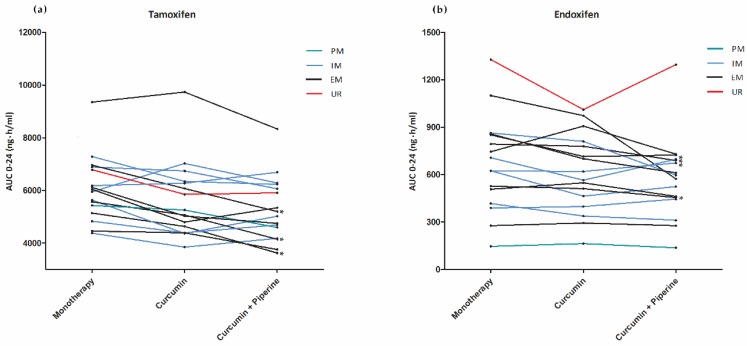
Tamoxifen is a prodrug that is primarily metabolized into the pharmacologically active metabolite endoxifen and eventually into inactive metabolites. The herb curcumin may increase endoxifen exposure by affecting phase II metabolism. We compared endoxifen and tamoxifen exposure in breast cancer patients with or without curcumin, and with addition of the bio-enhancer piperine. Tamoxifen (20⁻30mg per day (q.d.)) was either given alone, or combined with curcumin (1200 mg three times daily (t.i.d.)) +/- piperine (10 mg t.i.d.). The primary endpoint of this study was the difference in geometric means for the area under the curve (AUC) of endoxifen. Genotyping was performed to determine CYP2D6 and CYP3A4 phenotypes. The endoxifen AUC decreased with 7.7% (95%CI: -15.4 to 0.7%; = 0.07) with curcumin and 12.4% (95%CI: -21.9 to -1.9%; = 0.02) with curcumin and piperine, compared to tamoxifen alone. Tamoxifen AUC showed similar results. For patients with an extensive CYP2D6 metabolism phenotype (EM), effects were more pronounced than for intermediate CYP2D6 metabolizers (IMs). In conclusion, the exposure to tamoxifen and endoxifen was significantly decreased by concomitant use of curcumin (+/- piperine). Therefore, co-treatment with curcumin could lower endoxifen concentrations below the threshold for efficacy (potentially 20⁻40% of the patients), especially in EM patients.
他莫昔芬是一种前体药物,主要代谢为具有药理活性的代谢物endoxifen,最终代谢为无活性的代谢物。草药姜黄素可能通过影响Ⅱ相代谢增加endoxifen的暴露量。我们比较了乳腺癌患者在服用或未服用姜黄素以及添加生物增强剂胡椒碱的情况下endoxifen和他莫昔芬的暴露量。他莫昔芬(每天20 - 30毫克(qd))单独给药,或与姜黄素(每日三次,每次1200毫克(tid))+/-胡椒碱(每日三次,每次10毫克(tid))联合使用。本研究的主要终点是endoxifen曲线下面积(AUC)的几何平均值差异。进行基因分型以确定CYP2D6和CYP3A4表型。与单独使用他莫昔芬相比,联合使用姜黄素时endoxifen的AUC降低了7.7%(95%CI:-15.4至0.7%;P = 0.07),联合使用姜黄素和胡椒碱时降低了12.4%(95%CI:-21.9至-1.9%;P = 0.02)。他莫昔芬的AUC显示出类似结果。对于具有广泛CYP2D6代谢表型(EM)的患者,其影响比中等CYP2D6代谢者(IM)更为明显。总之,同时使用姜黄素(+/-胡椒碱)会显著降低他莫昔芬和endoxifen的暴露量。因此,与姜黄素联合治疗可能会使endoxifen浓度低于疗效阈值(可能20 - 40%的患者),尤其是在EM患者中。