Instituto de Biomedicina y Biotecnología de Cantabria (IBBTEC) CSIC-Universidad de Cantabria and Department of Biología Molecular, Universidad de Cantabria, 39011 Santander, Spain.
Current address: Systems Biology Ireland, University College Dublin, Belfield, Dublin 4, Ireland.
Genes (Basel). 2019 Mar 22;10(3):244. doi: 10.3390/genes10030244.
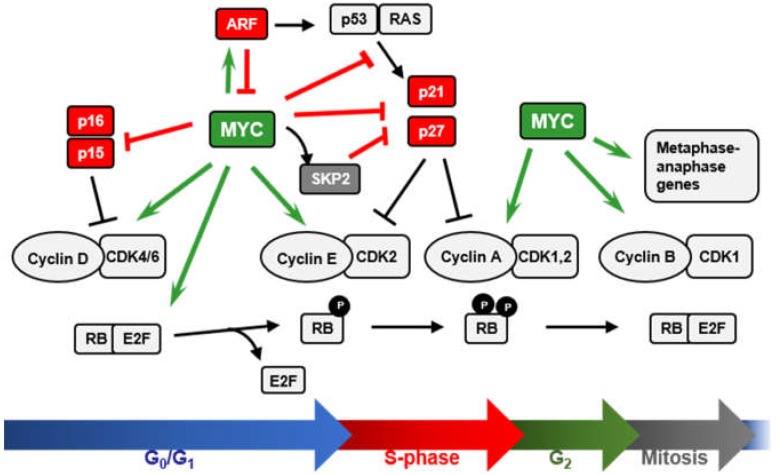
Promotion of the cell cycle is a major oncogenic mechanism of the oncogene c-MYC (MYC). MYC promotes the cell cycle by not only activating or inducing cyclins and CDKs but also through the downregulation or the impairment of the activity of a set of proteins that act as cell-cycle brakes. This review is focused on the role of MYC as a cell-cycle brake releaser i.e., how MYC stimulates the cell cycle mainly through the functional inactivation of cell cycle inhibitors. MYC antagonizes the activities and/or the expression levels of p15, ARF, p21, and p27. The mechanism involved differs for each protein. p15 (encoded by CDKN2B) and p21 (CDKN1A) are repressed by MYC at the transcriptional level. In contrast, MYC activates ARF, which contributes to the apoptosis induced by high MYC levels. At least in some cells types, MYC inhibits the transcription of the p27 gene (CDKN1B) but also enhances p27's degradation through the upregulation of components of ubiquitin ligases complexes. The effect of MYC on cell-cycle brakes also opens the possibility of antitumoral therapies based on synthetic lethal interactions involving MYC and CDKs, for which a series of inhibitors are being developed and tested in clinical trials.
促进细胞周期是癌基因 c-MYC(MYC)的主要致癌机制。MYC 通过激活或诱导细胞周期蛋白和细胞周期蛋白依赖性激酶(CDKs)来促进细胞周期,还通过下调或削弱一组作为细胞周期制动器的蛋白质的活性来实现。这篇综述重点介绍了 MYC 作为细胞周期制动器释放剂的作用,即 MYC 如何主要通过细胞周期抑制剂的功能失活来刺激细胞周期。MYC 拮抗 p15、ARF、p21 和 p27 的活性和/或表达水平。每种蛋白质的相关机制均不相同。p15(由 CDKN2B 编码)和 p21(CDKN1A)在转录水平上受到 MYC 的抑制。相比之下,MYC 激活 ARF,这有助于高水平 MYC 诱导的细胞凋亡。至少在某些细胞类型中,MYC 抑制 p27 基因(CDKN1B)的转录,但也通过上调泛素连接酶复合物的成分增强 p27 的降解。MYC 对细胞周期制动器的影响也为基于涉及 MYC 和 CDK 的合成致死相互作用的抗肿瘤疗法开辟了可能性,为此正在开发和临床试验中测试一系列抑制剂。