Fitschen-Oestern Stefanie, Lippross Sebastian, Lefering Rolf, Besch Lutz, Klüter Tim, Schenzer-Hoffmann Elke, Seekamp Andreas
Department of Trauma Surgery, University Medical Center of Schleswig-Holstein, Campus Kiel, Arnold-Heller Straße 7, 24105, Kiel, Germany.
Institute for Research in Operative Medicine (IFOM), University Witten/Herdecke, Cologne, Germany.
BMC Musculoskelet Disord. 2019 Mar 25;20(1):121. doi: 10.1186/s12891-019-2501-8.
Missed or underestimated injuries are one of the central problems in trauma care. Foot injuries can easily be missed because they lay beyond the regularly screened field of a trauma computer tomography scan (CT scan). During primary and secondary survey a careful examination of the extremities often becomes of secondary interest in the severely injured patient.
Thirty-four thousand ninety-one multiple trauma patients of the TraumaRegister DGU® were evaluated from 2002 to 2014. We differentiated between patients with foot injuries, patients with missed foot injuries and patients without foot injuries. Included were ankle fractures, calcaneus fractures, talus fractures, metatarsal fractures, toe fractures, amputation, soft tissue injuries and/or ligamentous injuries.
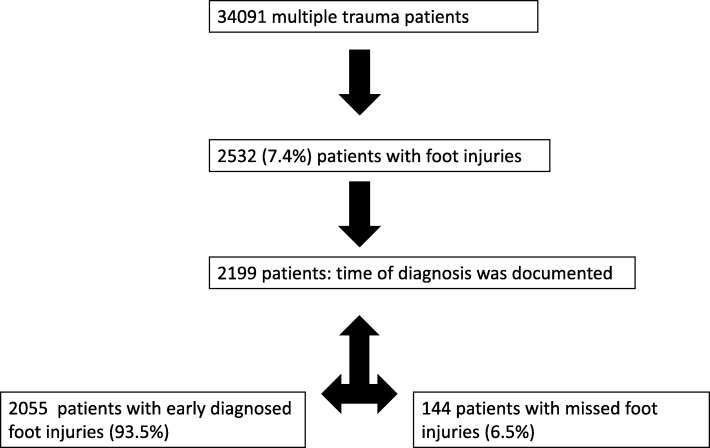
Summarized evaluation of 34,091 trauma patients showed a share of 2532 patients with foot injuries. Time of diagnosis was documented in 2199 cases. 2055 patients had early diagnosed foot injuries and 144 patients had initially missed foot injuries. Missed foot injuries were especially found in patients with car accidents or fall from ≥3 m. Patients with higher Abbreviated Injury Scale (AIS) or lower Glasgow Coma Scale (GCS) were not significantly more affected by missed foot injuries. Missing foot injuries was also not caused by injury severity or higher age.
Our data highlights the need of careful evaluation of the feet during primary and secondary survey particularly when a tibia or femur fracture is diagnosed. Special attention should be turned to patients after car accidents or fall from great height. Suicide victims also need major attention. Patients with early operations also need careful examination and tertiary survey is highly recommended.
漏诊或低估的损伤是创伤护理中的核心问题之一。足部损伤很容易被漏诊,因为它们位于创伤计算机断层扫描(CT扫描)常规筛查范围之外。在初级和次级检查过程中,对于重伤患者,对四肢进行仔细检查往往成为次要关注点。
对2002年至2014年创伤注册数据库DGU®中的34091例多发伤患者进行评估。我们区分了有足部损伤的患者、漏诊足部损伤的患者和无足部损伤的患者。纳入的损伤包括踝关节骨折、跟骨骨折、距骨骨折、跖骨骨折、趾骨骨折、截肢、软组织损伤和/或韧带损伤。
对34091例创伤患者的综合评估显示,有2532例患者存在足部损伤。2199例记录了诊断时间。2055例患者足部损伤得到早期诊断,144例患者最初漏诊了足部损伤。漏诊的足部损伤尤其多见于车祸或从≥3米高处坠落的患者。损伤严重程度评分(AIS)较高或格拉斯哥昏迷量表(GCS)较低的患者,漏诊足部损伤的情况并无显著增加。漏诊足部损伤也不是由损伤严重程度或高龄所致。
我们的数据强调了在初级和次级检查过程中,尤其是在诊断胫骨或股骨骨折时,需要对足部进行仔细评估。应特别关注车祸或高处坠落患者。自杀受害者也需要重点关注。早期接受手术的患者也需要仔细检查,强烈建议进行三级检查。