Horino Satoshi, Kitazawa Hiroshi, Satou Taiki, Miura Katsushi
Department of Allergy, Miyagi Children's Hospital, Sendai, Japan.
Department of Pediatrics, Tohoku Medical and Pharmaceutical University Hospital, Sendai, Japan.
Allergy Asthma Immunol Res. 2019 May;11(3):433-437. doi: 10.4168/aair.2019.11.3.433.
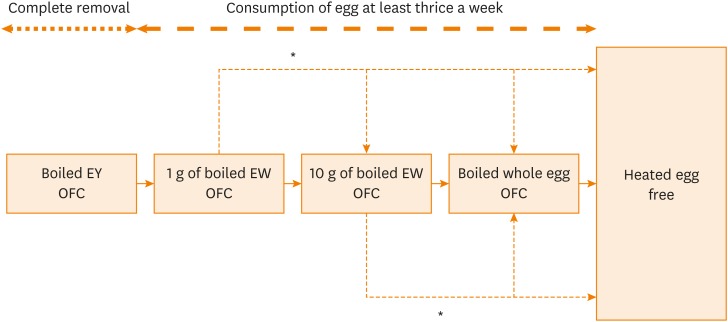
Hen's egg is the most common allergen in IgE-mediated food allergy among children in Japan. Although the majority of patients with egg allergy can eat heated egg yolk safely because of its low allergenicity, severely allergic patients show an immediate-type reaction to heated egg yolk. We hypothesized that patients with hyperresponsiveness to boiled egg yolk may have difficulty in acquiring tolerance to egg. The purpose of this study was to examine the prognosis of patients with hyperresponsiveness to boiled egg yolk. Data from 121 patients with egg allergy who underwent oral food challenge (OFC) with boiled egg yolk between January 2012 and December 2013 were analyzed retrospectively. The proportion of patients who could consume heated whole egg 3 years after OFC was 15.4% in the OFC-positive group and 75.8% in the OFC-negative group. Hyperresponsiveness to boiled egg yolk in early life might lead to prolonged egg allergy in children. This finding might aid in the selection of an appropriate population requiring practical immunotherapy.
在日本儿童中,鸡蛋是IgE介导的食物过敏中最常见的过敏原。尽管大多数鸡蛋过敏患者由于其低致敏性可以安全食用加热后的蛋黄,但严重过敏的患者对加热后的蛋黄会出现速发型反应。我们推测,对煮过的蛋黄反应过度的患者可能难以获得对鸡蛋的耐受性。本研究的目的是研究对煮过的蛋黄反应过度的患者的预后情况。回顾性分析了2012年1月至2013年12月期间121例对煮过的蛋黄进行口服食物激发试验(OFC)的鸡蛋过敏患者的数据。在OFC阳性组中,OFC后3年能够食用加热全蛋的患者比例为15.4%,而在OFC阴性组中这一比例为75.8%。儿童早期对煮过的蛋黄反应过度可能会导致鸡蛋过敏持续时间延长。这一发现可能有助于选择需要进行实际免疫治疗的合适人群。