Department of Endocrinology, University Medical Center Groningen, University of Groningen, 9700 RB Groningen, The Netherlands.
Department of Gastroenterology and Hepatology, University Medical Center Groningen, University of Groningen, 9700 RB Groningen, The Netherlands.
Nutrients. 2019 Mar 26;11(3):705. doi: 10.3390/nu11030705.
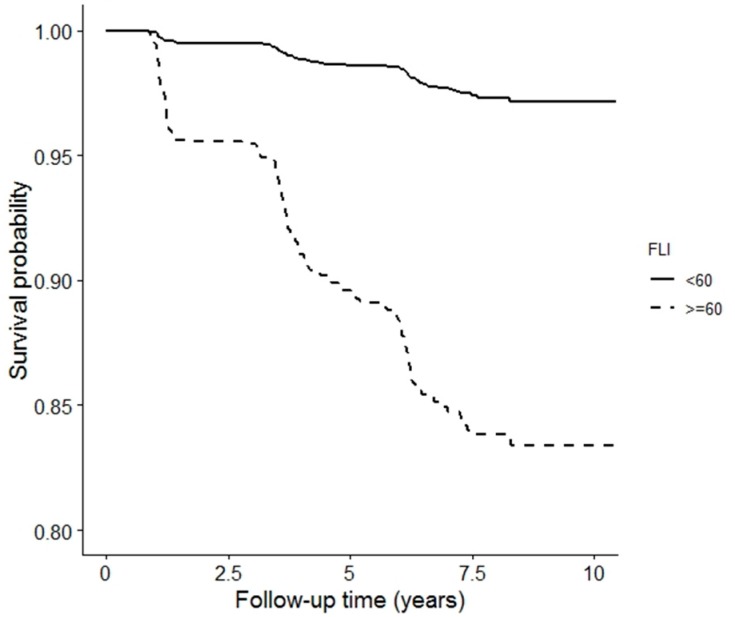
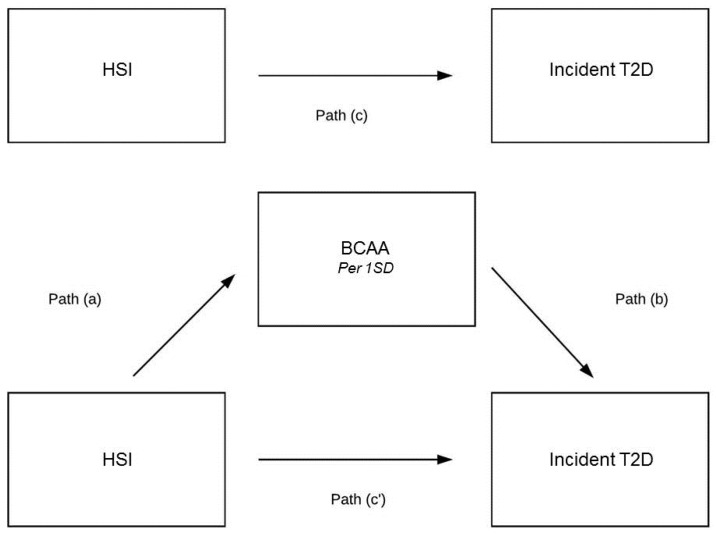
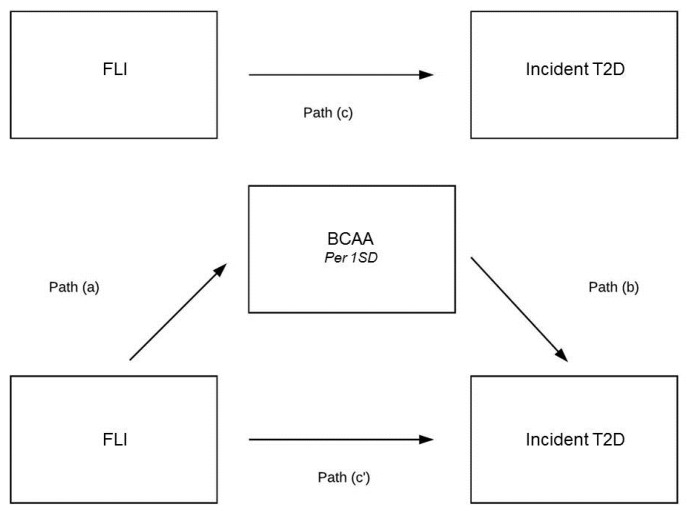
Non-alcoholic fatty liver disease (NAFLD) is likely to be associated with elevated plasma branched-chain amino acids (BCAAs) and may precede the development of type 2 diabetes (T2D). We hypothesized that BCAAs may be involved in the pathogenesis of T2D attributable to NAFLD and determined the extent to which plasma BCAAs influence T2D development in NAFLD. We evaluated cross-sectional associations of NAFLD with fasting plasma BCAAs (nuclear magnetic resonance spectroscopy), and prospectively determined the extent to which the influence of NAFLD on incident T2D is attributable to BCAA elevations. In the current study, 5791 Prevention of REnal and Vascular ENd-stage Disease (PREVEND) cohort participants without T2D at baseline were included. Elevated fatty liver index (FLI) ≥60, an algorithm based on triglycerides, gamma-glutamyltransferase, body mass index (BMI) and waist circumference, was used as proxy of NAFLD. Elevated FLI ≥ 60 was present in 1671 (28.9%) participants. Cross-sectionally, BCAAs were positively associated with FLI ≥ 60 (β = 0.208, < 0.001). During a median follow-up of 7.3 years, 276 participants developed T2D, of which 194 (70.2%) had an FLI ≥ 60 (log-rank test, < 0.001). Cox regression analyses revealed that both FLI ≥60 (hazard ratio (HR) 3.46, 95% CI 2.45⁻4.87, < 0.001) and higher BCAA levels (HR 1.19, 95% CI 1.03⁻1.37, = 0.01) were positively associated with incident T2D. Mediation analysis showed that the association of FLI with incident T2D was in part attributable to elevated BCAAs (proportion mediated 19.6%). In conclusion, both elevated FLI and elevated plasma BCAA levels are associated with risk of incident T2D. The association of NAFLD with T2D development seems partly mediated by elevated BCAAs.
非酒精性脂肪性肝病(NAFLD)可能与血浆支链氨基酸(BCAAs)升高有关,并可能先于 2 型糖尿病(T2D)的发生。我们假设 BCAAs 可能参与了 NAFLD 导致的 T2D 的发病机制,并确定了血浆 BCAAs 对 NAFLD 患者 T2D 发生的影响程度。我们评估了 NAFLD 与空腹血浆 BCAAs(核磁共振光谱)的横断面相关性,并前瞻性地确定了 NAFLD 对 T2D 发病的影响在多大程度上归因于 BCAAs 的升高。在本研究中,共纳入了 5791 名基线时无 T2D 的预防肾脏和血管终点疾病(PREVEND)队列参与者。使用基于甘油三酯、γ-谷氨酰转移酶、体重指数(BMI)和腰围的脂肪酸指数(FLI)升高(≥60)作为 NAFLD 的替代指标。在 1671 名(28.9%)参与者中存在升高的 FLI≥60。横断面分析显示,BCAAs 与 FLI≥60 呈正相关(β=0.208,<0.001)。在中位随访 7.3 年期间,276 名参与者发生了 T2D,其中 194 名(70.2%)有 FLI≥60(对数秩检验,<0.001)。Cox 回归分析显示,FLI≥60(风险比(HR)3.46,95%CI 2.45⁻4.87,<0.001)和较高的 BCAAs 水平(HR 1.19,95%CI 1.03⁻1.37,=0.01)与新发 T2D 均呈正相关。中介分析显示,FLI 与新发 T2D 的关联部分归因于 BCAAs 的升高(介导比例 19.6%)。总之,升高的 FLI 和血浆 BCAAs 水平均与新发 T2D 的风险相关。NAFLD 与 T2D 发生的关联部分可能是由升高的 BCAAs 介导的。