Department of Clinical Pharmacy, University of Gondar, Gondar, Amhara, Ethiopia.
PLoS One. 2019 Mar 28;14(3):e0214191. doi: 10.1371/journal.pone.0214191. eCollection 2019.
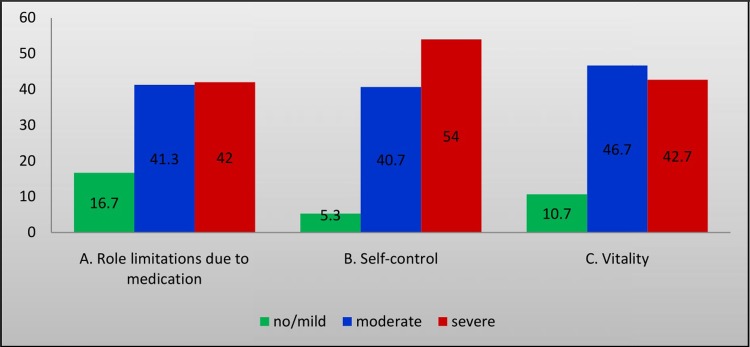
Polypharmacy among older patients has been associated with a decline in their quality of life. We aimed to assess the medication-related quality of life (MRQOL) among older patients with polypharmacy at Gondar University Hospital, Gondar, Ethiopia. A prospective cross-sectional study was carried out among 150 elder patients who had visited the internal medicine ward and ambulatory ward of Gondar referral hospital from March 25 to May 15, 2017, using a validated scale, Medication-Related Quality of Life Scale version 1.0 (MRQoLS-v1.0). A total of 150 older patients with polypharmacy participated in the study with a mean age of 70.06±5.12, andtwo-thirds of the participants (67.3%) were female. The overall prevalence of poor quality of life due to polypharmacy in the current study was found to be three fourth (75.3%) of the participants. Regarding the severity of impairment in MRQoL, Univariate analysis revealed that frequency of hospital visits (COR = 1.34, 95% CI, 1.02-1.77) and medication number (COR = 1.94, 95% CI, 1.33, 2.8) had a statistically significant positive association with the likelihood of having a severe impairment.The multivariate analysis also showed that one unit increase in the number of hospital visits (AOR = 1.45, 95% CI, 1.040-2.024) and medications greater than 5 (AOR = 1.91, 95% CI, 1.29, 2.84) increases 1.45 and 1.91 times the likely hood of posing severe impairment of MRQoL, respectively. As far as poor MRQoL quality of life is concerned, multivariate analysis did not show any significant association between the poor MRQoL;and Sociodemographic and clinical data of patients. The poor QoL associated with medication was very high in this study. Deprescribing should be sought by the health care providers to optimize drug therapy and minimize the polypharmacy related poor quality of life.
在老年患者中,多种药物治疗与生活质量下降有关。我们旨在评估埃塞俄比亚贡德尔大学医院老年多种药物治疗患者的与药物相关的生活质量(MRQOL)。2017 年 3 月 25 日至 5 月 15 日,我们对在该医院内科病房和门诊就诊的 150 名老年患者进行了一项前瞻性的横断面研究,使用了经过验证的量表,即药物相关生活质量量表 1.0 版(MRQoLS-v1.0)。共有 150 名患有多种药物治疗的老年患者参与了这项研究,他们的平均年龄为 70.06±5.12 岁,其中三分之二(67.3%)为女性。在本研究中,由于多种药物治疗导致生活质量差的总体患病率为 75.3%的参与者。关于 MRQoL 受损的严重程度,单变量分析显示,住院就诊频率(COR = 1.34,95%CI,1.02-1.77)和药物数量(COR = 1.94,95%CI,1.33,2.8)与发生严重损害的可能性呈统计学显著正相关。多变量分析还表明,住院就诊次数增加一个单位(AOR = 1.45,95%CI,1.040-2.024)和药物数量大于 5(AOR = 1.91,95%CI,1.29,2.84)分别增加了 1.45 和 1.91 倍,增加了 MRQoL 发生严重损害的可能性。就生活质量差而言,多变量分析并未显示生活质量差与患者的社会人口统计学和临床数据之间存在任何显著关联。在这项研究中,与药物相关的生活质量差的情况非常高。医疗保健提供者应寻求减药,以优化药物治疗并最小化与多种药物治疗相关的生活质量差。