Pritzker School of Medicine, University of Chicago, Chicago, IL, USA.
Pritzker School of Medicine, University of Chicago, Chicago, IL, USA; Section of Academic Pediatrics, University of Chicago Medical Center, Chicago, IL, USA.
Sleep Med. 2019 May;57:87-91. doi: 10.1016/j.sleep.2019.01.030. Epub 2019 Jan 31.
To contextualize inpatient sleep duration and disruptions in a general pediatric hospital ward by comparing in-hospital and at-home sleep durations to recommended guidelines and to objectively measure nighttime room entries.
Caregivers of patients four weeks - 18 years of age reported patient sleep duration and disruptions in anonymous surveys. Average at-home and in-hospital sleep durations were compared to National Sleep Foundation recommendations. Objective nighttime traffic was evaluated as the average number of room entries between 11:00pm and 7:00am using GOJO brand hand-hygiene room entry data.
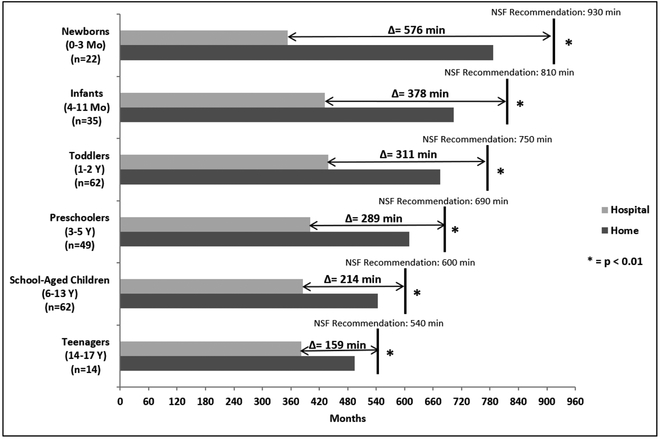
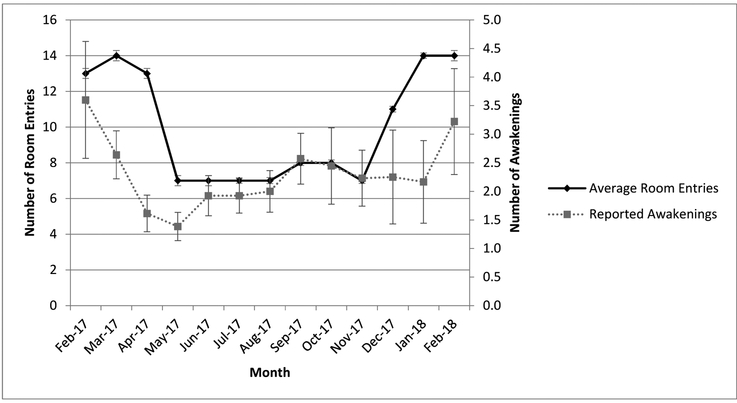
Among 246 patients, patients slept less in the hospital than at home with newborn and infant cohorts experiencing 7- and 4-h sleep deficits respectively (Newborn: 787 ± 318 min at home vs. 354 ± 211 min in hospital, p < 0.001; Infants: 703 ± 203 min at home vs. 412 ± 152 min in hospital, p < 0.01). Newborn children also experienced >2 h sleep deficits at home when compared to NSF recommendations (Newborns: 787 ± 318 min at home vs. 930 min recommended, p < 0.05). Objective nighttime traffic measures revealed that hospitalized children experienced 7.3 room entries/night (7.3 ± 0.25 entries). Nighttime traffic was significantly correlated with caregiver-reported nighttime awakenings (Spearman Rank Correlation Coefficient: 0.83, p < 0.001).
Hospitalization is a missed opportunity to improve sleep both in the hospital and at home.
通过比较住院和在家的睡眠时间与推荐指南,并客观测量夜间进入房间的次数,来了解儿科综合病房住院患者的睡眠时长和睡眠中断情况。
在匿名调查中,患儿的照顾者报告了患者的睡眠时长和睡眠中断情况。将平均在家和住院睡眠时间与国家睡眠基金会的建议进行比较。使用 GOJO 牌手部卫生进入房间数据,评估夜间 11:00 至 7:00 之间的平均进入房间次数作为客观的夜间交通量。
在 246 名患者中,患者在医院的睡眠时间比在家中少,新生儿和婴儿组分别存在 7 小时和 4 小时的睡眠不足(新生儿:在家中 787 ± 318 分钟,在医院中 354 ± 211 分钟,p < 0.001;婴儿:在家中 703 ± 203 分钟,在医院中 412 ± 152 分钟,p < 0.01)。与 NSF 建议相比,新生儿在家中的睡眠时间也不足 2 小时(新生儿:在家中 787 ± 318 分钟,推荐睡眠时间为 930 分钟,p < 0.05)。客观夜间交通量测量结果显示,住院患儿夜间有 7.3 次进出房间(7.3 ± 0.25 次)。夜间交通量与照顾者报告的夜间觉醒情况呈显著相关性(Spearman 秩相关系数:0.83,p < 0.001)。
住院是改善医院和家庭睡眠的一个错失的机会。