Kumar Jatin, Agrawal Veena
Department of Botany, University of Delhi, Delhi, 110007, India.
Heliyon. 2019 Mar 16;5(3):e01346. doi: 10.1016/j.heliyon.2019.e01346. eCollection 2019 Mar.
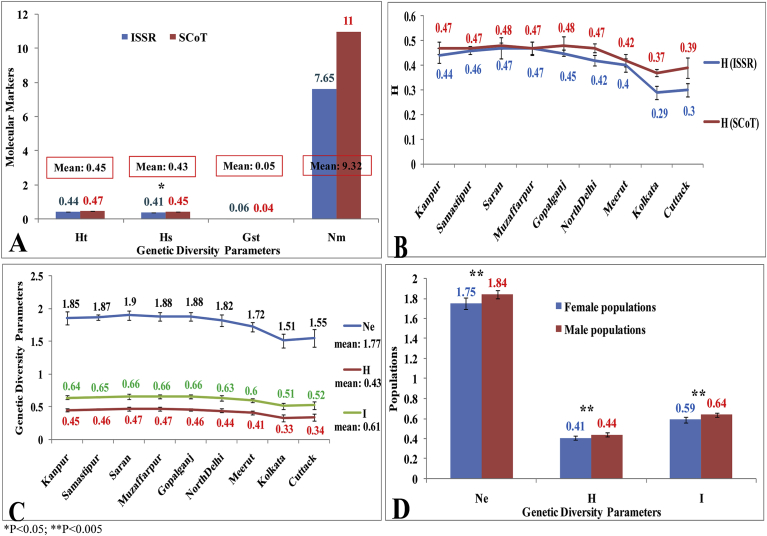
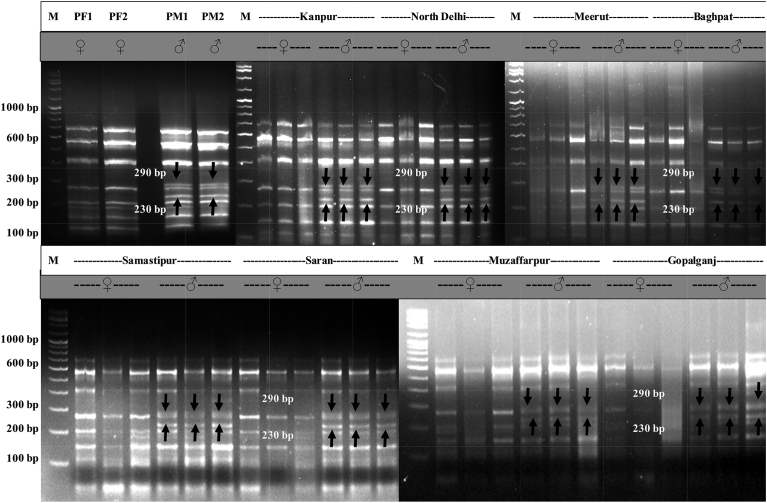
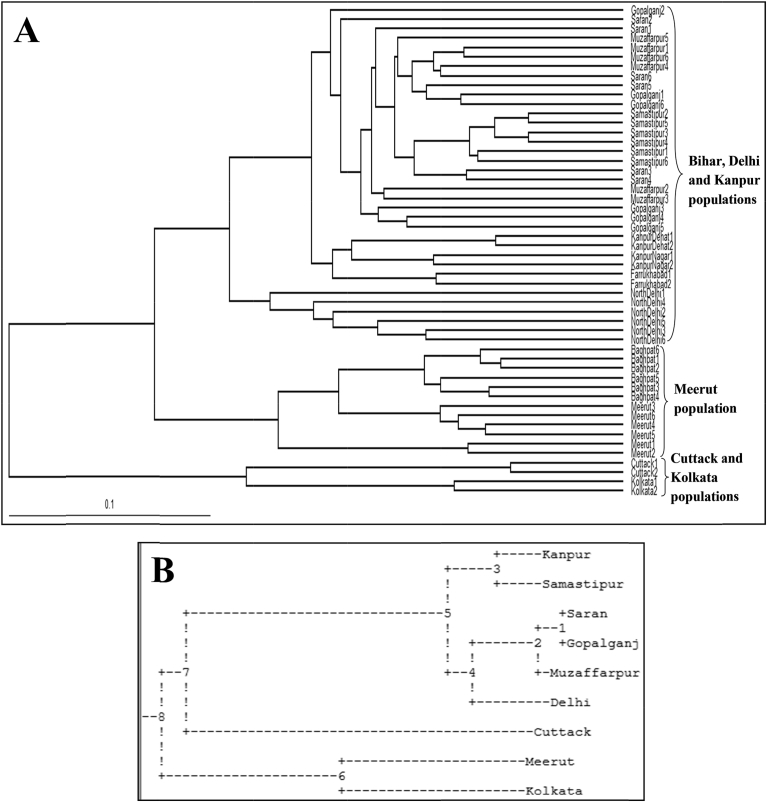
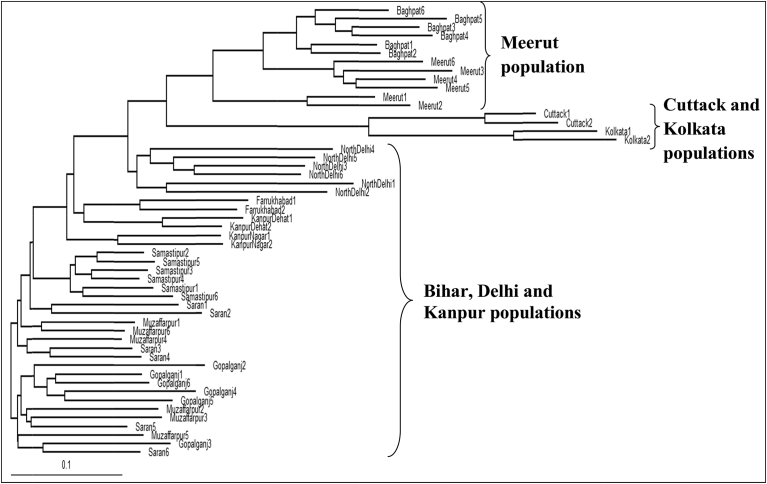
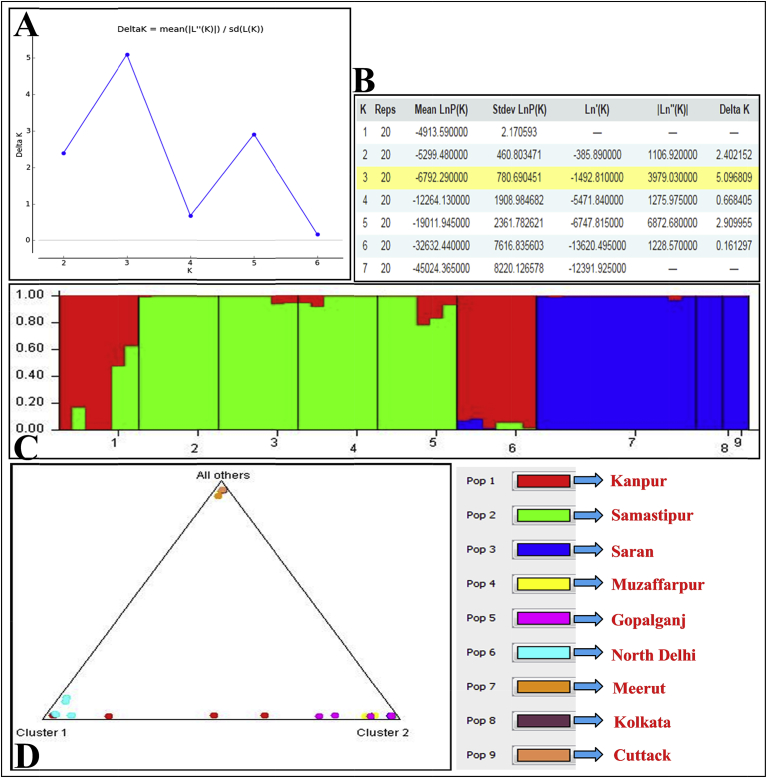
Twenty inter-simple sequence repeat (ISSR) and twenty two start codon targeted (SCoT) primers were employed to analyze genetic diversity and population structure among 52 Roxb. accessions collected from nine different eco-geographical regions of India. ISSR markers proved to be more informative in genetic diversity assessment and produced higher mean number of polymorphic bands (15.25 with 95.96% polymorphism) and polymorphic information content (PIC) value (0.47) compared to SCoT markers (12.55 polymorphic bands with 92.20% polymorphism and PIC: 0.45). Total genetic diversity () and genetic diversity within populations () in accessions was found to be very high (0.45 and 0.43, respectively). AMOVA analysis also revealed higher genetic variation within populations (81%) than among them (19%). Among different populations, very low genetic differentiation (: 0.05) and high gene flow (: 9.32) were observed. populations of Bihar state were found to be highly diverse and Kolkata and Cuttack populations were least diverse. male plants were more variable than females. UPGMA, Neighbor-Joining and population structure analyses divided populations into three main clusters. First cluster comprised of Meerut population, second cluster included of Cuttack and Kolkata populations and populations of Bihar, Delhi and Kanpur occurred in third cluster. Genetic diversity was found to be strongly positively correlated with the latitude and strongly negatively correlated with annual mean rainfall of different cultivated regions. For sex identification, one SRAP primer combination, 'Em-6/Me-4' amplified two molecular markers of around 230 and 290 bp specific to male plants of Bihar, Kanpur, North Delhi and Meerut populations and were completely absent from female plants.
使用20个简单序列重复区间(ISSR)引物和22个起始密码子靶向(SCoT)引物,对从印度9个不同生态地理区域收集的52份萝芙木种质进行遗传多样性和群体结构分析。结果表明,与SCoT标记相比,ISSR标记在遗传多样性评估中信息量更大,产生的多态性条带平均数更高(15.25条,多态性为95.96%),多态信息含量(PIC)值也更高(0.47),而SCoT标记的多态性条带数为12.55条,多态性为92.20%,PIC值为0.45。在种质中,总遗传多样性()和群体内遗传多样性()都非常高(分别为0.45和0.43)。方差分析(AMOVA)还显示,群体内的遗传变异(81%)高于群体间的遗传变异(19%)。在不同的萝芙木群体中,观察到非常低的遗传分化(:0.05)和高基因流(:9.3)。比哈尔邦的萝芙木群体遗传多样性最高,加尔各答和库塔克的群体遗传多样性最低。雄性植株比雌性植株变异更大。通过非加权组平均法(UPGMA)、邻接法和群体结构分析,将萝芙木群体分为三个主要类群。第一类群包括密鲁特群体,第二类群包括库塔克和加尔各答群体,比哈尔邦、德里和坎普尔的群体出现在第三类群中。研究发现,遗传多样性与不同萝芙木种植区域的纬度呈显著正相关,与年平均降雨量呈显著负相关。对于性别鉴定,一个序列相关扩增多态性(SRAP)引物组合“Em-6/Me-4”扩增出了两条约230和290 bp的分子标记,这些标记特异于比哈尔邦、坎普尔、北德里和密鲁特群体的雄性萝芙木植株,而雌性植株中完全没有。