Department of Dermatology, Nanfang Hospital, Southern Medical University, Guangzhou, China.
Department of Dermatology, Guangzhou Institute of Dermatology, Guangzhou, China.
Mol Genet Genomic Med. 2019 Jun;7(6):e670. doi: 10.1002/mgg3.670. Epub 2019 Mar 29.
Erythrokeratodermia variabilis et progressiva (EKVP, OMIM 133200) is a rare hereditary disorder characterized by varies from transient, fast moving erythema to persistent brown hyperkeratotic plaques. Recently, mutations in the genes gap junction alpha 1 gene (GJA1), GJB3, and GJB4 have been reported to cause EKVP. Here, we report the identification of two de novo missense mutations in the GJA1 gene in two unrelated individuals with EKVP.
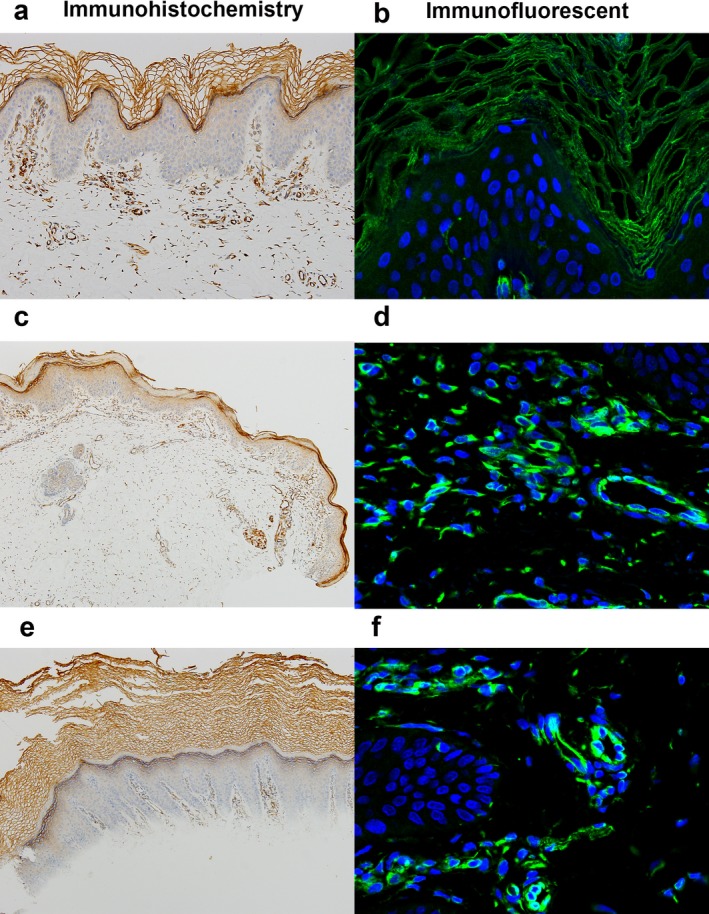
The patients and his family members were subjected to mutation detection in the candidate gene GJA1, GJB3, and GJB4 by Sanger sequencing. The expression of connexin (Cx) 43 was detected by immunohistochemistry and immunofluorescence (IF) studies in the lesions.
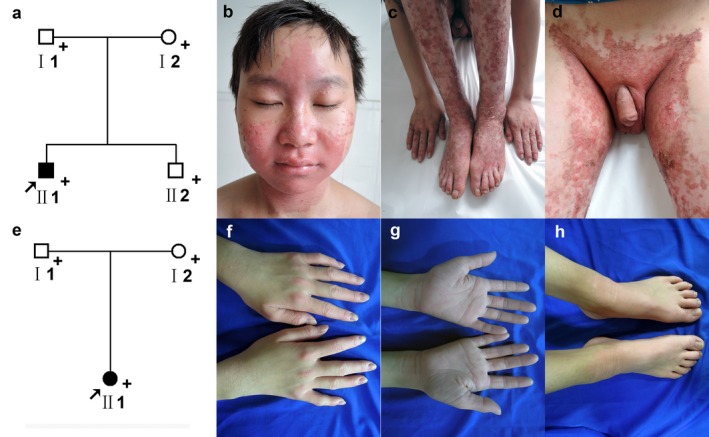
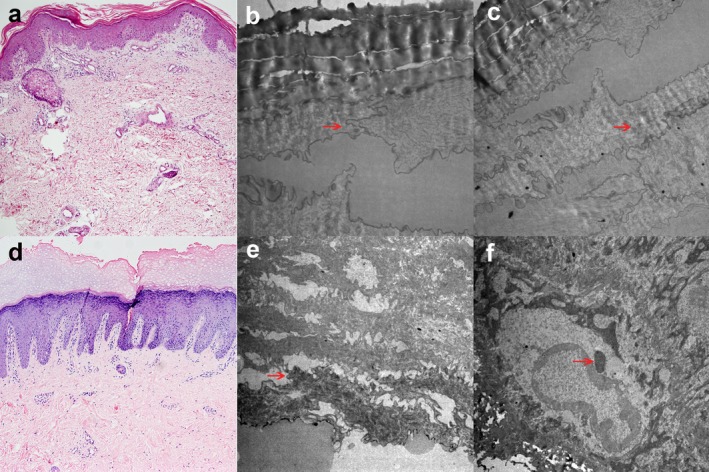
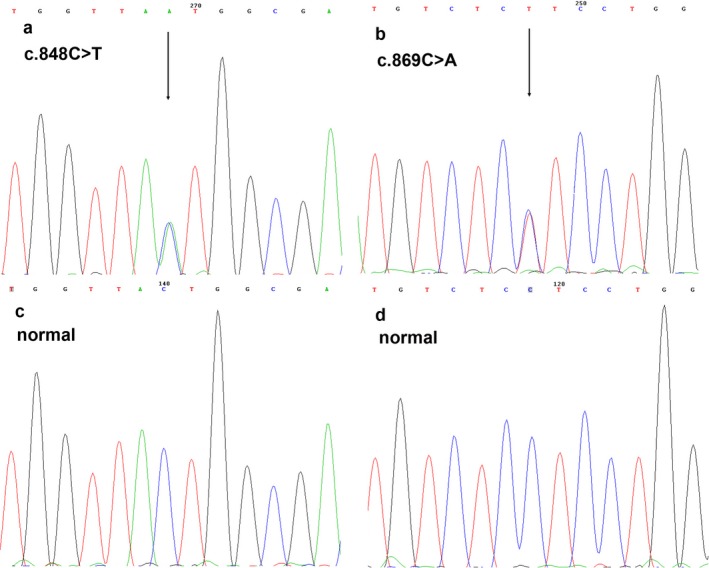
A 12-year-old boy presented with multiple hyperkeratotic plaques on the face, neck, elbows, wrists, limbs, knees, inguinal region, hands, and feet. A 7-year-old girl presented with symmetrical erythematous, plaques on the hands, feet, wrists, and ankles. A novel heterozygous missense mutation c.848C > T (p.P283L) in exon 2 of the GJA1 gene was identified in both patients. A novel heterozygous missense mutation c.869C > A (p.T290N) in exon 2 of the GJA1 gene was also identified in the boy. These mutations were not found in the unaffected family members and 100 normal controls. In the patients' lesions, Cx43 protein was located to the cytomembrane and cytoplasm in the stratum corneum, and granular layer. Compound heterozygous mutations in the boy showed a more severe clinical phenotype and cytoplasmic mislocalization.
The novel mutations c.848C > T (p.P283L) and c.869C > A(p.T290N) arose de novo and were considered as the cause of two Chinese EKVP. GJA1 P283L and T290N mutations lead to Cx43 protein cytoplasmic mislocalization. Our finding expands the mutant spectrum of GJA1 gene and adds new understanding of the genotype-phenotype correlation.
进行性红斑角化症(EKVP,OMIM 133200)是一种罕见的遗传性疾病,其特征为从短暂、快速移动的红斑到持续性棕色角化过度斑块不等。最近,已有报道称间隙连接蛋白α 1 基因(GJA1)、GJB3 和 GJB4 基因的突变可导致 EKVP。在这里,我们报告了在两名 EKVP 患者中发现 GJA1 基因的两个新的错义突变。
对患者及其家族成员进行候选基因 GJA1、GJB3 和 GJB4 的突变检测,通过免疫组化和免疫荧光(IF)研究检测连接蛋白(Cx)43 在病变部位的表达。
一名 12 岁男孩表现为面部、颈部、肘部、手腕、四肢、膝盖、腹股沟、手部和足部多发性角化过度斑块。一名 7 岁女孩表现为手部、足部、手腕和脚踝对称性红斑、斑块。在两名患者中均发现 GJA1 基因外显子 2 中的新型杂合错义突变 c.848C>T(p.P283L)。在男孩中还发现了 GJA1 基因外显子 2 中的新型杂合错义突变 c.869C>A(p.T290N)。这些突变在未受影响的家庭成员和 100 名正常对照中均未发现。在患者的病变部位,Cx43 蛋白位于角质层和颗粒层的细胞浆和细胞质中。男孩的复合杂合突变表现出更严重的临床表型和细胞质定位异常。
新型突变 c.848C>T(p.P283L)和 c.869C>A(p.T290N)为新生突变,被认为是两名中国 EKVP 的病因。GJA1 P283L 和 T290N 突变导致 Cx43 蛋白细胞质定位异常。我们的发现扩展了 GJA1 基因突变谱,并为基因型-表型相关性增加了新的认识。