Wuhan University School of Health Sciences, Wuhan, China.
State Key Laboratory of Virology, Wuhan University, Wuhan, China.
PLoS Negl Trop Dis. 2019 Mar 29;13(3):e0007308. doi: 10.1371/journal.pntd.0007308. eCollection 2019 Mar.
Severe fever with thrombocytopenia syndrome (SFTS) is an emerging viral hemorrhagic fever with a high fatality rate and high frequency of person-to-person transmission and is caused by SFTSV, a tick-borne Phlebovirus. Because SFTS has similar clinical manifestations and epidemic characters (such as spatial and temporal distributions) with hemorrhagic fever with renal syndrome (HFRS) in China, we reason that SFTS patients might be misdiagnosed as HFRS.
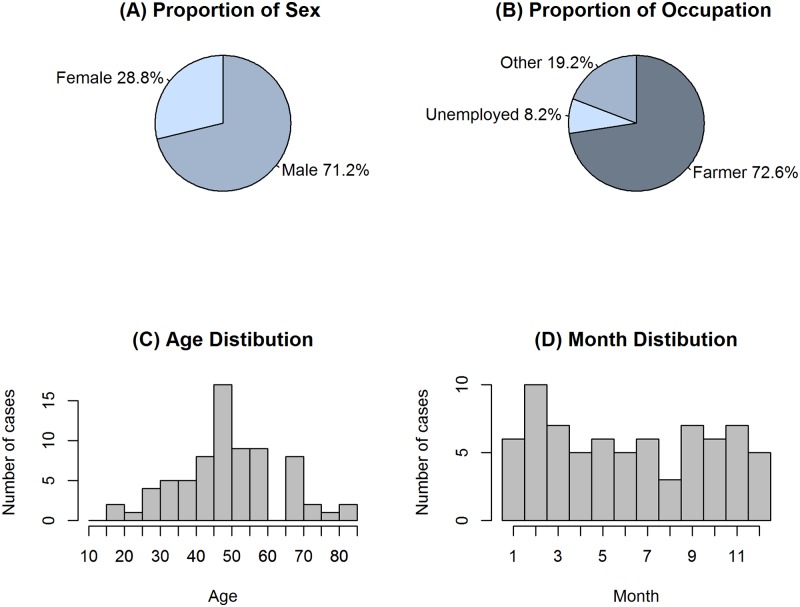
METHODOLOGY/PRINCIPAL FINDINGS: Acute-phase sera of 128 clinically diagnosed HFRS patients were retrospectively analyzed for Hantavirus IgM antibodies with ELISA. Hantavirus-negative patients' sera were further analyzed for SFTSV IgM antibodies with ELISA. ELISA showed that 73 of 128 (57.0%) of clinically diagnosed HFRS patients were IgM antibody positive to Hantaviruses. Among the 55 Hantavirus-IgM negative patients, four (7.3%) were IgM antibody positive to SFTSV. The results indicated that the four SFTS patients were misdiagnosed as HFRS. The misdiagnosed SFTS patients had clinical manifestations common to HFRS and were unable to be differentiated from HFRS clinically.
Our study showed that SFTS patients could be clinically misdiagnosed as HFRS. The misdiagnosis of SFTS as HFRS causes particular concern because it may increase the risk of death of SFTS patients and person-to-person transmission of SFTSV without proper care for and isolation of SFTS patients.
严重发热伴血小板减少综合征(SFTS)是一种新发的病毒性出血热,病死率高,人际传播频率高,由蜱传 Phlebovirus 引起的 SFTSV。由于 SFTS 与中国的肾综合征出血热(HFRS)具有相似的临床表现和流行特征(如时空分布),我们推断 SFTS 患者可能被误诊为 HFRS。
方法/主要发现:采用 ELISA 法对 128 例临床诊断为 HFRS 的患者的急性期血清进行汉坦病毒 IgM 抗体检测。对汉坦病毒阴性患者的血清进行进一步的 SFTSV IgM 抗体检测 ELISA。ELISA 结果显示,128 例临床诊断为 HFRS 的患者中,73 例(57.0%)汉坦病毒 IgM 抗体阳性。在 55 例汉坦病毒 IgM 阴性患者中,有 4 例(7.3%)SFTSV IgM 抗体阳性。结果表明,这 4 例 SFTS 患者被误诊为 HFRS。误诊的 SFTS 患者具有与 HFRS 共同的临床表现,临床上无法与 HFRS 区分。
本研究表明 SFTS 患者可能被误诊为 HFRS。将 SFTS 误诊为 HFRS 特别令人关注,因为如果不对 SFTS 患者进行适当的护理和隔离,可能会增加 SFTS 患者的死亡风险和 SFTSV 的人际传播风险。