Department of Psychology and Cellular and Behavioral Neurobiology, The University of Oklahoma, Norman, OK.
Division of Nutritional Sciences, Cornell University, Ithaca, NY.
J Nutr. 2019 Apr 1;149(4):687-697. doi: 10.1093/jn/nxy265.
Evidence suggests that iron deficiency (ID) affects cognitive performance, as measured in behavior. Although such effects must be mediated by changes in the brain, very few studies have included measures of brain activity to assess this relation.
We tested the hypothesis that provision of iron-biofortified beans would result in improvements in measures of iron status, brain dynamics, and behavior.
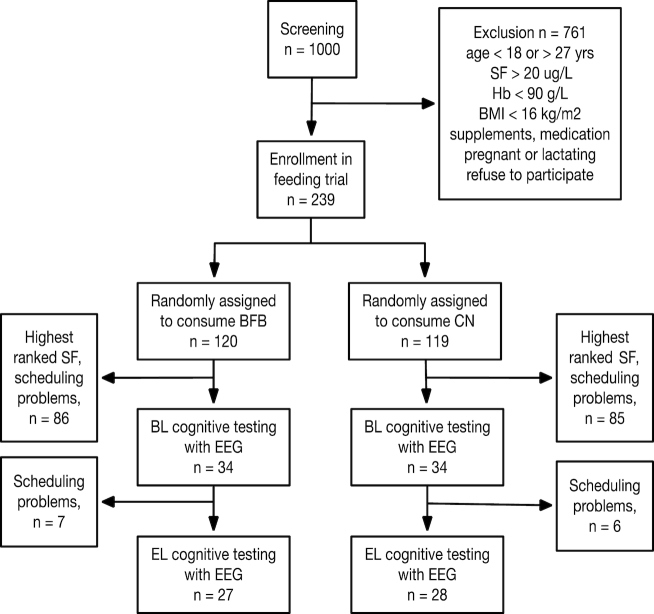
A double-blind, randomized, intervention study was conducted in 55 women aged 18-27 y with low iron status (serum ferritin <20 µg/L). Women were randomly assigned to consume iron-biofortified (86.1 ppm iron) or comparison beans (50.1 ppm iron) daily for 18 wk. Iron status was assessed by hemoglobin, ferritin, transferrin receptor, and body iron; cognitive performance with 5 computerized tasks; and brain dynamics by concurrent electroencephalography (EEG). All measures were taken at baseline and endline.
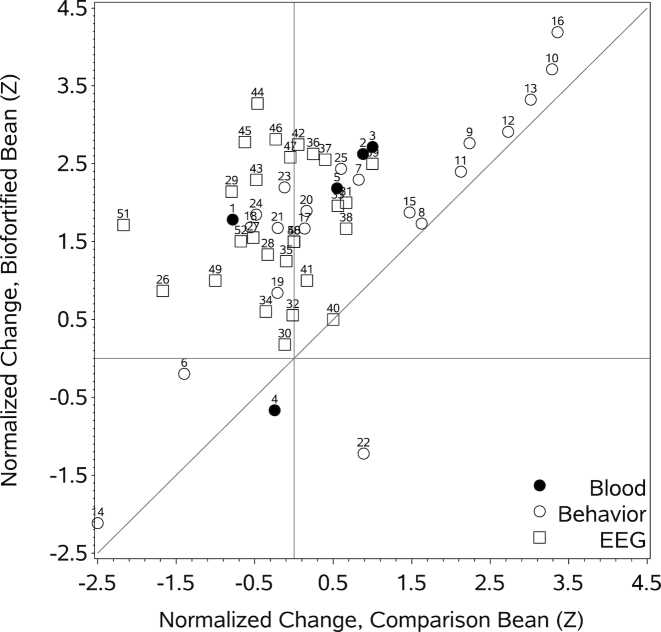
The groups did not differ on any measures at baseline. Intention-to-treat analyses revealed significant (all P < 0.05) improvements in hemoglobin (partial effect size attributable to the independent variable, η2 = 0.16), ferritin (η2 = 0.17), and body iron (η2 = 0.10), speed of responding in attentional and mnemonic tasks (η2 = 0.04-0.29), sensitivity and efficiency of memory retrieval (η2 = 0.12-0.55), and measures of EEG amplitude and spectral power (η2 = 0.08 to 0.49). Mediation models provided evidence in support of the hypothesis that changes in iron status produce changes in behavior by way of changes in brain activity.
Behavioral performance and brain activity, as measured by EEG, are sensitive to iron status, and the consumption of iron-biofortified beans for 18 wk resulted in improvements in measures of both, relative to what was obtained with a comparison bean, in a sample of female university students. Furthermore, the results support the conclusion that changes in brain activity resulting from consumption of biofortified beans mediate the relations between changes in iron biomarkers and changes in cognition. Clinical trial registry: ClinicalTrials.gov Reg No. NCT01594359.
有证据表明,缺铁(ID)会影响行为测量的认知表现。尽管这种影响必须通过大脑的变化来介导,但很少有研究包括大脑活动的测量来评估这种关系。
我们测试了这样一个假设,即提供铁生物强化豆将导致改善铁状态、大脑动力学和行为的措施。
在 55 名年龄在 18-27 岁之间、铁状态较低(血清铁蛋白 <20 µg/L)的女性中进行了一项双盲、随机、干预研究。女性被随机分配每天食用铁生物强化(86.1 ppm 铁)或对照豆(50.1 ppm 铁)18 周。通过血红蛋白、铁蛋白、转铁蛋白受体和体内铁来评估铁状态;通过 5 项计算机任务评估认知表现;通过同时进行的脑电图(EEG)评估大脑动态。所有措施均在基线和终点进行。
两组在任何基线测量上均无差异。意向治疗分析显示血红蛋白(归因于自变量的部分效应大小,η2=0.16)、铁蛋白(η2=0.17)和体内铁(η2=0.10)显著改善(均 P<0.05),注意力和记忆任务的反应速度(η2=0.04-0.29),记忆检索的敏感性和效率(η2=0.12-0.55),以及 EEG 幅度和频谱功率的测量(η2=0.08 到 0.49)。中介模型提供了证据支持这样的假设,即铁状态的变化通过大脑活动的变化产生行为的变化。
行为表现和大脑活动,如脑电图测量的,对铁状态敏感,18 周内食用铁生物强化豆可改善这两者的测量结果,与对照豆相比,在女大学生样本中均有改善。此外,结果支持这样的结论,即食用生物强化豆导致的大脑活动变化介导了铁生物标志物变化与认知变化之间的关系。临床试验注册:ClinicalTrials.gov 注册号 NCT01594359。