Department of Psychology, University of Zurich, Switzerland.
Health Services and Population Research Department, Institute of Psychiatry, Psychology and Neuroscience, King's College London, UK.
Epidemiol Psychiatr Sci. 2019 Apr 1;29:e28. doi: 10.1017/S2045796019000167.
This systematic review compiled evidence on interventions to reduce mental health-related stigma among medical and nursing students in low- and middle-income countries (LMICs). Primary outcomes were stigmatising attitudes and discriminatory behaviours.
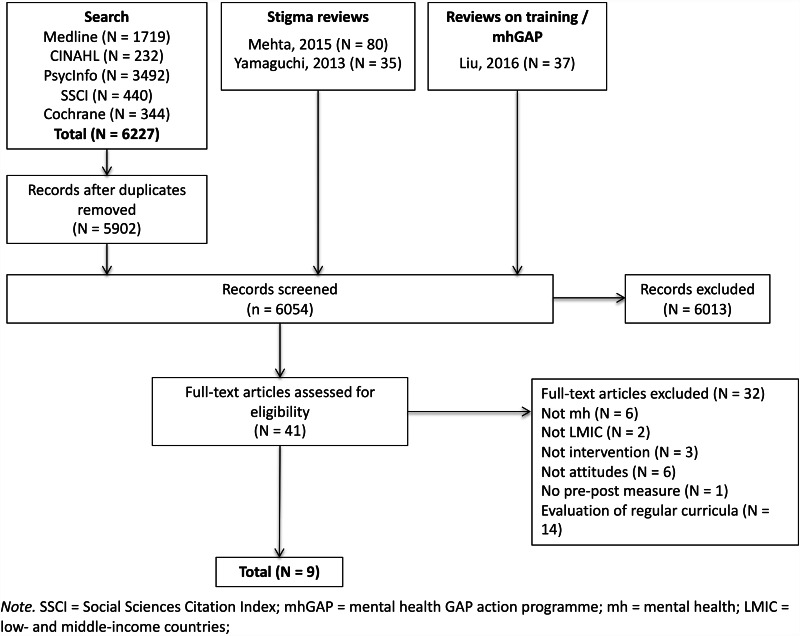
Data collection included two strategies. First, previous systematic reviews were searched for studies that met the inclusion criteria of the current review. Second, a new search was done, covering the time since the previous reviews, i.e. January 2013 to May 2017. Five search concepts were combined in order to capture relevant literature: stigma, mental health, intervention, professional students in medicine and nursing, and LMICs. A qualitative analysis of all included full texts was done with the software MAXQDA. Full texts were analysed with regard to the content of interventions, didactic methods, mental disorders, cultural adaptation, type of outcome measure and primary outcomes. Furthermore, a methodological quality assessment was undertaken.
A total of nine studies from six countries (Brazil, China, Malaysia, Nigeria, Somaliland and Turkey) were included. All studies reported significant results in at least one outcome measure. However, from the available literature, it is difficult to draw conclusions on the most effective interventions. No meta-analysis could be calculated due to the large heterogeneity of intervention content, evaluation design and outcome measures. Studies with contact interventions (either face-to-face or video) demonstrated attitudinal change. There was a clear lack of studies focusing on discriminatory behaviours. Accordingly, training of specific communication and clinical skills was lacking in most studies, with the exception of one study that showed a positive effect of training interview skills on attitudes. Methods for cultural adaptation of interventions were rarely documented. The methodological quality of most studies was relatively low, with the exception of two studies.
There is an increase in studies on anti-stigma interventions among professional students in LMICs. Some of these studies used contact interventions and showed positive effects. A stronger focus on clinical and communication skills and behaviour-related outcomes is needed in future studies.
本系统综述汇总了在中低收入国家(LMICs)中针对医学和护理专业学生的心理健康相关污名干预措施的证据。主要结果是歧视态度和歧视行为。
数据收集包括两个策略。首先,搜索了以前的系统综述,以寻找符合本综述纳入标准的研究。其次,进行了新的搜索,涵盖了自上次综述以来的时间,即 2013 年 1 月至 2017 年 5 月。结合了五个搜索概念,以捕获相关文献:污名、心理健康、干预、医学和护理专业的专业学生以及 LMICs。使用 MAXQDA 软件对所有纳入的全文进行了定性分析。全文分析了干预内容、教学方法、精神障碍、文化适应、结果测量类型和主要结果。此外,还进行了方法学质量评估。
共纳入来自六个国家(巴西、中国、马来西亚、尼日利亚、索马里兰和土耳其)的九项研究。所有研究在至少一项结果测量中均报告了显著结果。然而,从现有文献中,很难得出关于最有效干预措施的结论。由于干预内容、评估设计和结果测量的高度异质性,无法进行荟萃分析。接触干预(面对面或视频)的研究表明态度发生了变化。几乎没有研究关注歧视行为。因此,大多数研究缺乏特定沟通和临床技能的培训,只有一项研究表明培训面试技巧对态度有积极影响。干预措施的文化适应方法很少有记录。大多数研究的方法学质量相对较低,只有两项研究除外。
针对 LMICs 中专业学生的反污名干预措施的研究有所增加。其中一些研究使用了接触干预措施,并显示出积极的效果。未来的研究需要更加强调临床和沟通技能以及行为相关的结果。