Zhang Zehua, Xu Junhai, Tang Jijun, Zou Quan, Guo Fei
School of Computer Science and Technology, College of Intelligence and Computing, Tianjin University, Tianjin, China.
School of Artificial Intelligence, College of Intelligence and Computing, Tianjin University, Tianjin, China.
Front Neurosci. 2019 Mar 14;13:197. doi: 10.3389/fnins.2019.00197. eCollection 2019.
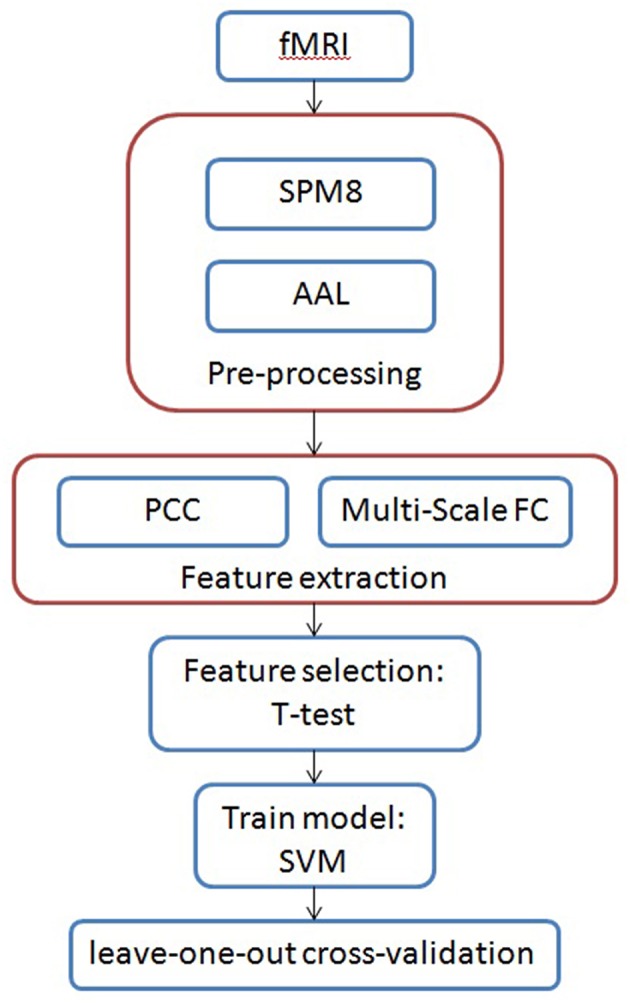
The functional magnetic resonance imaging (fMRI) data and brain network analysis have been widely applied to automated diagnosis of neural diseases or brain diseases. The fMRI time series data not only contains specific numerical information, but also involves rich dynamic temporal information, those previous graph theory approaches focus on local topology structure and lose contextual information and global fluctuation information. Here, we propose a novel multi-scale functional connectivity for identifying the brain disease via fMRI data. We calculate the discrete probability distribution of co-activity between different brain regions with various intervals. Also, we consider nonsynchronous information under different time dimensions, for analyzing the contextual information in the fMRI data. Therefore, our proposed method can be applied to more disease diagnosis and other fMRI data, particularly automated diagnosis of neural diseases or brain diseases. Finally, we adopt Support Vector Machine (SVM) on our proposed time-series features, which can be applied to do the brain disease classification and even deal with all time-series data. Experimental results verify the effectiveness of our proposed method compared with other outstanding approaches on Alzheimer's Disease Neuroimaging Initiative (ADNI) dataset and Major Depressive Disorder (MDD) dataset. Therefore, we provide an efficient system via a novel perspective to study brain networks.
功能磁共振成像(fMRI)数据和脑网络分析已被广泛应用于神经疾病或脑部疾病的自动诊断。fMRI时间序列数据不仅包含特定的数值信息,还涉及丰富的动态时间信息,以往的图论方法侧重于局部拓扑结构,丢失了上下文信息和全局波动信息。在此,我们提出一种通过fMRI数据识别脑部疾病的新型多尺度功能连接性。我们计算不同脑区之间不同时间间隔的共激活离散概率分布。此外,我们考虑不同时间维度下的非同步信息,以分析fMRI数据中的上下文信息。因此,我们提出的方法可应用于更多疾病诊断及其他fMRI数据,特别是神经疾病或脑部疾病的自动诊断。最后,我们将支持向量机(SVM)应用于我们提出的时间序列特征,可用于进行脑部疾病分类,甚至处理所有时间序列数据。实验结果验证了我们提出的方法与其他优秀方法相比在阿尔茨海默病神经影像倡议(ADNI)数据集和重度抑郁症(MDD)数据集上的有效性。因此,我们从一个新的视角提供了一个研究脑网络的高效系统。