Butot Sophie, Ricchi Matteo, Sevilla Iker A, Michot Lise, Molina Elena, Tello Maitane, Russo Simone, Arrigoni Norma, Garrido Joseba M, Tomas David
Nestlé Institute of Food Safety & Analytical Sciences, Nestlé Research Center, Lausanne, Switzerland.
Istituto Zooprofilattico Sperimentale della Lombardia e dell'Emilia Romagna, National Reference Centre for Paratuberculosis, Brescia, Italy.
Front Microbiol. 2019 Mar 15;10:509. doi: 10.3389/fmicb.2019.00509. eCollection 2019.
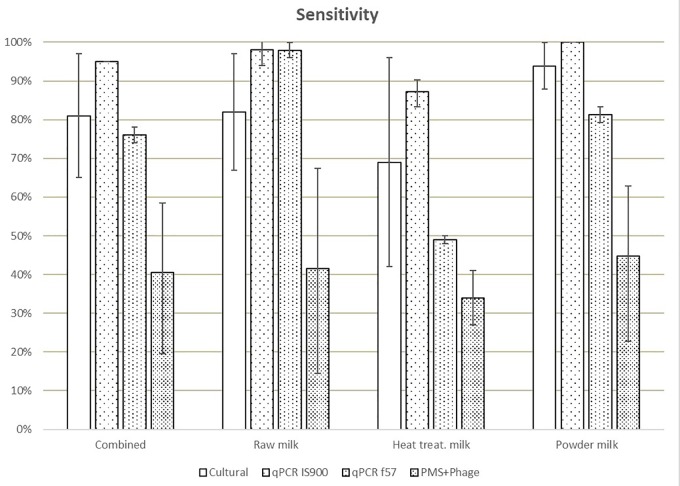
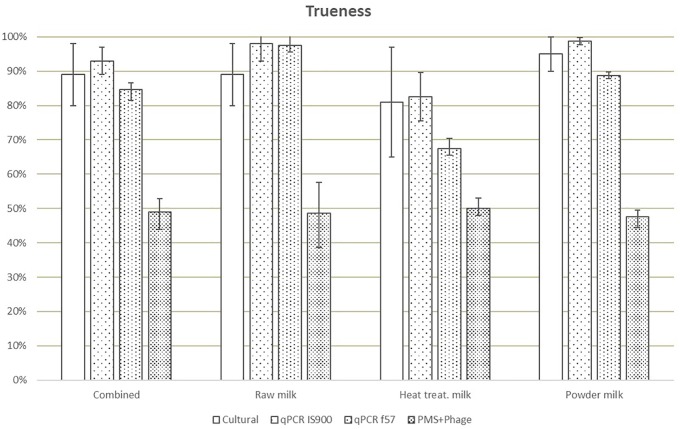
Paratuberculosis is a chronic enteric infection, caused by subsp. (MAP), affecting virtually all ruminants as well as other animals. MAP is also suspected to be involved in the etiology of some human diseases, like Crohn's disease and others. In surveillance studies, different analytical methodologies were employed to detect MAP, showing different results and incidence in dairy products. The aim of this study was to evaluate the performance characteristics of three analytical methods [culture, quantitative PCR (qPCR) and peptide-mediated magnetic separation (PMS) phage-based assay] for MAP detection in raw, heat-treated and powdered milk. The methods were evaluated according to performance characteristics defined for qualitative methods in ISO 16140-2:2016. To estimate sensitivity (including trueness) and LOD, 720, and 900 test portions, respectively, were blind tested by two laboratories. Considering all matrices, different sensitivities, expressed as the percentage of positives from the total of true positive test portions, were obtained for IS900 qPCR (94%), f57 qPCR (76%), culture (83%), and PMS-phage (40%). Trueness, expressed as results correctly assigned (including positive and negative) to the reference value, was 93% for the IS900 qPCR method, 89% for culture and 49% for the PMS-phage. The LODs obtained in this study were similar to the LODs previously published for cultural and qPCR methods. However, for the PMS-phage method, the obtained results showed higher LOD values compared to the limited data available in the scientific literature. Our results highlight that while the PMS-phage assay is workable in pure liquid culture for estimation of MAP counts, its usage for surveillance of dairy matrices should be treated with a lot of caution as performance characteristics obtained were lower than for the two other methods tested. qPCR and culture are the most appropriate methods to detect MAP in milk-based matrices according to ISO 16140 methodology. Cultural techniques are considered the gold standard for detection of viable MAP, but qPCR, which is widely used in analytical and surveillance studies, can be considered a suitable and recommendable alternative to cultural methods for screening, if confirmation of MAP's viability is not requested.
副结核病是一种由副结核分枝杆菌亚种(MAP)引起的慢性肠道感染,几乎影响所有反刍动物以及其他动物。MAP也被怀疑与某些人类疾病如克罗恩病等的病因有关。在监测研究中,采用了不同的分析方法来检测MAP,在乳制品中显示出不同的结果和发生率。本研究的目的是评估三种分析方法[培养法、定量聚合酶链反应(qPCR)和基于肽介导磁分离(PMS)的噬菌体检测法]在生牛奶、热处理牛奶和奶粉中检测MAP的性能特征。这些方法根据ISO 16140-2:2016中为定性方法定义的性能特征进行评估。为了估计灵敏度(包括准确性)和检测限,两个实验室分别对720个和900个测试部分进行了盲测。考虑所有基质,IS900 qPCR(94%)、f57 qPCR(76%)、培养法(83%)和PMS-噬菌体法(40%)获得了不同的灵敏度,以真阳性测试部分总数中的阳性百分比表示。以正确分配给参考值的结果(包括阳性和阴性)表示的准确性,IS900 qPCR方法为93%,培养法为89%,PMS-噬菌体法为49%。本研究中获得的检测限与先前发表的培养法和qPCR方法的检测限相似。然而,对于PMS-噬菌体法,与科学文献中有限的数据相比,获得的结果显示出更高的检测限值。我们的结果强调,虽然PMS-噬菌体检测法在纯液体培养中用于估计MAP数量是可行的,但由于获得的性能特征低于其他两种测试方法,其在乳制品基质监测中的应用应谨慎对待。根据ISO 16140方法,qPCR和培养法是检测基于牛奶的基质中MAP的最合适方法。培养技术被认为是检测活MAP的金标准,但如果不要求确认MAP的活力,广泛用于分析和监测研究的qPCR可被视为一种适合且可推荐的替代培养法进行筛查的方法。