Regional Livestock Development Centre, Department of Livestock, Tsimasham, Chukha Bhutan.
Department of Ecosystem and Public Health, Faculty of Veterinary Medicine, University of Calgary, Alberta, Canada.
PLoS Negl Trop Dis. 2019 Apr 1;13(4):e0007305. doi: 10.1371/journal.pntd.0007305. eCollection 2019 Apr.
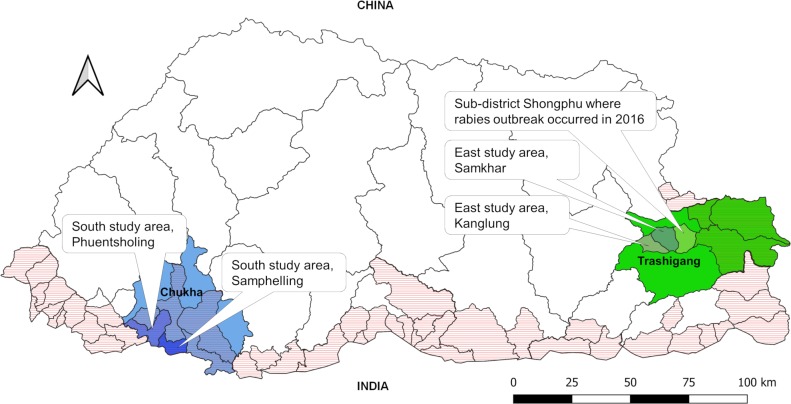
Rabies remains a disease of significant zoonotic and economic concern in rabies endemic areas of Bhutan. Rabies outbreaks in livestock threaten the livelihoods of subsistence farming communities and pose a potential public health threat. As a part of identifying approaches to prevent rabies in cattle, a Knowledge, Attitude, and Practice (KAP) survey was conducted among cattle owners in selected rural areas of the southern rabies high-risk zone and low-risk zone in eastern Bhutan. Between March and April 2017, 562 cattle owners (281 in the east and 281 in the south) were interviewed using a questionnaire. Eighty-eight percent of the participants had heard of rabies but only 39% of the participants who had heard of rabies had adequate knowledge about rabies. Multivariable logistic regression analysis showed that residing in the south [OR = 9.25 (95% CI: 6.01-14.53)] and having seen a rabies case [OR = 2.46 (95% CI: 1.6-3.82)] were significantly associated with having adequate knowledge about rabies. Based on our scoring criteria, 65% of the total participants who had heard of rabies had a favorable attitude towards rabies control and prevention programs. The participants residing in the east were two times more likely to have a favourable attitude than their counterparts in the south [OR = 2.08 (95% CI: 1.43-3.05)]. More than 70% of the participants reported engaging in farm activities such as examining the oral cavity of sick cattle and assisting cattle during parturition. Only 25% of the participants reported using personal protective equipment while undertaking these activities. Despite a high level of rabies awareness, we observed that there is a lack of comprehensive knowledge about rabies regarding susceptible hosts, transmission routes, the health outcome of rabies infection in humans, and appropriate health-seeking behaviours. This study highlights the need to strengthen rabies education programs in rural communities to address the knowledge gaps that have been identified.
在不丹的狂犬病流行地区,狂犬病仍然是一种具有重要动物源性和经济意义的疾病。家畜狂犬病疫情威胁到自给农业社区的生计,并构成潜在的公共卫生威胁。作为确定预防牛狂犬病方法的一部分,在不丹东部狂犬病高风险区和低风险区的选定农村地区对牛主人进行了知识、态度和实践(KAP)调查。2017 年 3 月至 4 月期间,对 562 名牛主人(东部 281 人,南部 281 人)进行了问卷调查。88%的参与者听说过狂犬病,但只有 39%听说过狂犬病的参与者对狂犬病有足够的了解。多变量逻辑回归分析表明,居住在南部[OR = 9.25(95%CI:6.01-14.53)]和看到狂犬病病例[OR = 2.46(95%CI:1.6-3.82)]与对狂犬病有足够的了解显著相关。根据我们的评分标准,听说过狂犬病的总参与者中有 65%对狂犬病控制和预防计划持有利态度。居住在东部的参与者比南部的参与者更有可能持有利态度[OR = 2.08(95%CI:1.43-3.05)]。超过 70%的参与者报告从事农场活动,如检查病牛的口腔和协助牛分娩。只有 25%的参与者在从事这些活动时报告使用个人防护设备。尽管对狂犬病的认识程度很高,但我们发现,人们对狂犬病的易感染宿主、传播途径、人类狂犬病感染的健康后果以及适当的求医行为等方面缺乏全面的了解。这项研究强调需要加强农村社区的狂犬病教育计划,以解决已确定的知识差距。