Department of Epidemiology and Environmental Health, School of Public Health and Health Professions, University at Buffalo, The State University of New York, Buffalo, New York, United States.
Department of Ophthalmology and Visual Sciences, School of Medicine and Public Health, The University of Wisconsin-Madison, Madison, Wisconsin, United States.
Invest Ophthalmol Vis Sci. 2019 Apr 1;60(5):1362-1371. doi: 10.1167/iovs.18-25945.
To investigate the association between serum 25-hydroxyvitamin D (25[OH]D) concentrations at visit 2 (1990-1992) and the 18-year incidence of age-related macular degeneration (AMD) between visit 3 (1993-1995) and visit 5 (2011-2013).
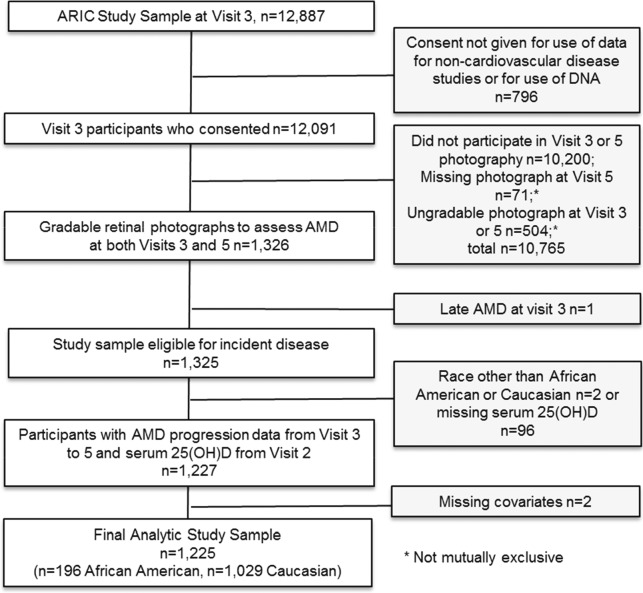
This prospective analysis was conducted in a subset of participants (n = 1225) from the Atherosclerosis Risk in Communities Study. We evaluated the incidence of any, early, and late AMD from visit 3 to 5. The 25(OH)D concentrations were assessed in 2012-2013 by using stored serum from visit 2. Retinal fundus photographs taken at both visits were graded side by side to determine the incidence of AMD. Logistic regression was used to estimate the odds ratios (ORs) and 95% confidence intervals (CIs) for incident AMD outcomes during 18 years of follow-up (1993-1995 to 2011-2013) by tertile of 25(OH)D adjusted for age, race, and smoking status. P for linear trend was estimated by using continuous 25(OH)D concentrations. Sensitivity analyses applied inverse probability weights to account for selection to have eye photographs, death, and loss to follow-up.
There was a decreased odds of any incident AMD (n = 139) and large, soft drusen (n = 80) in 25(OH)D tertile 3 versus 1, with OR (95% CI) = 0.57 (0.36-0.90), P trend = 0.11 and with 0.52 (0.28-0.93), P trend = 0.18, respectively. Applying sampling weights attenuated these results to 0.66 (0.38-1.16), P trend = 0.32 (any incident AMD) and 0.54 (0.27-1.09), P trend = 0.36 (large, soft drusen), respectively, suggesting these associations may be biased by loss to follow-up and sampling for retinal photographs at visit 5. No statistically significant results were observed with pigmentary abnormalities (n = 46) or incident late AMD (n = 26).
High 25(OH)D concentrations, approximately >70 nM, may be associated with decreased odds of incident early AMD.
研究 1990-1992 年就诊时血清 25-羟维生素 D(25[OH]D)浓度与 1993-1995 年就诊时至 2011-2013 年就诊时的年龄相关性黄斑变性(AMD)发病的 18 年相关性。
该前瞻性分析选择了动脉粥样硬化风险社区研究(Atherosclerosis Risk in Communities Study)中的一部分参与者(n=1225)。我们从就诊 3 至就诊 5 评估了任何、早期和晚期 AMD 的发病情况。2012-2013 年,通过使用就诊 2 时储存的血清,评估 25(OH)D 浓度。两次就诊均拍摄眼底照片并排查看,以确定 AMD 的发病情况。采用逻辑回归,通过 25(OH)D 三分位,调整年龄、种族和吸烟状况,对 18 年随访期间(1993-1995 年至 2011-2013 年)的 AMD 发病结果进行比值比(OR)和 95%置信区间(CI)估计。采用连续 25(OH)D 浓度估计线性趋势 P 值。敏感性分析应用逆概率权重,以考虑选择拍摄眼底照片、死亡和失访。
与 25(OH)D 第 1 三分位相比,第 3 三分位的任何新发 AMD(n=139)和大、软性玻璃疣(n=80)的发病几率降低,OR(95%CI)分别为 0.57(0.36-0.90),P 趋势=0.11 和 0.52(0.28-0.93),P 趋势=0.18。应用抽样权重后,这些结果分别为 0.66(0.38-1.16),P 趋势=0.32(任何新发 AMD)和 0.54(0.27-1.09),P 趋势=0.36(大、软性玻璃疣),表明这些关联可能因随访失访和在就诊 5 时选择拍摄眼底照片而存在偏倚。色素异常(n=46)或新发晚期 AMD(n=26)的结果未见统计学意义。
25(OH)D 浓度较高(约>70 nM)可能与新发早期 AMD 发病几率降低相关。