Department of Microbiology, Faculty of Pharmacy, University of Granada, 18071 Granada, Spain.
Institute of Biotechnology, Biomedical Research Center (CIBM), University of Granada, 18100 Granada, Spain.
Mar Drugs. 2019 Mar 25;17(3):191. doi: 10.3390/md17030191.
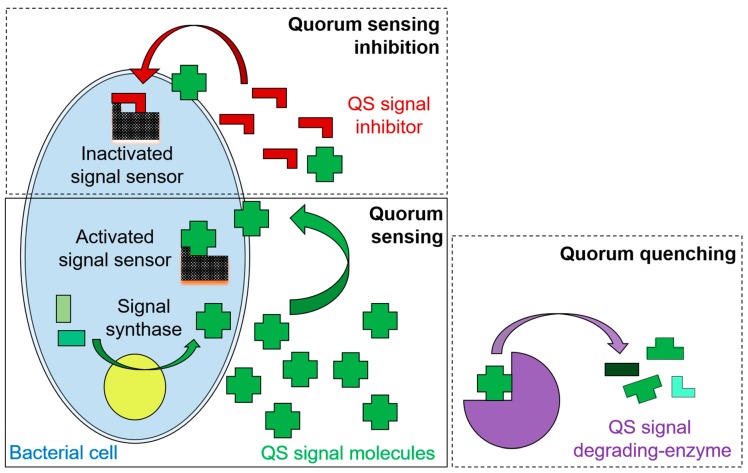
Saline environments, such as marine and hypersaline habitats, are widely distributed around the world. They include sea waters, saline lakes, solar salterns, or hypersaline soils. The bacteria that live in these habitats produce and develop unique bioactive molecules and physiological pathways to cope with the stress conditions generated by these environments. They have been described to produce compounds with properties that differ from those found in non-saline habitats. In the last decades, the ability to disrupt quorum-sensing (QS) intercellular communication systems has been identified in many marine organisms, including bacteria. The two main mechanisms of QS interference, i.e., quorum sensing inhibition (QSI) and quorum quenching (QQ), appear to be a more frequent phenomenon in marine aquatic environments than in soils. However, data concerning bacteria from hypersaline habitats is scarce. Salt-tolerant QSI compounds and QQ enzymes may be of interest to interfere with QS-regulated bacterial functions, including virulence, in sectors such as aquaculture or agriculture where salinity is a serious environmental issue. This review provides a global overview of the main works related to QS interruption in saline environments as well as the derived biotechnological applications.
盐水环境,如海洋和高盐环境,在世界各地广泛分布。它们包括海水、盐水湖、盐田或高盐土壤。生活在这些栖息地的细菌会产生和发展独特的生物活性分子和生理途径,以应对这些环境产生的压力条件。据报道,它们产生的化合物具有与非盐水环境中发现的化合物不同的特性。在过去的几十年中,许多海洋生物,包括细菌,都被发现具有破坏群体感应(QS)细胞间通讯系统的能力。QS 干扰的两种主要机制,即群体感应抑制(QSI)和群体淬灭(QQ),似乎在海洋水生环境中比在土壤中更为常见。然而,关于高盐环境中细菌的数据却很少。耐盐 QSI 化合物和 QQ 酶可能对干扰 QS 调节的细菌功能具有重要意义,包括在水产养殖或农业等领域的毒力,因为盐度是一个严重的环境问题。本综述提供了一个关于盐水环境中 QS 中断的主要工作以及由此产生的生物技术应用的全球概述。