Clinical Nutrition, Geneva University Hospitals and University of Geneva, 1205 Geneva, Switzerland.
Rehabilitation and Palliative Care, Geneva University Hospitals and University of Geneva, 1205 Geneva, Switzerland.
Nutrients. 2019 Mar 25;11(3):701. doi: 10.3390/nu11030701.
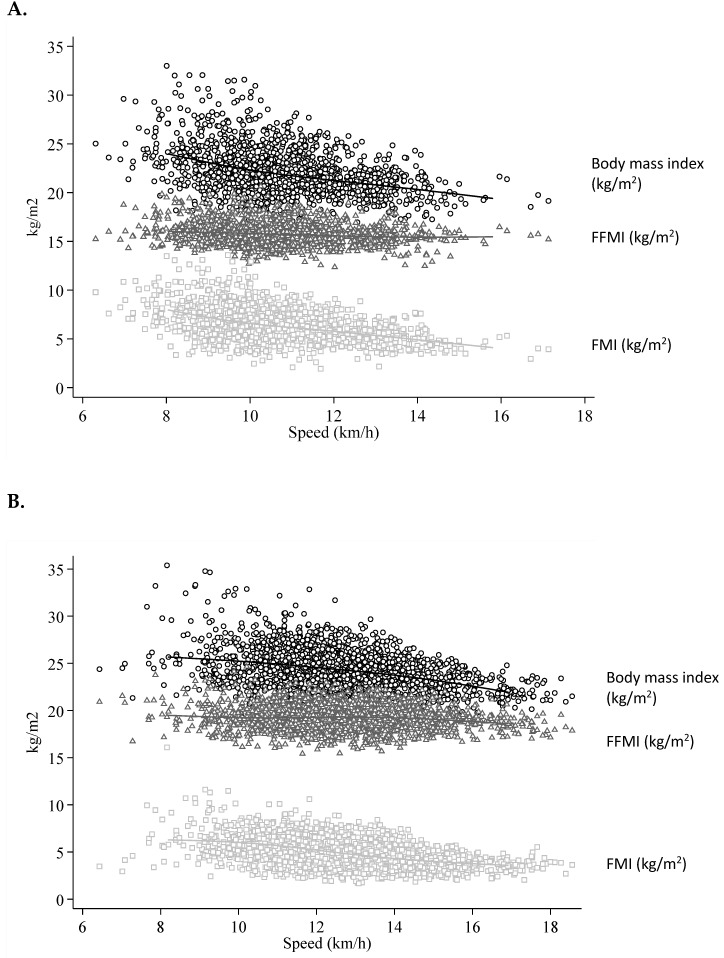
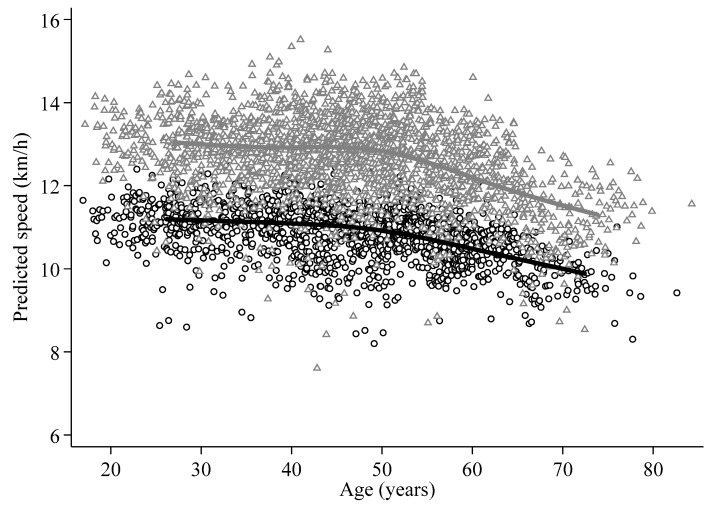
A low fat mass is associated with a good running performance. This study explores whether modifications in body composition predicted changes in running speed. We included people who underwent several measurements of body composition by bioelectrical impedance analysis between 1999 and 2016, at the "Course de l'Escalade", taking place yearly in Geneva. Body composition was reported as a fat-free mass index (FFMI) and fat mass index (FMI). Running distances (men: 7.2 km; women: 4.8 km) and running times were used to calculate speed in km/h. We performed multivariate linear mixed regression models to determine whether modifications of body mass index, FFMI, FMI or the combination of FFMI and FMI predicted changes in running speed. The study population included 377 women (1419 observations) and 509 men (2161 observations). Changes in running speed were best predicted by the combination of FFMI and FMI. Running speed improved with a reduction of FMI in both sexes (women: ß -0.31; 95% CI -0.35 to -0.27, < 0.001. men: ß -0.43; 95% CI -0.48 to -0.39, < 0.001) and a reduction of FFMI in men (ß -0.20; 95% CI -0.26 to -0.15, < 0.001). Adjusted for body composition, the decline in running performance occurred from 50 years onward, but appeared earlier with a body mass, FFMI or FMI above the median value at baseline. Changes of running speed are determined mostly by changes in FMI. The decline in running performance occurs from 50 years onward but appears earlier in people with a high body mass index, FFMI or FMI at baseline.
低体脂量与良好的跑步表现有关。本研究探讨了身体成分的变化是否能预测跑步速度的变化。我们纳入了 1999 年至 2016 年期间在日内瓦举行的“Course de l'Escalade”多次进行身体成分生物电阻抗分析的人群。身体成分报告为无脂肪质量指数(FFMI)和脂肪质量指数(FMI)。跑步距离(男性:7.2 公里;女性:4.8 公里)和跑步时间用于计算每小时公里数。我们进行了多元线性混合回归模型,以确定身体质量指数、FFMI、FMI 的变化或 FFMI 和 FMI 的组合是否能预测跑步速度的变化。研究人群包括 377 名女性(1419 次观察)和 509 名男性(2161 次观察)。FFMI 和 FMI 的组合最能预测跑步速度的变化。在两性中,FMI 的减少都能改善跑步速度(女性:ß -0.31;95% CI -0.35 至 -0.27, < 0.001. 男性:ß -0.43;95% CI -0.48 至 -0.39, < 0.001),男性的 FFMI 减少也能改善跑步速度(ß -0.20;95% CI -0.26 至 -0.15, < 0.001)。在调整身体成分后,从 50 岁开始,跑步表现的下降就开始发生,但在基线时体重、FFMI 或 FMI 高于中位数的人,下降更早发生。跑步速度的变化主要取决于 FMI 的变化。从 50 岁开始,跑步表现的下降就开始发生,但在基线时体重指数、FFMI 或 FMI 较高的人,下降更早发生。