Department of Pharmaceutical Sciences, Tshwane University of Technology, Private Bag X680, Pretoria 0001, South Africa.
SAMRC Herbal Drugs Research Unit, Tshwane University of Technology, Private Bag X680, Pretoria 0001, South Africa.
Nutrients. 2019 Mar 29;11(4):739. doi: 10.3390/nu11040739.
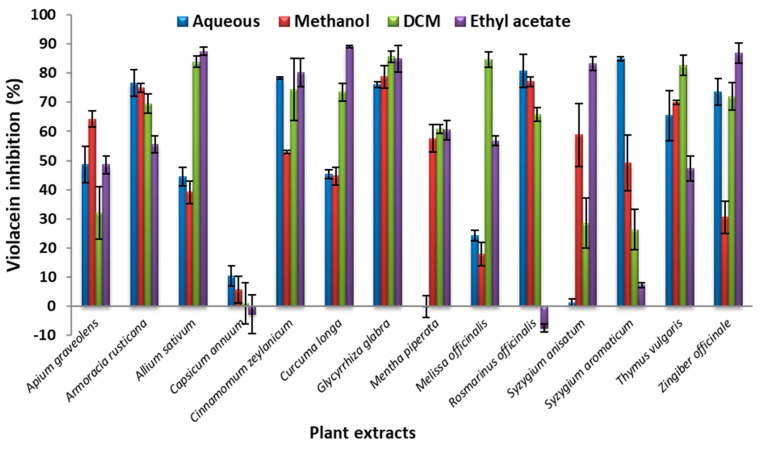
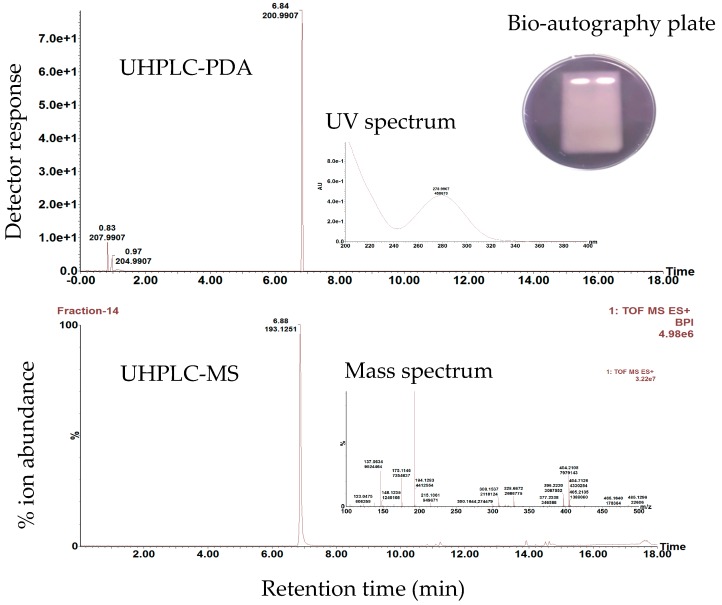
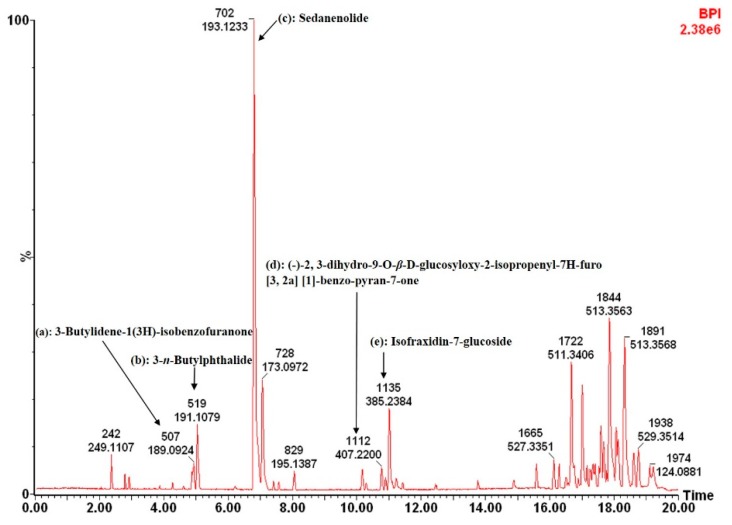
Quorum sensing controls bacterial pathogenesis and virulence; hence, interrupting this system renders pathogenic bacteria non-virulent, and presents a novel treatment for various bacterial infections. In the search for novel anti-quorum sensing (AQS) compounds, 14 common culinary herbs and spices were screened for potential antipathogenicity activity against ATCC 12472. Extracts of (liquorice), (celery), (cayenne pepper) and (aniseed) demonstrated good AQS potential, yielding opaque halo zones ranging from 12⁻19 mm diameter at sub-minimum inhibitory concentrations (0.350⁻4.00 mg/mL). For the same species, the percentage reduction in violacein production ranged from 56.4 to 97.3%. Zones with violacein inhibitory effects were evident in a celery extract analysed using high performance thin layer chromatography-bio-autography. The major active compound was isolated from celery using preparative-high performance liquid chromatography-mass spectrometry and identified using gas chromatography-mass spectrometry (GC-MS) as 3--butyl-4,5-dihydrophthalide (sedanenolide). Potent opaque zones of inhibition observed on the HPTLC-bio-autography plate seeded with confirmed that sedanenolide was probably largely responsible for the AQS activity of celery. The bacteriocidal properties of many herbs and spices are reported. This study, however, was focussed on AQS activity, and may serve as initial scientific validation for the anti-infective properties ascribed to several culinary herbs and spices.
群体感应控制着细菌的发病机制和毒力;因此,中断这个系统会使致病菌失去毒力,并为各种细菌感染提供一种新的治疗方法。在寻找新型抗群体感应(AQS)化合物的过程中,筛选了 14 种常见的烹饪香草和香料,以评估它们对 ATCC 12472 的潜在抗病原体活性。(甘草)、(芹菜)、(辣椒)和(八角茴香)的提取物表现出良好的 AQS 潜力,在亚最小抑制浓度(0.350-4.00 mg/mL)下产生直径为 12-19 毫米的不透明晕圈。对于同一物种,紫色素产量的降低百分比范围为 56.4%至 97.3%。使用高效薄层层析-生物自显影法分析芹菜提取物时,发现了具有紫色素抑制作用的区域。使用制备高效液相色谱-质谱联用仪从芹菜中分离出主要活性化合物,并使用气相色谱-质谱联用仪(GC-MS)鉴定为 3--丁基-4,5-二氢邻苯二甲酸(sedanenolide)。在 HPTLC-生物自显影板上用 接种后观察到的强烈不透明抑制区证实,sedanenolide 可能是芹菜 AQS 活性的主要原因。许多香草和香料的杀菌特性都有报道。然而,这项研究专注于 AQS 活性,可能为几种烹饪香草和香料的抗感染特性提供初步的科学验证。