Ragon Institute of MGH, MIT and Harvard, Cambridge, MA 02139.
Ragon Institute of MGH, MIT and Harvard, Cambridge, MA 02139
J Immunol. 2019 May 15;202(10):2856-2872. doi: 10.4049/jimmunol.1700950. Epub 2019 Apr 1.
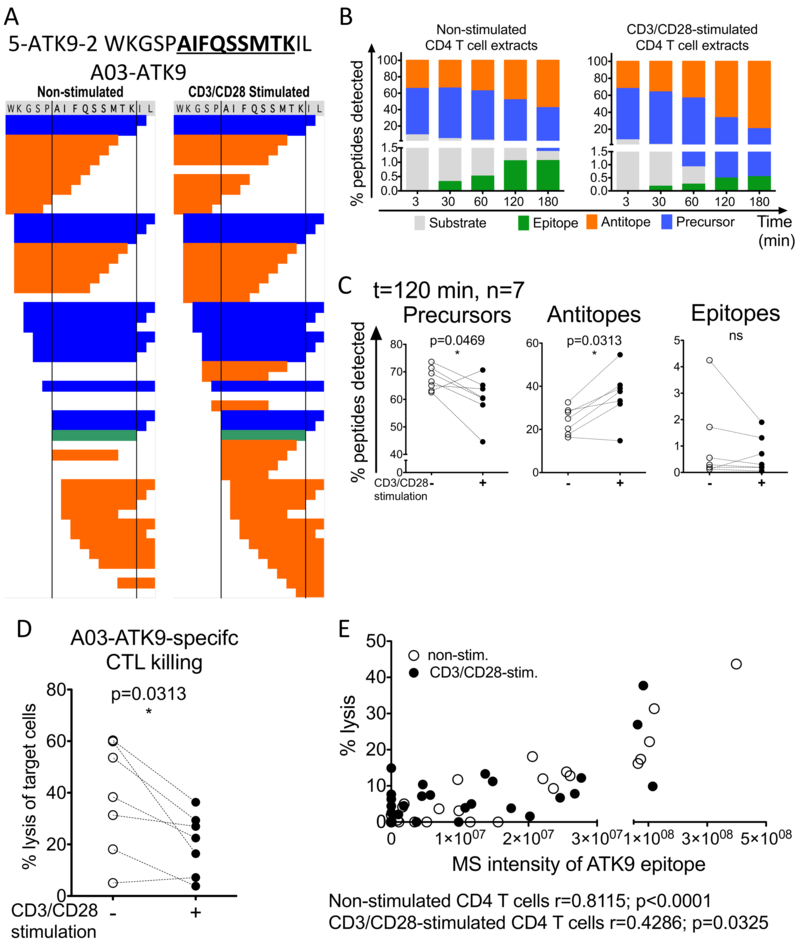
CD4 T cell activation is critical to the initiation of adaptive immunity. CD4 T cells are also the main targets of HIV infection, and their activation status contributes to the maintenance and outcome of infection. Although the role of activation in the differentiation and proliferation of CD4 T cells is well studied, its impact on the processing and MHC class I (MHC-I) presentation of epitopes and immune recognition by CD8 T cells are not investigated. In this study, we show that the expression and hydrolytic activities of cellular peptidases are increased upon TCR-dependent and MHC-peptide activation of primary CD4 T cells from healthy or HIV-infected persons. Changes in peptidase activities altered the degradation patterns of HIV Ags analyzed by mass spectrometry, modifying the amount of MHC-I epitopes produced, the antigenicity of the degradation products, and the coverage of Ags by degradation peptides presentable by MHC-I. The computational analysis of 2237 degradation peptides generated during the degradation of various HIV-antigenic fragments in CD4 T cells identified cleavage sites that were predictably enhanced, reduced, or unchanged upon cellular activation. Epitope processing and presentation by CD4 T cells may be modulated by the activation state of cells in a sequence-dependent manner. Accordingly, cellular activation modified endogenous Ag processing and presentation and killing of HIV-infected CD4 T cells by CD8 T cells in a way that mirrored differences in in vitro epitope processing. The clearance of HIV-infected cells may rely on different immune responses according to activation state during HIV infection.
CD4 T 细胞的激活对于适应性免疫的启动至关重要。CD4 T 细胞也是 HIV 感染的主要靶标,其激活状态有助于感染的维持和结果。尽管激活在 CD4 T 细胞的分化和增殖中的作用已经得到了很好的研究,但它对表位的加工和 MHC Ⅰ类(MHC-I)呈递以及 CD8 T 细胞的免疫识别的影响尚未得到研究。在这项研究中,我们表明,在来自健康个体或 HIV 感染者的原代 CD4 T 细胞中,TCR 依赖性和 MHC 肽激活会增加细胞肽酶的表达和水解活性。肽酶活性的变化改变了通过质谱分析的 HIV 抗原的降解模式,改变了 MHC-I 表位产生的数量、降解产物的抗原性以及由 MHC-I 呈递的降解肽覆盖的抗原。对 2237 个在 CD4 T 细胞中降解各种 HIV 抗原片段过程中产生的降解肽的计算分析,确定了在细胞激活时可预测性增强、降低或不变的切割位点。CD4 T 细胞的表位加工和呈递可能会以序列依赖性的方式被细胞的激活状态所调节。因此,细胞激活以一种类似于体外表位加工差异的方式,修饰了内源性 Ag 加工和呈递以及 CD8 T 细胞对 HIV 感染的 CD4 T 细胞的杀伤。HIV 感染细胞的清除可能依赖于 HIV 感染期间不同的激活状态下的不同免疫反应。