Department of Child Health, Faculty of Medicine, Public Health and Nursing, Universitas Gadjah Mada, Yogyakarta, Indonesia.
Timika Malaria Research Programme, Papuan Health and Community Development Foundation, Timika, Papua, Indonesia.
Malar J. 2019 Apr 2;18(1):111. doi: 10.1186/s12936-019-2745-7.
Primaquine (PQ) prevents relapses of vivax malaria but may induce severe haemolysis in glucose-6-phosphate dehydrogenase (G6PD) deficient patients. Data on the safety of primaquine in infants are limited.
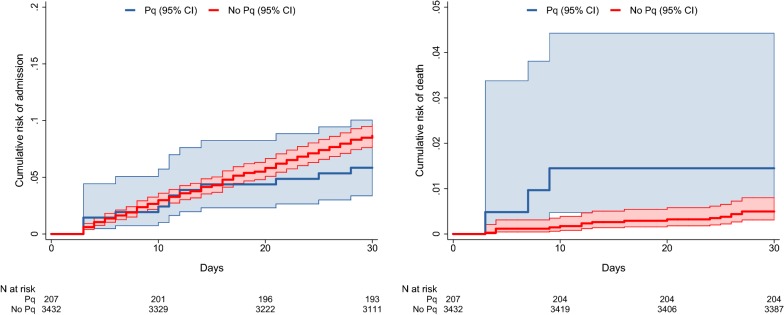
A retrospective, hospital-based cohort study of infants aged 1-12 months with vivax malaria was carried out in Timika, Papua province, Indonesia. Risks of admission, death and severe haematological outcomes within 30 days of first presentation were compared between infants who did and did not receive primaquine. Infants were not tested routinely for G6PD deficiency as per local guidelines.
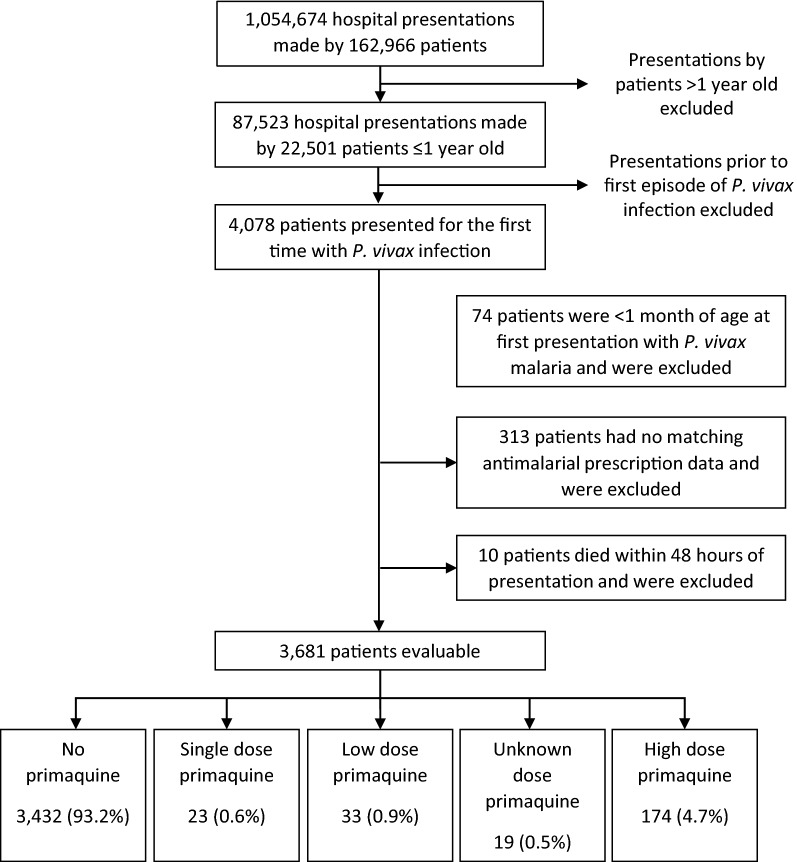
Between 2004 and 2013, 4078 infants presented to the hospital for the first time with vivax malaria, of whom 3681 (90.3%) had data available for analysis. In total 1228 (33.4%) infants were aged between 1 and 6 months and 2453 (66.6%) between 6 and 12 months of age. Thirty-three (0.9%) patients received low-dose primaquine (LDP), 174 (4.7%) received high-dose primaquine (HDP), 3432 (93.2%) received no primaquine (NPQ) and 42 patients received either a single dose or an unknown dose of primaquine. The risk of the Hb concentration falling by > 25% to less than 5 g/dL was similar in the LDP or HDP groups (4.3%, 1/23) versus the NPQ group (3.5%, 16/461). Three infants (1.4%) died following receipt of PQ, all of whom had major comorbidities. Seventeen patients (0.5%) died in the NPQ group. None of the infants had documented massive haemolysis or renal impairment.
Severe clinical outcomes amongst infants treated with primaquine in Papua were rare. The risks of using primaquine in infancy must be weighed against the risks of recurrent vivax malaria in early life.
伯氨喹可预防间日疟复发,但在葡萄糖-6-磷酸脱氢酶(G6PD)缺乏的患者中可能会引起严重的溶血。关于婴儿使用伯氨喹的安全性的数据有限。
在印度尼西亚巴布亚省提米卡(Timika)进行了一项回顾性、基于医院的 1-12 个月龄间日疟患儿队列研究。比较了首次就诊时接受和未接受伯氨喹的患儿住院、死亡和 30 天内严重血液学结局的风险。根据当地指南,婴儿未常规进行 G6PD 缺乏检测。
2004 年至 2013 年期间,共有 4078 名婴儿首次因间日疟就诊,其中 3681 名(90.3%)有数据分析。1228 名(33.4%)婴儿年龄在 1-6 个月之间,2453 名(66.6%)在 6-12 个月之间。33 名(0.9%)患者接受了低剂量伯氨喹(LDP),174 名(4.7%)接受了高剂量伯氨喹(HDP),3432 名(93.2%)未接受伯氨喹(NPQ),42 名患者接受了单剂量或未知剂量的伯氨喹。LDP 或 HDP 组(4.3%,1/23)与 NPQ 组(3.5%,16/461)相比,Hb 浓度下降超过 25%至<5g/dL 的风险相似。在接受伯氨喹治疗后,有 3 名婴儿(1.4%)死亡,均有严重的合并症。NPQ 组有 17 名患者(0.5%)死亡。没有患儿发生大量溶血或肾功能损害的记录。
巴布亚使用伯氨喹治疗的婴儿出现严重临床结局的情况很少见。在婴儿中使用伯氨喹的风险必须与婴儿期复发性间日疟的风险相权衡。