Certara UK Limited (Simcyp Division), Sheffield, UK.
CPT Pharmacometrics Syst Pharmacol. 2024 Mar;13(3):386-395. doi: 10.1002/psp4.13090. Epub 2023 Dec 12.
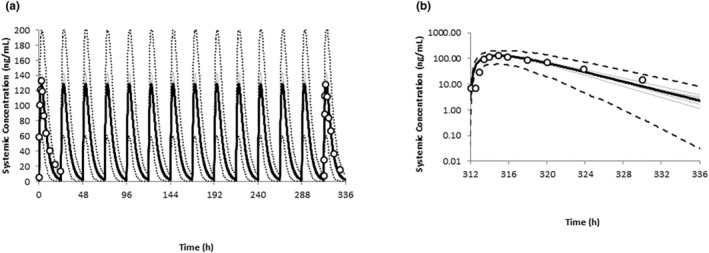
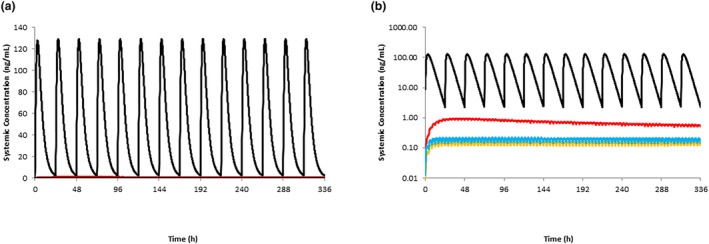
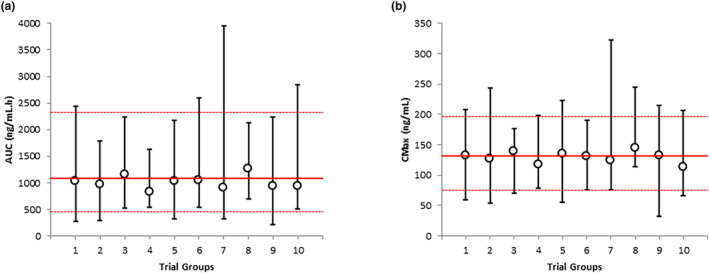
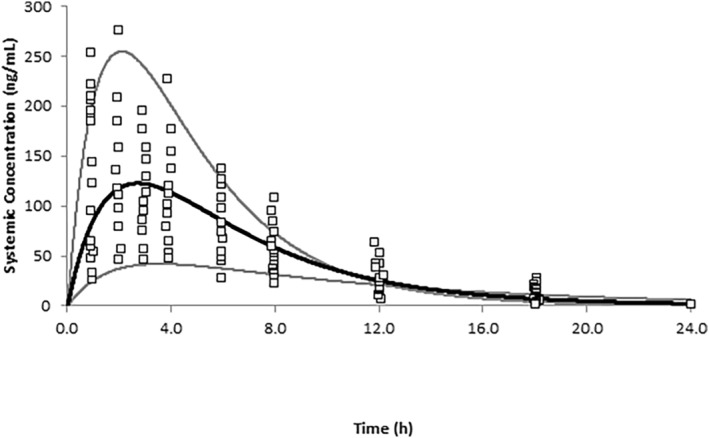
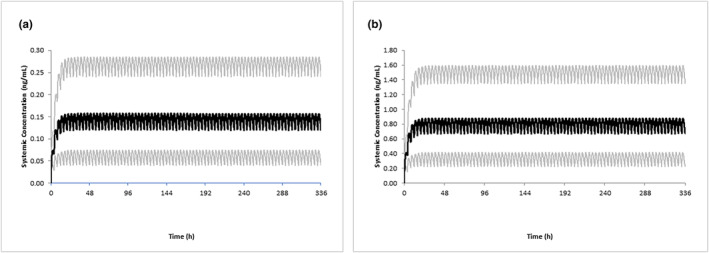
Evaluating the safety of primaquine (PQ) during breastfeeding requires an understanding of its pharmacokinetics (PKs) in breast milk and its exposure in the breastfed infant. Physiologically-based PK (PBPK) modeling is primed to assess the complex interplay of factors affecting the exposure of PQ in both the mother and the nursing infant. A published PBPK model for PQ describing the metabolism by monoamine oxidase A (MAO-A; 90% contribution) and cytochrome P450 2D6 (CYP2D6; 10%) in adults was applied to predict the exposure of PQ in mothers and their breastfeeding infants. Plasma exposures following oral daily dosing of 0.5 mg/kg in the nursing mothers in a clinical lactation study were accurately captured, including the observed ranges. Reported infant daily doses based on milk data from the clinical study were used to predict the exposure of PQ in breastfeeding infants greater than or equal to 28 days. On average, the predicted exposures were less than or equal to 0.13% of the mothers. Furthermore, in simulations involving neonates less than 28 days, PQ exposures remain less than 0.16% of the mothers. Assuming that MAO-A increases slowly with age, the predicted relative exposure of PQ remains low in neonates (<0.46%). Thus, the findings of our study support the recommendation made by the authors who reported the results of the clinical lactation study, that is, that when put into context of safety data currently available in children, PQ should not be withheld in lactating women as it is unlikely to cause adverse events in breastfeeding infants greater than or equal to 28 days old.
评估在哺乳期使用伯氨喹(PQ)的安全性需要了解其在母乳中的药代动力学(PKs)及其在母乳喂养婴儿中的暴露情况。基于生理学的 PK(PBPK)建模是评估影响母亲和哺乳婴儿中 PQ 暴露的复杂因素相互作用的首选方法。已发表的 PBPK 模型用于描述 PQ 在成人中的单胺氧化酶 A(MAO-A;贡献 90%)和细胞色素 P450 2D6(CYP2D6;贡献 10%)代谢,用于预测母亲及其哺乳婴儿中 PQ 的暴露情况。通过对哺乳期妇女进行临床泌乳研究,口服每日 0.5mg/kg 剂量,该模型准确地捕捉到了 PQ 的血浆暴露情况,包括观察到的范围。报告的婴儿每日剂量基于来自临床研究的牛奶数据,用于预测母乳喂养 28 天以上婴儿的 PQ 暴露情况。平均而言,预测的暴露量小于或等于母亲的 0.13%。此外,在涉及 28 天以下新生儿的模拟中,PQ 暴露量仍小于母亲的 0.16%。假设 MAO-A 随年龄增长缓慢增加,因此在新生儿中(<0.46%),PQ 的相对暴露量仍然较低。因此,我们的研究结果支持报告临床泌乳研究结果的作者的建议,即在将目前在儿童中可用的安全性数据纳入考虑后,不应在哺乳期妇女中拒绝使用 PQ,因为它不太可能导致 28 天以上的母乳喂养婴儿出现不良反应。