
阈下高频重复经颅磁刺激对皮质血流动力学反应和连接性的调制
Cortical Hemodynamic Response and Connectivity Modulated by Sub-threshold High-Frequency Repetitive Transcranial Magnetic Stimulation.
作者信息
Li Rihui, Potter Thomas, Wang Jun, Shi Zhixi, Wang Chushan, Yang Lingling, Chan Rosa, Zhang Yingchun
机构信息
Department of Biomedical Engineering, University of Houston, Houston, TX, United States.
Guangdong Provincial Work Injury Rehabilitation Hospital, Guangzhou, China.
出版信息
Front Hum Neurosci. 2019 Mar 19;13:90. doi: 10.3389/fnhum.2019.00090. eCollection 2019.
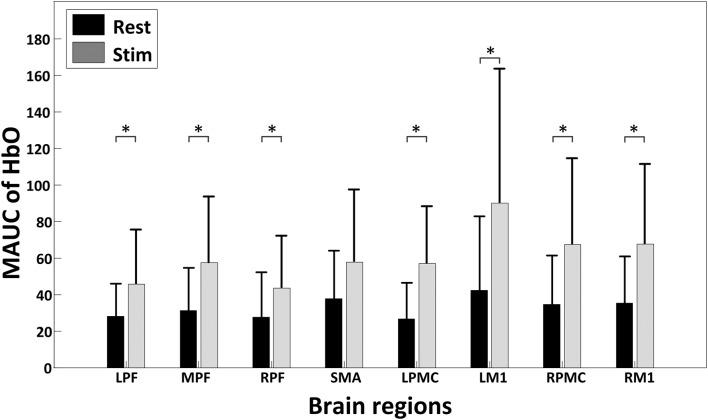
Repetitive transcranial magnetic stimulation (rTMS) at sub-threshold intensity is a viable clinical strategy to enhance the sensory and motor functions of extremities by increasing or decreasing motor cortical excitability. Despite this, it remains unclear how sub-threshold rTMS modulates brain cortical excitability and connectivity. In this study, we applied functional near-infrared spectroscopy (fNIRS) to investigate the alterations in hemodynamic responses and cortical connectivity patterns that are induced by high-frequency rTMS at a sub-threshold intensity. Forty high-frequency (10 Hz) trains of rTMS at 90% resting motor threshold (RMT) were delivered through a TMS coil placed over 1-2 cm lateral from the vertex. fNIRS signals were acquired from the frontal and bilateral motor areas in healthy volunteers ( = 20) during rTMS administration and at rest. A significant reduction in oxygenated hemoglobin (HbO) concentration was observed in most defined regions of interest (ROIs) during the stimulation period ( < 0.05). Decreased functional connectivity within prefrontal areas as well as between symmetrical ROI-pairs was also observed in most participants during the stimulation ( < 0.05). Results suggest that fNIRS imaging is able to provide a reliable measure of regional cortical brain activation that advances our understanding of the manner in which sub-threshold rTMS affects cortical excitability and brain connectivity.
阈下强度重复经颅磁刺激(rTMS)是一种通过增加或降低运动皮层兴奋性来增强肢体感觉和运动功能的可行临床策略。尽管如此,尚不清楚阈下rTMS如何调节脑皮质兴奋性和连接性。在本研究中,我们应用功能近红外光谱(fNIRS)来研究阈下强度高频rTMS诱导的血流动力学反应和皮质连接模式的变化。通过放置在头顶外侧1-2厘米处的TMS线圈,以90%静息运动阈值(RMT)施加40组高频(10Hz)的rTMS。在rTMS施加期间和静息状态下,从健康志愿者(n=20)的额叶和双侧运动区域采集fNIRS信号。在刺激期间,在大多数定义的感兴趣区域(ROI)中观察到氧合血红蛋白(HbO)浓度显著降低(p<0.05)。在大多数参与者的刺激过程中,还观察到前额叶区域内以及对称ROI对之间的功能连接性降低(p<0.05)。结果表明,fNIRS成像能够提供区域皮质脑激活的可靠测量,这有助于我们理解阈下rTMS影响皮质兴奋性和脑连接性的方式。


 Zotero 插件