Aghaei Maryam, Aghaei Shahrzad, Sokhanvari Fatemeh, Ansari Nazli, Hosseini Sayed Mohsen, Mohaghegh Mohammad-Ali, Hejazi Seyed Hossein
Skin Diseases and Leishmaniasis Research Centre, Isfahan University of Medical Sciences, Isfahan, Iran.
Department of Molecular Medicine, School of Advanced Technologies,Shahrekord University of Medical Sciences, Shahrekord, Iran.
Iran J Basic Med Sci. 2019 Jan;22(1):25-30. doi: 10.22038/ijbms.2018.29232.7064.
Leishmaniasis is one of the main health problems in developing countries, caused by intracellular protozoan parasites of the Leishmania genus. Although research has been successful in discovering vaccines and anti-parasitic drugs like antimony compounds, their side effects like high toxicity, prolonged regeneration, etc., have raised the replacement importance of natural products with antioxidant and antibacterial properties. It can be said that an appropriate alternative to this is the ozonated olive oil. Ozone by introducing O in involved tissues and bloodstream could degrade parasite amastigotes and lead to cleared leishmaniasis infections. So, the present study aimed to evaluate the effect of ozonated olive oil in Iranian leishmaniasis patients compared to glucantime, a choice drug for the treatment of Leishmaniasis.
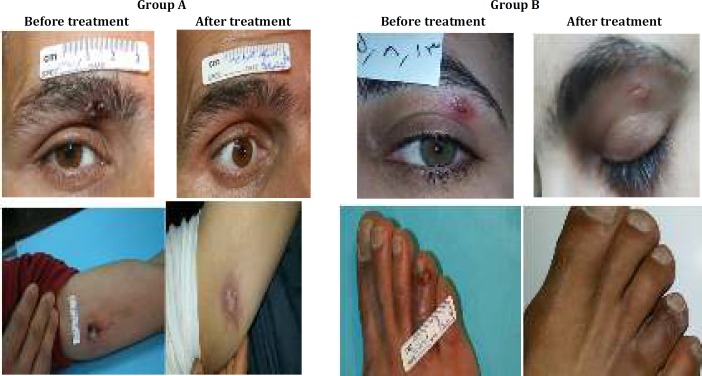
Thirty patients with confirmed leishmaniasis lesions were included and divided into two groups, 15 cases as control and 15 cases as test with lesions of 30-50 mm2 in diameter. The control group received glucantime intralesionally and the test group ozonated olive oil plus glucantime, 2 times daily.
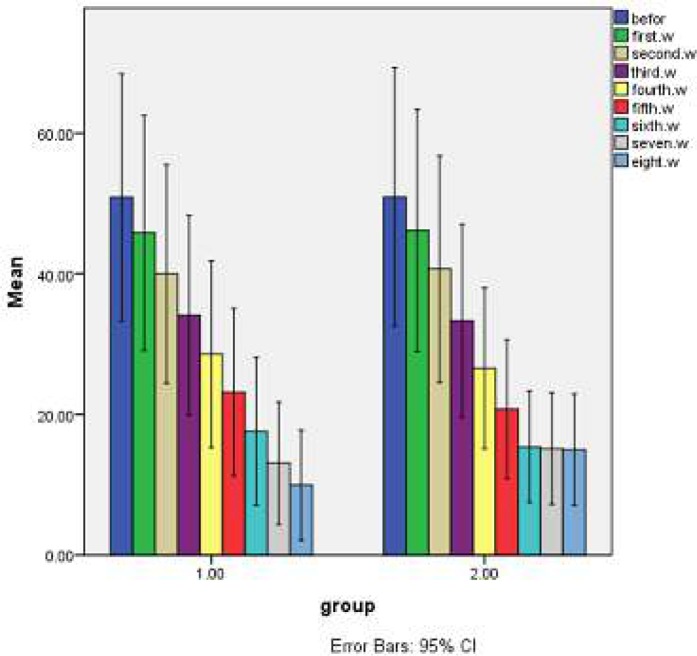
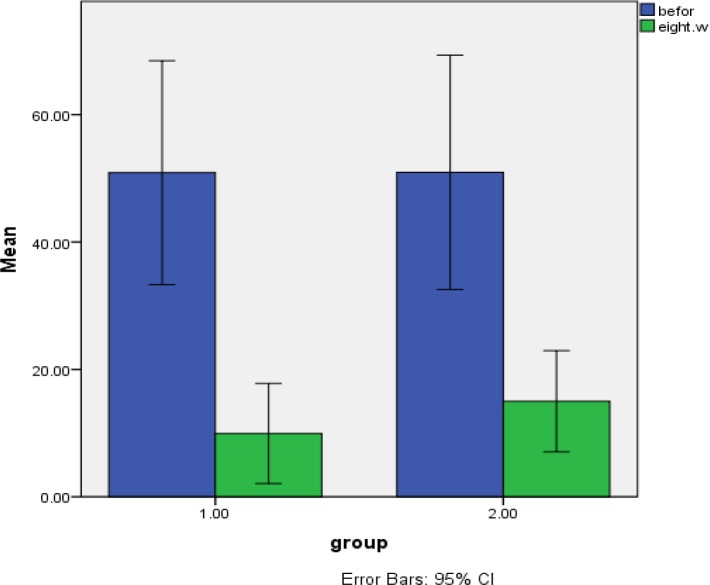
The mean of lesion size was (50.94±33.20) before and (15±14.34) after treatment in control (0.00) and (50.88±31.74) before and (9.93±14.18) after treatment in the test group (0.00). Moreover, the mean course of therapy was 10.4(±1.84) weeks and 8.93(±2.15) weeks in control and test groups, respectively (0.636). Significant differences were reported in lesion size after treatment between the two groups (0.00).
Data suggested ozonated olive oil can have synergistic effects with glucantime in the treatment of cutaneous leishmaniasis.
利什曼病是发展中国家主要的健康问题之一,由利什曼原虫属的细胞内原生动物寄生虫引起。尽管在发现疫苗和抗寄生虫药物如锑化合物方面取得了成功,但它们的副作用如高毒性、再生时间长等,提高了具有抗氧化和抗菌特性的天然产物的替代重要性。可以说,臭氧处理过的橄榄油是一个合适的替代品。臭氧通过在相关组织和血液中引入氧,可降解寄生虫无鞭毛体并清除利什曼病感染。因此,本研究旨在评估与治疗利什曼病的首选药物葡糖胺相比,臭氧处理过的橄榄油对伊朗利什曼病患者的疗效。
纳入30例确诊为利什曼病皮损的患者,分为两组,每组15例,皮损直径为30 - 50平方毫米。对照组皮损内注射葡糖胺,试验组皮损内注射臭氧处理过的橄榄油加葡糖胺,每日2次。
对照组治疗前皮损大小均值为(50.94±33.20),治疗后为(15±14.34)(P = 0.00);试验组治疗前为(50.88±31.74),治疗后为(9.93±14.18)(P = 0.00)。此外,对照组和试验组的平均治疗疗程分别为10.4(±1.84)周和8.93(±2.15)周(P = 0.636)。两组治疗后皮损大小有显著差异(P = 0.00)。
数据表明,臭氧处理过的橄榄油在治疗皮肤利什曼病方面可与葡糖胺产生协同作用。