Vannier Nathan, Mony Cendrine, Bittebiere Anne-Kristel, Theis Kevin R, Rosenberg Eugene, Vandenkoornhuyse Philippe
Université de Rennes, CNRS, UMR6553 EcoBio, Rennes, France.
Université de Lyon 1, CNRS, Villeurbanne, France.
mSystems. 2019 Mar 19;4(2). doi: 10.1128/mSystems.00213-18. eCollection 2019 Mar-Apr.
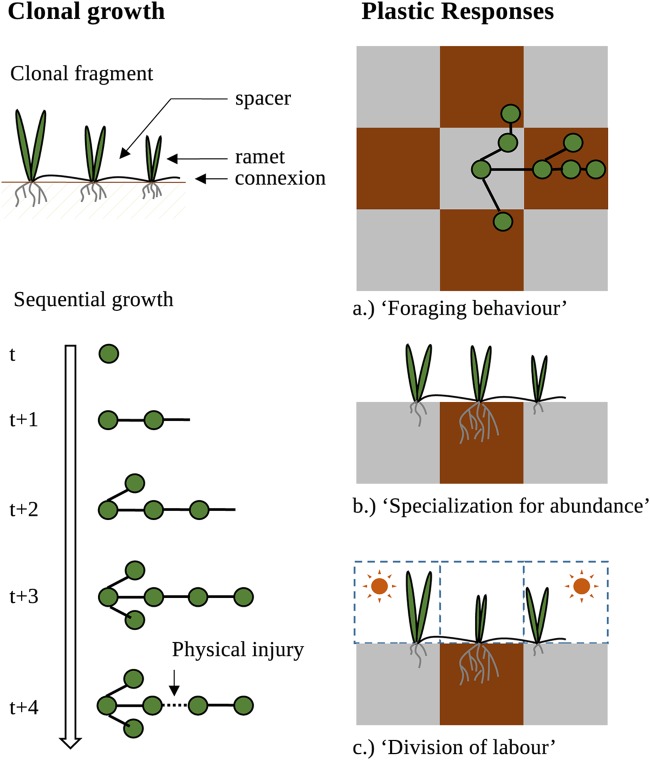
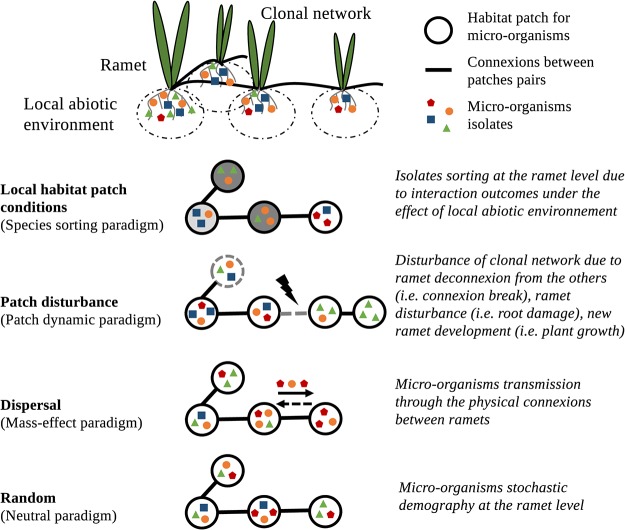
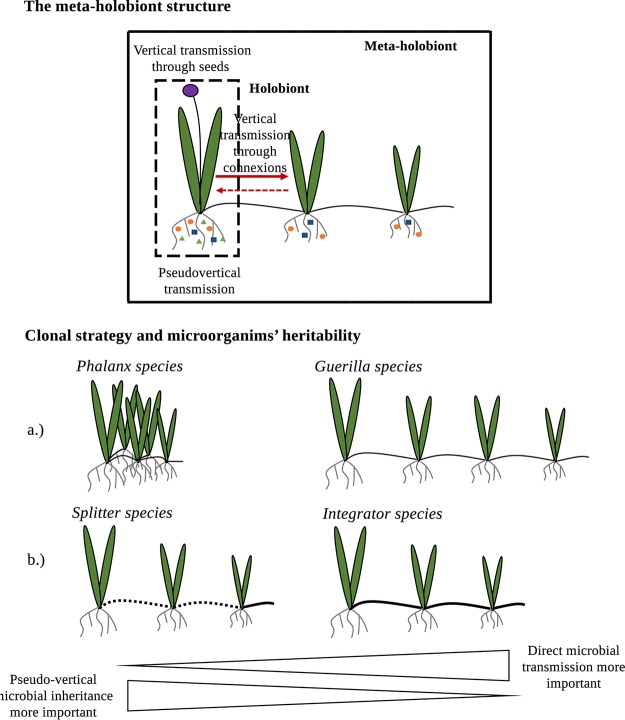
The holobiont concept defines a given organism and its associated symbionts as a potential level of selection over evolutionary time. In clonal plants, recent experiments demonstrated vertical transmission of part of the microbiota from one ramet (i.e., potentially autonomous individual) to another within the clonal network (i.e., connections by modified stems present in ∼35% of all plants). Because of this heritability, and potentially reciprocal exchange of microbes between generations of ramets, we propose to extend the existing holobiont framework to the concept of meta-holobiont. A meta-holobiont is a network of holobionts that can exchange biomolecules and microbiota across generations, thus impacting the fitness of both biological scales: holobionts and meta-holobionts. Specifically, meta-holobiont dynamics can result in sharing, specialization, and division of labor across plant clonal generations. This paper, which coins the meta-holobiont concept, is expected to stimulate discussion and to be applied beyond the context of networked clonal plants (e.g., to social insects).
全生物概念将特定生物体及其相关共生体定义为进化时间内一个潜在的选择层次。在克隆植物中,最近的实验表明,微生物群的一部分可在克隆网络内从一个分株(即潜在的自主个体)垂直传播到另一个分株(即通过约35%的植物中存在的变态茎连接)。由于这种遗传性,以及分株世代之间微生物可能的相互交换,我们建议将现有的全生物框架扩展到元全生物概念。元全生物是一个全生物网络,它可以跨代交换生物分子和微生物群,从而影响生物的两个尺度的适应性:全生物和元全生物。具体而言,元全生物动态可导致植物克隆世代间的共享、专业化和分工。本文提出了元全生物概念,有望激发讨论,并应用于网络化克隆植物之外的领域(如社会性昆虫)。