Department of Neuroscience, Medical University of South Carolina, Charleston, South Carolina, USA.
Center on Mindfulness and Integrative Health Intervention Development, University of Utah, Salt Lake City, Utah, USA.
Addict Biol. 2020 Mar;25(2):e12743. doi: 10.1111/adb.12743. Epub 2019 Apr 4.
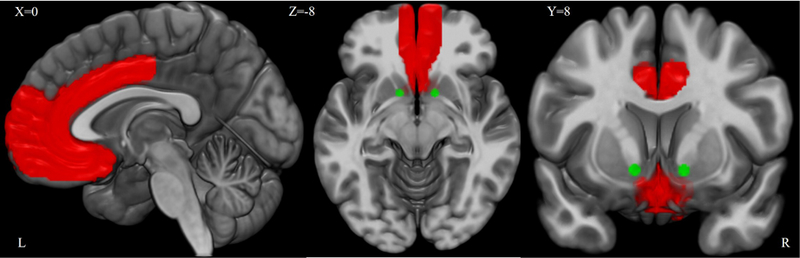
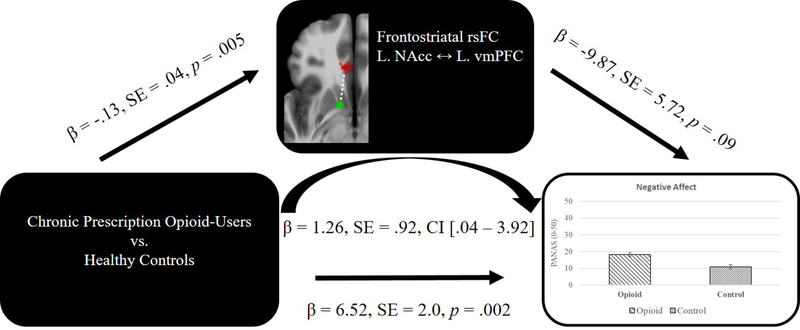
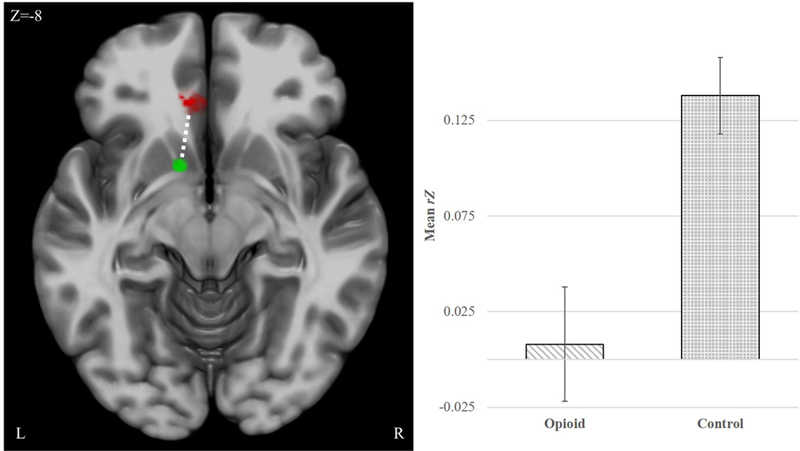
Preclinical studies have shown effects of chronic exposure to addictive drugs on glutamatergic-mediated neuroplasticity in frontostriatal circuitry. These initial findings have been paralleled by human functional magnetic resonance imaging (fMRI) research demonstrating weaker frontostriatal resting-state functional connectivity (rsFC) among individuals with psychostimulant use disorders. However, there is a dearth of human imaging literature describing associations between long-term prescription opioid use, frontostriatal rsFC, and brain morphology among chronic pain patients. We hypothesized that prescription opioid users with chronic pain, as compared with healthy control subjects, would evidence weaker frontostriatal rsFC coupled with less frontostriatal gray matter volume (GMV). Further, those opioid use-related deficits in frontostriatal circuitry would be associated with negative affect and drug misuse. Prescription opioid users with chronic pain (n = 31) and drug-free healthy controls (n = 30) underwent a high-resolution anatomical and an eyes-closed resting-state functional scan. The opioid group, relative to controls, exhibited weaker frontostriatal rsFC, and less frontostriatal GMV in both L.NAc and L.vmPFC. Frontostriatal rsFC partially mediated group differences in negative affect. Within opioid users, L.NAc GMV predicted opioid misuse severity. The current study revealed that prescription opioid use in the context of chronic pain is associated with functional and structural abnormalities in frontostriatal circuitry. These results suggest that opioid use-related abnormalities in frontostriatal circuitry may undergird disturbances in affect that may contribute to the ongoing maintenance of opioid use and misuse. These findings warrant further examination of interventions to treat opioid pathophysiology in frontostriatal circuitry over the course of treatment.
临床前研究表明,慢性接触成瘾药物会影响额皮质纹状体回路中的谷氨酸能介导的神经可塑性。这些初步发现与人类功能磁共振成像(fMRI)研究相平行,该研究表明,有精神兴奋剂使用障碍的个体之间额皮质纹状体静息状态功能连接(rsFC)较弱。然而,描述长期使用处方类阿片与慢性疼痛患者额皮质纹状体 rsFC 和大脑形态之间的关联的人类影像学文献很少。我们假设,与健康对照组相比,慢性疼痛的处方类阿片使用者会表现出较弱的额皮质纹状体 rsFC 以及较少的额皮质纹状体灰质体积(GMV)。此外,额皮质纹状体回路中与阿片类药物使用相关的这些缺陷与负面情绪和药物滥用有关。31 名慢性疼痛的处方类阿片使用者和 30 名无药物的健康对照者接受了高分辨率解剖学和闭眼静息状态功能扫描。与对照组相比,阿片类药物组的额皮质纹状体 rsFC 较弱,左侧伏隔核和左侧 vmPFC 的额皮质纹状体 GMV 也较少。额皮质纹状体 rsFC 部分介导了组间负面情绪的差异。在阿片类药物使用者中,左侧伏隔核 GMV 预测了阿片类药物滥用的严重程度。本研究表明,慢性疼痛背景下的处方类阿片使用与额皮质纹状体回路的功能和结构异常有关。这些结果表明,额皮质纹状体回路中与阿片类药物使用相关的异常可能会导致情绪紊乱,这可能有助于阿片类药物的持续使用和滥用。这些发现需要进一步研究,以在治疗过程中针对额皮质纹状体回路中的阿片类药物病理生理学进行干预。