School of Finance, Actuarial Studies and Statistics, Australian National University, Acton, ACT, Australia.
Faculty of Social Sciences, University of Stirling, Scotland, United Kingdom.
PLoS One. 2019 Apr 4;14(4):e0214838. doi: 10.1371/journal.pone.0214838. eCollection 2019.
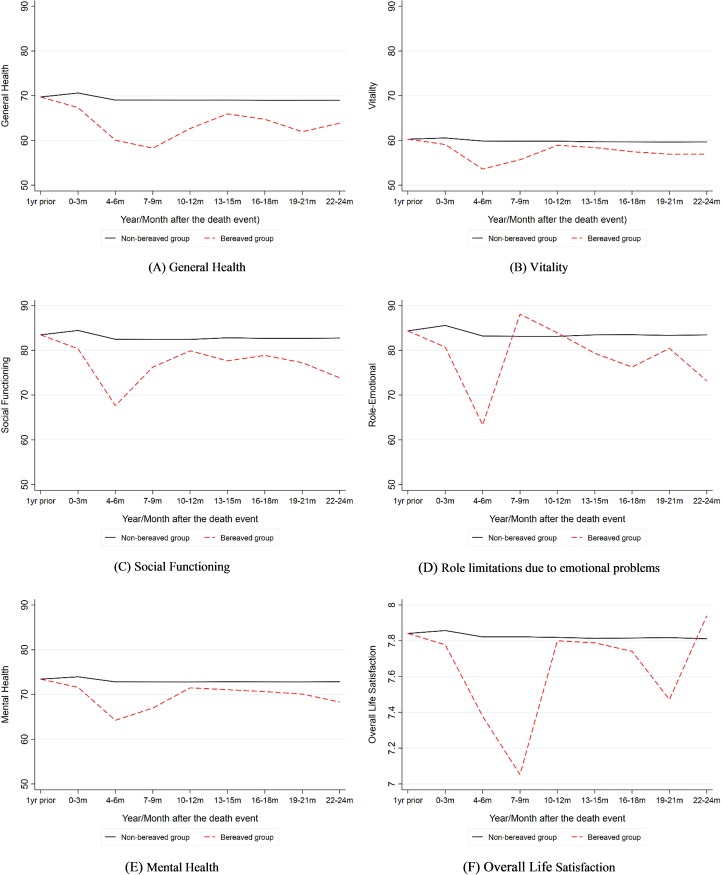
This paper reports the impact of a major life event-death-on the physical, psychological and social well-being of the deceased's close friends. We utilised data from a large longitudinal survey covering a period of 14 years (2002-2015) consisting a cohort of 26,515 individuals in Australia, of whom 9,586 had experienced the death of at least one close friend. This longitudinal cohort dataset comprises responses to the SF-36 (health related quality of life measure) and allowed for analysis of the short and longer-term impacts of bereavement. In order to manage the heterogeneity of the socio-demographics of respondents who did/not experience a death event, we use a new and robust approach known as the Entropy Balancing method to construct a set of weights applied to the bereaved group and the control group (the group that did not experience death). This approach enables us to match the two groups so that the distribution of socio-demographic variables between the two groups are balanced. These variables included gender, age, marital status, ethnicity, personality traits, religion, relative socio-economic disadvantage, economic resources, and education and occupation and where they resided. The data show, for the first time, a range of negative and enduring consequences experienced by people following the death of a close friend. Significant adverse physical and psychological well-being, poorer mental health and social functioning occur up to four years following bereavement. Bereaved females experienced a sharper fall in vitality, suffered greater deterioration in mental health, impaired emotional and social functioning than the male counterparts up to four years after the death. The data show that the level of social connectedness plays an important role in bereavement outcomes. Specifically, we found that less socially active respondents experienced a longer deterioration in physical and psychological health. Finally, we found evidence that the death of a close friend lowered the respondent's satisfaction with their health. Since death of friends is a universal phenomenon, we conclude the paper by reflecting on the need to recognise the death of a close friend as a substantial experience, and to offer support and services to address this disenfranchised grief. Recognising bereaved friends as a group experiencing adverse outcomes can be used internationally to prompt health and psychological services to assist this specific group, noting that there may be substantial longevity to the negative sequelae of the death of a friend. Facilitating bereaved people's support networks may be a fruitful approach to minimising these negative outcomes.
本文报告了重大生活事件——死亡对死者亲密朋友的身心健康、心理和社会福祉的影响。我们利用了一项为期 14 年(2002-2015 年)的大型纵向调查的数据,该调查涵盖了澳大利亚的 26515 名个体,其中 9586 人经历过至少一位亲密朋友的死亡。这个纵向队列数据集包括对 SF-36(健康相关生活质量测量)的回应,并允许分析丧亲之痛的短期和长期影响。为了控制经历/未经历死亡事件的受访者的社会人口统计学特征的异质性,我们使用一种新的稳健方法,称为熵平衡方法,为丧亲组和对照组(未经历死亡的组)构建一组权重。这种方法使我们能够匹配这两个组,以便两组之间的社会人口统计学变量分布保持平衡。这些变量包括性别、年龄、婚姻状况、种族、人格特质、宗教、相对社会经济劣势、经济资源以及教育和职业以及他们的居住地。这些数据首次显示了死者亲密朋友死亡后人们经历的一系列负面和持久的后果。在丧亲之痛后的四年内,人们会经历显著的身心健康恶化、心理健康状况较差以及社会功能受损。丧亲的女性在活力方面下降得更明显,在精神健康、情感和社会功能方面的恶化程度比男性更严重,甚至在死亡后的四年内也是如此。数据显示,社交联系的程度在丧亲之痛的结果中起着重要作用。具体来说,我们发现,社交活动较少的受访者的身心健康恶化时间更长。最后,我们有证据表明,亲密朋友的死亡降低了受访者对自己健康的满意度。由于朋友的死亡是一种普遍现象,我们通过反思认识到亲密朋友的死亡是一种重要的经历,并提供支持和服务来解决这种被剥夺的悲伤,以此作为本文的结尾。将丧亲的朋友视为一个经历不良后果的群体,可以在国际上被用来促使健康和心理服务机构为这一特定群体提供帮助,同时注意到朋友死亡的负面影响可能会持续很长时间。促进丧亲者的支持网络可能是减少这些负面后果的一种富有成效的方法。