Department of Nutrition, Food Science and Physiology, University of Navarra, Irunlarrea 1, 31008, Pamplona, Navarra, Spain.
IdiSNA (Navarra Institute for Health Research), Pamplona, Spain.
BMC Pediatr. 2019 Apr 4;19(1):90. doi: 10.1186/s12887-019-1468-9.
Physical activity (PA) is associated with changes in body composition that affect insulin sensitivity and leptin levels. Few studies have assessed the effect of lifestyle interventions on changes in objectively measured PA levels in obese children. To evaluate the effects of a multidisciplinary lifestyle intervention on anthropometric indices, biochemical parameters and accelerometer measured PA in abdominal obese children.
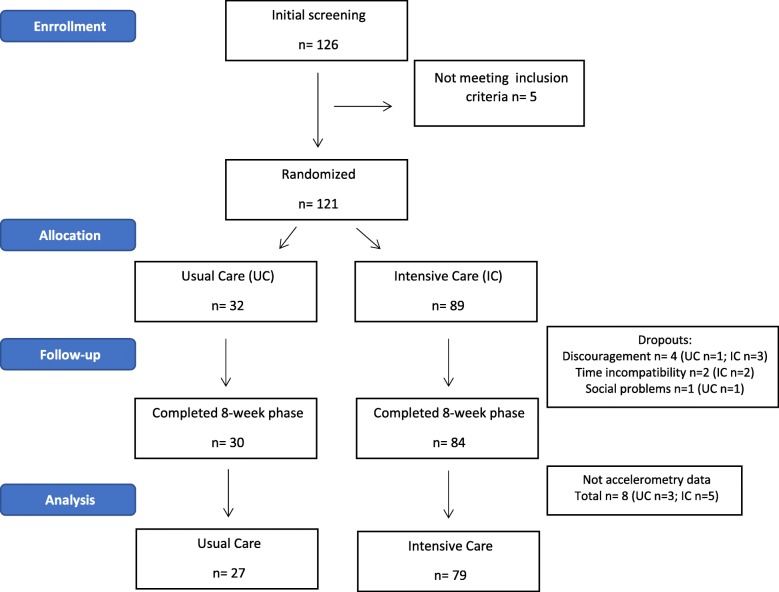
A randomized control trial was performed in 106 children and adolescents with abdominal obesity. Participants were randomly assigned to usual or intensive care group for 8-week. PA was measured by accelerometry over four days including, at least, two weekdays in all participants. Both groups were encouraged to accumulate an extra time of 200 min per week in their PA.
At baseline, 75% of subjects do not fulfill the WHO recommendation of being more than 60 min/day on moderate-to-vigorous PA (MVPA). The intensive care group achieved a significant reduction in anthropometric indexes compared to the usual care but no significant change was found in biochemical or PA parameters. Both groups achieved a significant reduction in light PA. Interestingly, intensive care participants significantly increased MVPA in 5.5 min/day. Moreover, an inverse association between changes in MVPA and leptin levels was found.
The two lifestyle intervention reduced anthropometric indexes and lowered light PA in abdominal obese children. No significant differences were observed between intensive care and usual care in regard to PA. Intensive care participants significantly increase physical activity (MVPA) and, changes in MVPA were inversely associated with changes in leptin levels after the intervention.
ClinicalTrials.gov , Identifier: NCT03147261 . Registered 10 May 2017. Retrospectively registered.
身体活动(PA)与身体成分的变化有关,这些变化会影响胰岛素敏感性和瘦素水平。很少有研究评估生活方式干预对肥胖儿童中客观测量的 PA 水平变化的影响。评估多学科生活方式干预对腹型肥胖儿童的人体测量指标、生化参数和加速度计测量的 PA 的影响。
对 106 名腹型肥胖儿童和青少年进行了一项随机对照试验。参与者被随机分配到常规护理或强化护理组,进行 8 周的治疗。使用加速度计在四天内测量 PA,所有参与者至少包括两个工作日。两组均鼓励每周额外增加 200 分钟的 PA。
基线时,75%的受试者未达到世界卫生组织(WHO)的建议,即每天进行超过 60 分钟的中等到剧烈强度的 PA(MVPA)。与常规护理组相比,强化护理组的人体测量指标显著降低,但生化或 PA 参数无显著变化。两组的轻度 PA 均显著减少。有趣的是,强化护理组参与者的 MVPA 每天增加了 5.5 分钟。此外,还发现 MVPA 的变化与瘦素水平呈负相关。
两种生活方式干预均降低了腹型肥胖儿童的人体测量指标和轻度 PA。强化护理和常规护理组在 PA 方面无显著差异。强化护理组参与者的 PA(MVPA)显著增加,干预后 MVPA 的变化与瘦素水平的变化呈负相关。
ClinicalTrials.gov,标识符:NCT03147261。2017 年 5 月 10 日注册。回顾性注册。