Department of Biological and Environmental Sciences and Technologies (Di.S.Te.B.A.), University of Salento, 73100 Lecce, Italy.
Department of Physical Activity, Sport Faculty of Sports Science, University of Murcia, 30720 Murcia, Spain.
Int J Environ Res Public Health. 2023 Jan 20;20(3):1927. doi: 10.3390/ijerph20031927.
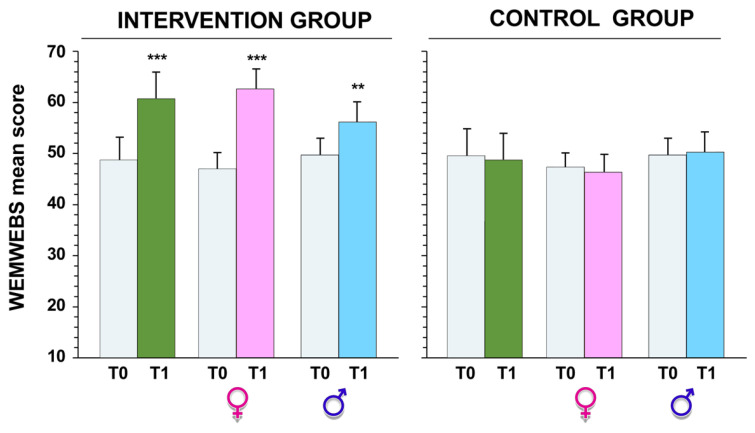
This study aimed to evaluate the effectiveness of physically active breaks of a total duration of 10 min a day, introduced during curricular lessons, together with a 10 min physical activity intervention during the daily school recess period on obesity prevention, fitness, cognitive function, and psychological well-being in school-aged children. A sample of 310 children (139 boys vs. 171 girls), aged between 8 and 10 years (9.82 ± 0.51), was selected. Our strategy was implemented over a 6-month period and the participants were randomly assigned to either the intervention group ( = 157) or the non-intervention (control) group ( =153). In the intervention group, a significant decrease ( < 0.05) in body mass index, waist circumference, waist-height ratio, and relative body fat mass was achieved after the intervention (T1) compared to the values measured before intervention (T0); in the control group, no differences emerged between T0 and T1 for any of the parameters considered. We found a significant increase in the intervention group in standing long jump, Ruffier, and sit and reach test scores ( < 0.001 for all). At T0, cognitive test scores did not differ between the girls and boys or between the intervention and control groups; instead at T1, significant differences were observed in the two groups regarding the total number of responses and the concentration performance scores ( < 0.001). Consistently, in the intervention group, well-being levels significantly increased between T0 and T1 ( < 0.001). Finally, the intervention had significant effects on the children regardless of gender. We may therefore conclude that schools should create more opportunities for teachers and students to introduce intervention strategies to promote regular PA during school recess.
本研究旨在评估每天进行 10 分钟的身体活跃课间休息,以及在每天课间休息期间进行 10 分钟的体育活动干预,对预防肥胖、健身、认知功能和学龄儿童心理健康的有效性。选择了 310 名年龄在 8 至 10 岁之间(9.82±0.51 岁)的儿童作为样本。我们的策略实施了 6 个月,参与者被随机分配到干预组(n=157)或非干预(对照组)组(n=153)。在干预组中,与干预前(T0)相比,干预后(T1)的体重指数、腰围、腰高比和相对体脂肪质量显著下降(<0.05);在对照组中,T0 和 T1 之间任何参数都没有差异。我们发现干预组的站立跳远、Ruffier 和坐式伸展测试得分显著增加(所有 P<0.001)。在 T0 时,女孩和男孩之间以及干预组和对照组之间的认知测试得分没有差异;而在 T1 时,两个组在总反应数和集中表现评分方面存在显著差异(均 P<0.001)。同样,在干预组中,幸福感水平在 T0 和 T1 之间显著增加(P<0.001)。最后,无论性别如何,干预对儿童都有显著影响。因此,我们可以得出结论,学校应该为教师和学生创造更多的机会,引入干预策略,以促进课间休息时的定期体育活动。