Demoz Gebre Teklemariam, Gebremariam Alem, Yifter Helen, Alebachew Minyahil, Niriayo Yirga Legesse, Gebreslassie Gebremicheal, Woldu Gebremariam, Bahrey Degena, Shibeshi Workineh
School of Pharmacy, Aksum University, Po.Box: 298, Aksum, Ethiopia.
School of Public Health, Adigrat University, Adigrat, Ethiopia.
BMC Res Notes. 2019 Apr 4;12(1):207. doi: 10.1186/s13104-019-4248-6.
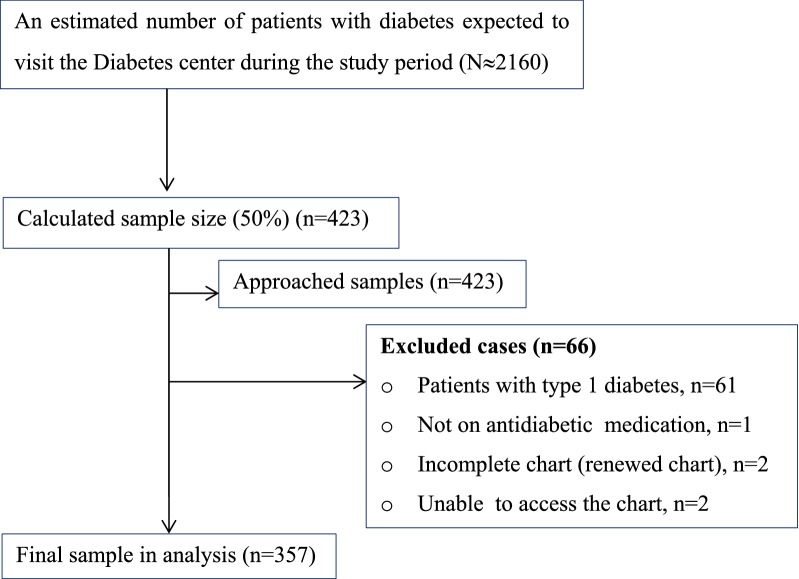
Contemporary clinical guidelines endorsed that glycemic control is the ultimate goal in the management patients with diabetes. The aim of this study was to assess the prevalence of glycemic control and to identify predictors of poor glycemic control in patients with type 2 diabetes (T2D). A cross-sectional study was conducted among systematically selected 357 diabetic patients. Data were collected through direct patients' interviews and medical chart review. Binary logistic regression analyses were performed and analyzed using SPSS version 22.0.
Participants' mean age was (± SD) 56.1 ± 11.6 years. Nearly four in five (77.9%) of the participants had comorbidities, mainly of hypertension, and 60.2% had diabetic complications, mainly diabetes neuropathy. Poor glycemic control was found in 68.3% of the participants with a mean (± SD) FBG of 174.1 ± 48.9 mg/dL. Being female gender, having greater body mass index and low medication adherence was significantly associated with poor glycemic control. In conclusion, the overall aspects of glycemic control level of patients were far from the standards. Being female, greater body mass index and poor medication adherence were predictors of poor glycemic control. In response to this finding, an aggressive intervention that targets in improving the glycemic control is required.
当代临床指南认可血糖控制是糖尿病患者管理的最终目标。本研究旨在评估血糖控制的患病率,并确定2型糖尿病(T2D)患者血糖控制不佳的预测因素。对系统选取的357例糖尿病患者进行了横断面研究。通过直接访谈患者和查阅病历收集数据。使用SPSS 22.0版进行二元逻辑回归分析。
参与者的平均年龄为(±标准差)56.1±11.6岁。近五分之四(77.9%)的参与者患有合并症,主要是高血压,60.2%患有糖尿病并发症,主要是糖尿病神经病变。68.3%的参与者血糖控制不佳,平均(±标准差)空腹血糖为174.1±48.9mg/dL。女性、体重指数较高和药物依从性低与血糖控制不佳显著相关。总之,患者血糖控制水平的整体情况远未达到标准。女性、较高的体重指数和较差的药物依从性是血糖控制不佳的预测因素。针对这一发现,需要采取积极的干预措施来改善血糖控制。