Department of Environmental Systems Science, Institute for Atmospheric and Climate Science, Swiss Federal Institute of Technology (ETH) Zürich, 8092 Zürich, Switzerland;
Department of Environmental Systems Science, Institute for Atmospheric and Climate Science, Swiss Federal Institute of Technology (ETH) Zürich, 8092 Zürich, Switzerland.
Proc Natl Acad Sci U S A. 2019 Apr 23;116(17):8184-8189. doi: 10.1073/pnas.1813647116. Epub 2019 Apr 4.
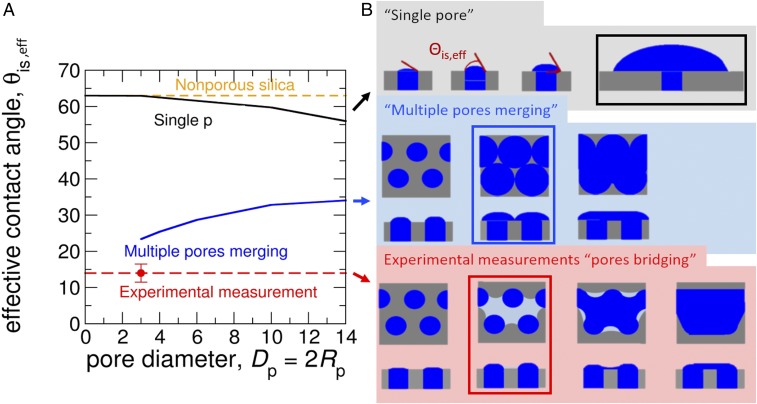
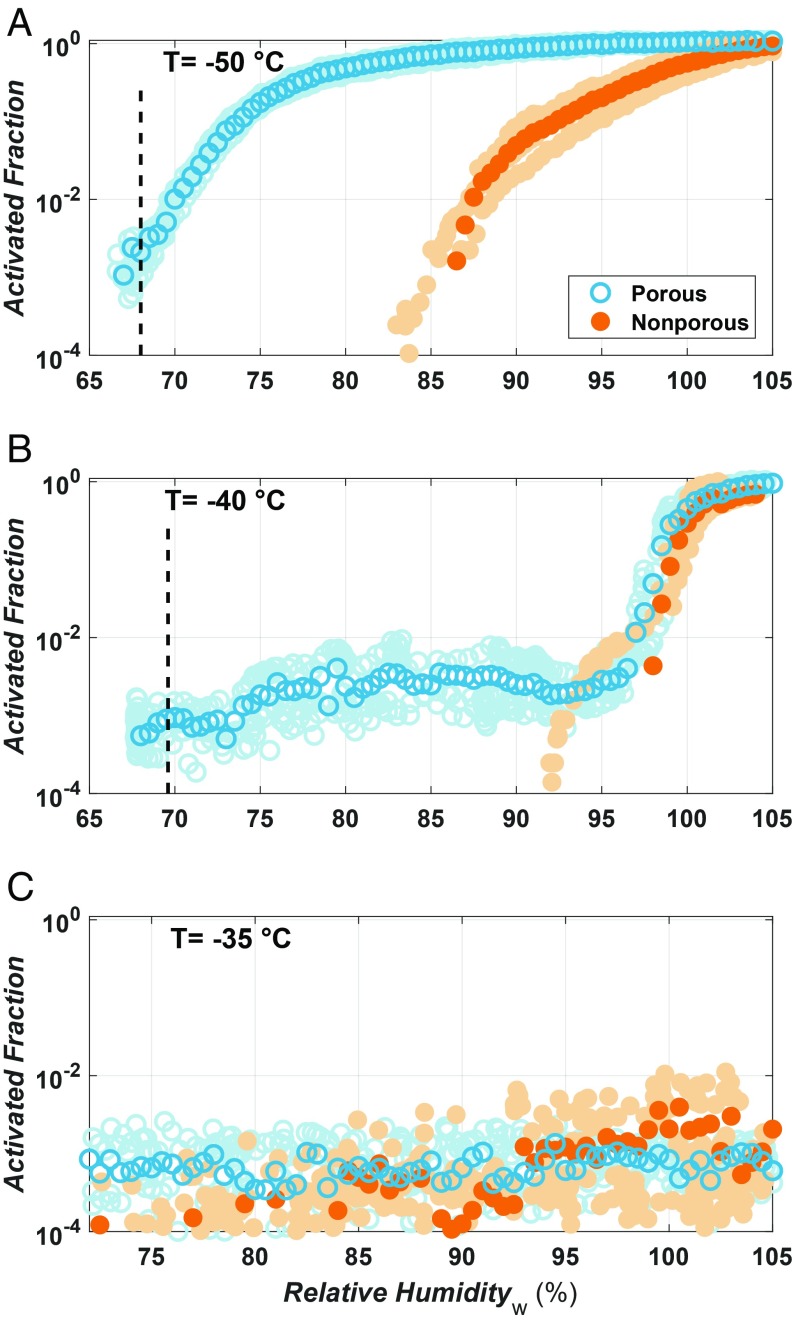
Ice nucleation in the atmosphere influences cloud properties, altering precipitation and the radiative balance, ultimately regulating Earth's climate. An accepted ice nucleation pathway, known as deposition nucleation, assumes a direct transition of water from the vapor to the ice phase, without an intermediate liquid phase. However, studies have shown that nucleation occurs through a liquid phase in porous particles with narrow cracks or surface imperfections where the condensation of liquid below water saturation can occur, questioning the validity of deposition nucleation. We show that deposition nucleation cannot explain the strongly enhanced ice nucleation efficiency of porous compared with nonporous particles at temperatures below -40 °C and the absence of ice nucleation below water saturation at -35 °C. Using classical nucleation theory (CNT) and molecular dynamics simulations (MDS), we show that a network of closely spaced pores is necessary to overcome the barrier for macroscopic ice-crystal growth from narrow cylindrical pores. In the absence of pores, CNT predicts that the nucleation barrier is insurmountable, consistent with the absence of ice formation in MDS. Our results confirm that pore condensation and freezing (PCF), i.e., a mechanism of ice formation that proceeds via liquid water condensation in pores, is a dominant pathway for atmospheric ice nucleation below water saturation. We conclude that the ice nucleation activity of particles in the cirrus regime is determined by the porosity and wettability of pores. PCF represents a mechanism by which porous particles like dust could impact cloud radiative forcing and, thus, the climate via ice cloud formation.
大气中的冰核会影响云的特性,改变降水和辐射平衡,最终调节地球的气候。一种被广泛接受的冰核形成途径,即沉积成核,假设水直接从气相转变为冰相,没有中间的液相。然而,研究表明,在具有狭窄裂缝或表面缺陷的多孔颗粒中,通过液相进行成核,在这种情况下,低于水饱和的液体可以发生凝结,从而质疑了沉积成核的有效性。我们表明,沉积成核无法解释多孔颗粒相对于非多孔颗粒在低于-40°C 的温度下具有更强的冰核形成效率,以及在-35°C 以下低于水饱和时没有冰核形成的现象。利用经典成核理论(CNT)和分子动力学模拟(MDS),我们表明,紧密间隔的孔隙网络对于克服从狭窄圆柱形孔隙宏观冰晶生长的障碍是必要的。在没有孔隙的情况下,CNT 预测成核势垒是不可逾越的,这与 MDS 中没有冰晶形成的情况一致。我们的结果证实,孔隙中的冷凝和冻结(PCF),即通过孔隙中液态水冷凝进行冰晶形成的机制,是低于水饱和度的大气冰核形成的主要途径。我们得出结论,云冰区颗粒的冰核活性取决于孔隙的多孔性和润湿性。PCF 代表了一种机制,多孔颗粒(如灰尘)可以通过冰云形成影响云辐射强迫,从而影响气候。