Rocha Vanessa da Silva, Claudio Erick Roberto Gonçalves, da Silva Vitor Loureiro, Cordeiro Jóctan Pimentel, Domingos Lucas Furtado, da Cunha Márcia Regina Holanda, Mauad Helder, do Nascimento Thiago Bruder, Lima-Leopoldo Ana Paula, Leopoldo André Soares
Physiology and Biochemistry Laboratory, Department of Sports, Center of Physical Education and Sports, Federal University of Espírito Santo, Vitória, Brazil.
Department of Physiological Sciences, Health Sciences Center, Federal University of Espírito Santo, Vitória, Brazil.
Front Physiol. 2019 Mar 20;10:268. doi: 10.3389/fphys.2019.00268. eCollection 2019.
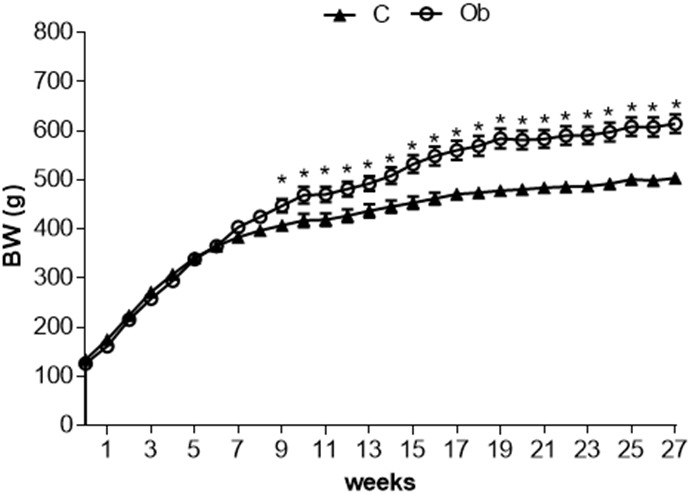
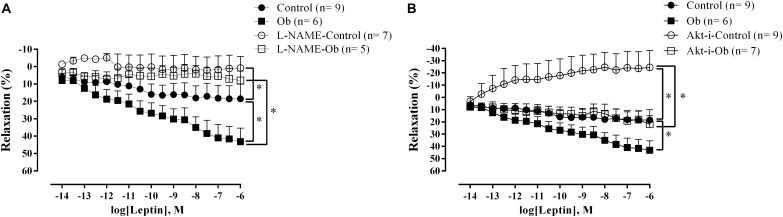
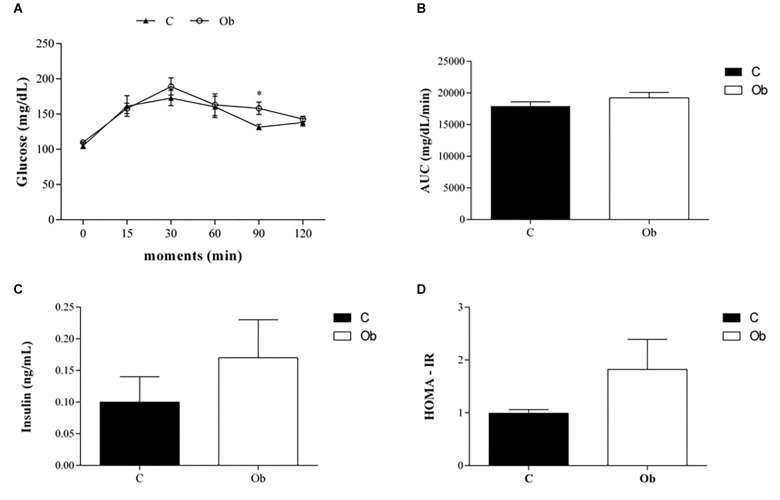
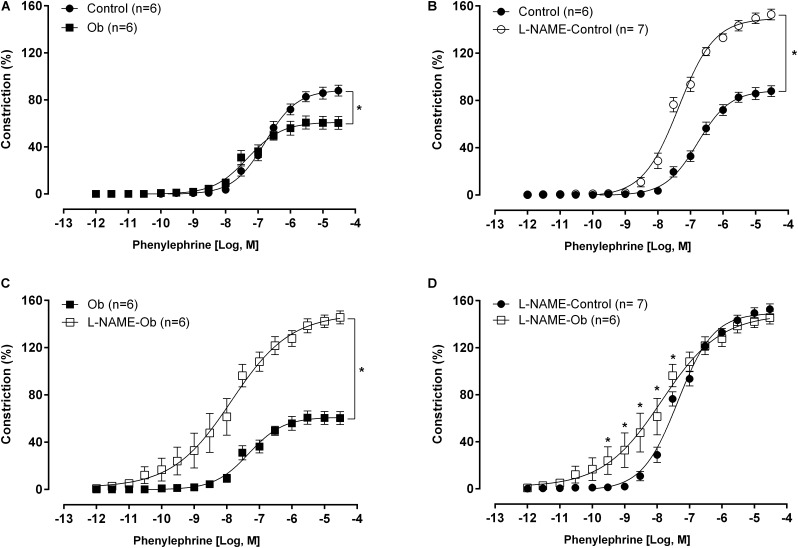
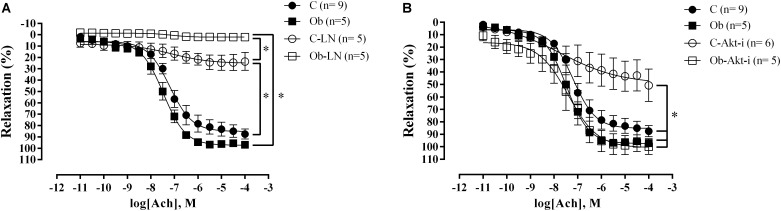
Experimental studies show that the unsaturated high-fat diet-induced obesity promotes vascular alterations characterized by improving the endothelial L-arginine/Nitric Oxide (NO) pathway. Leptin seems to be involved in this process, promoting vasodilation via increasing NO bioavailability. The aim of this study was to test the hypothesis that unsaturated high-fat diet-induced obesity does not generate endothelial dysfunction via increasing the vascular leptin/Akt/eNOS signaling. Thirty-day-old male rats were randomized into two groups: control (C) and obese (Ob). Group C was fed a standard diet, while group Ob was fed an unsaturated high-fat diet for 27 weeks. Adiposity, hormonal and biochemical parameters, and systolic blood pressure were observed. Concentration response curves were performed for leptin or acetylcholine in the presence or absence of Akt and NOS inhibitor. Our results showed that an unsaturated high-fat diet promoted a greater feed efficiency (FE), elevation of body weight and body fat (BF), and an adiposity index, characterizing a model of obesity. However, comorbidities frequently associated with experimental obesity were not visualized, such as glucose intolerance, dyslipidemia and hypertension. The evaluation of the endothelium-dependent relaxation with acetylcholine showed no differences between the C and Ob rats. After NOS inhibition, the response was completely abolished in the Ob group, but not in the C group. Furthermore, Akt inhibition completely blunted vascular relaxation in the C group, but not in the Ob group, which was more sensitive to leptin-induced vascular relaxation. L-NAME incubation abolished the relaxation in both groups at the same level. Although Akt inhibitor pre-incubation reduced the leptin response, group C was more sensitive to its effect. In conclusion, the high-unsaturated fat diet-induced obesity improved the vascular reactivity to leptin and does not generate endothelial dysfunction, possibly by the increase in the vascular sensitivity to leptin and increasing NO bioavailability. Moreover, our results suggest that the increase in NO production occurs through the increase in NOS activation by leptin and is partially mediated by the Akt pathway.
实验研究表明,不饱和高脂饮食诱导的肥胖会促进血管改变,其特征是改善内皮型L-精氨酸/一氧化氮(NO)途径。瘦素似乎参与了这一过程,通过增加NO生物利用度促进血管舒张。本研究的目的是检验不饱和高脂饮食诱导的肥胖不会通过增加血管瘦素/Akt/内皮型一氧化氮合酶(eNOS)信号传导而产生内皮功能障碍这一假设。将30日龄雄性大鼠随机分为两组:对照组(C)和肥胖组(Ob)。C组喂食标准饮食,而Ob组喂食不饱和高脂饮食27周。观察肥胖程度、激素和生化参数以及收缩压。在存在或不存在Akt和一氧化氮合酶抑制剂的情况下,对瘦素或乙酰胆碱进行浓度反应曲线测定。我们的结果表明,不饱和高脂饮食促进了更高的饲料效率(FE)、体重和体脂(BF)升高以及肥胖指数,形成了肥胖模型。然而,未观察到与实验性肥胖经常相关的合并症,如葡萄糖不耐受、血脂异常和高血压。用乙酰胆碱评估内皮依赖性舒张功能显示,C组和Ob组大鼠之间没有差异。一氧化氮合酶抑制后,Ob组的反应完全消失,但C组没有。此外,Akt抑制使C组的血管舒张完全减弱,但Ob组没有,Ob组对瘦素诱导的血管舒张更敏感。L-硝基精氨酸甲酯(L-NAME)孵育在相同水平上消除了两组的舒张功能。尽管Akt抑制剂预孵育降低了瘦素反应,但C组对其作用更敏感。总之,高不饱和脂肪饮食诱导的肥胖改善了血管对瘦素的反应性,并且不会产生内皮功能障碍,这可能是通过增加血管对瘦素的敏感性和增加NO生物利用度实现的。此外,我们的结果表明NO产生的增加是通过瘦素增加一氧化氮合酶的激活而发生的,并且部分由Akt途径介导。