Cancer Epidemiology Unit, Nuffield Department of Population Health, University of Oxford, Oxford, United Kingdom.
International Agency for Research on Cancer, Lyon, France.
Int J Cancer. 2020 Feb 1;146(3):720-730. doi: 10.1002/ijc.32314. Epub 2019 Apr 29.
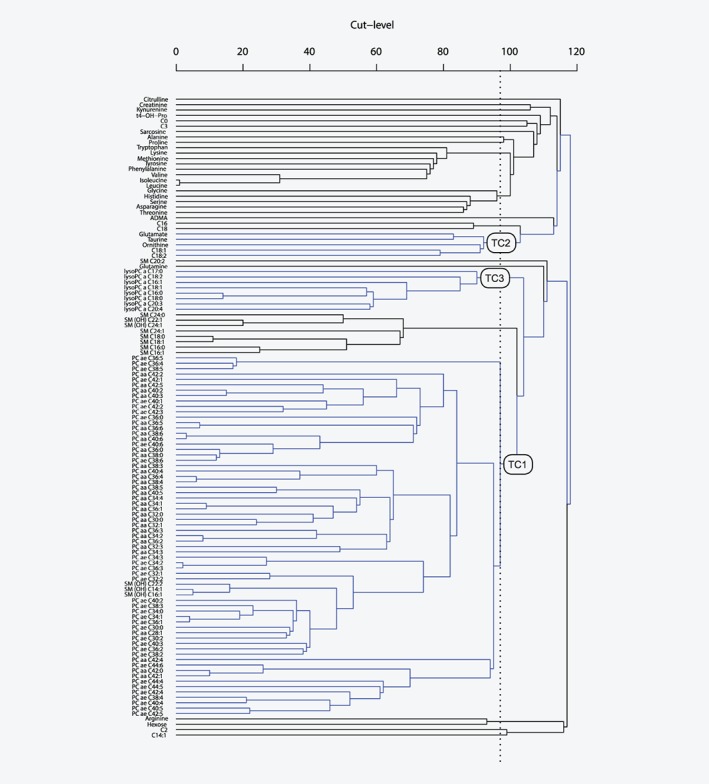
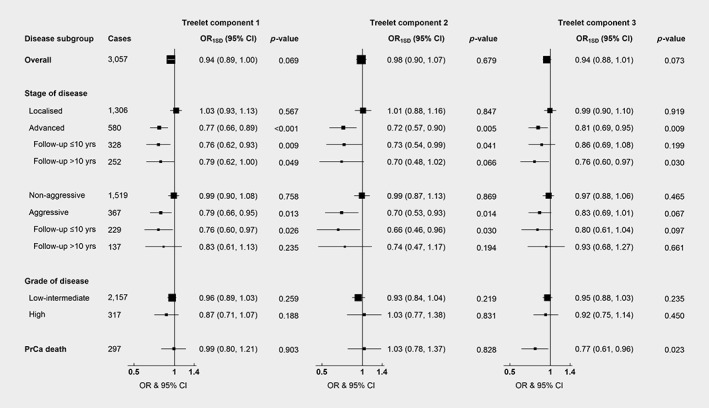
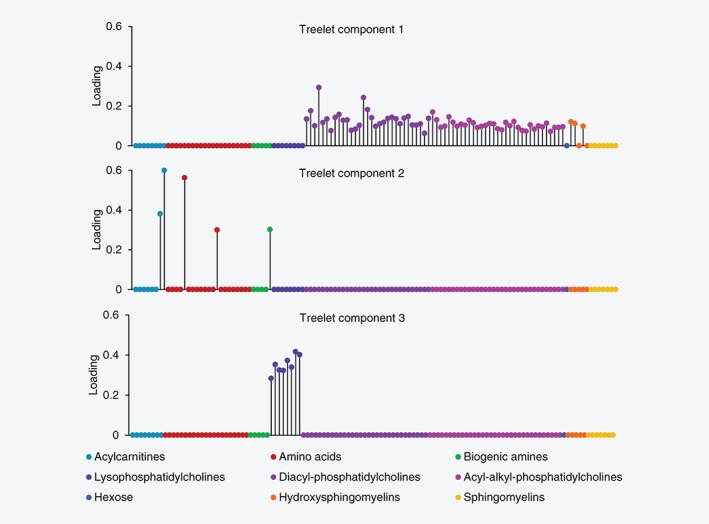
Metabolomics may reveal novel insights into the etiology of prostate cancer, for which few risk factors are established. We investigated the association between patterns in baseline plasma metabolite profile and subsequent prostate cancer risk, using data from 3,057 matched case-control sets from the European Prospective Investigation into Cancer and Nutrition (EPIC). We measured 119 metabolite concentrations in plasma samples, collected on average 9.4 years before diagnosis, by mass spectrometry (AbsoluteIDQ p180 Kit, Biocrates Life Sciences AG). Metabolite patterns were identified using treelet transform, a statistical method for identification of groups of correlated metabolites. Associations of metabolite patterns with prostate cancer risk (OR ) were estimated by conditional logistic regression. Supplementary analyses were conducted for metabolite patterns derived using principal component analysis and for individual metabolites. Men with metabolite profiles characterized by higher concentrations of either phosphatidylcholines or hydroxysphingomyelins (OR = 0.77, 95% confidence interval 0.66-0.89), acylcarnitines C18:1 and C18:2, glutamate, ornithine and taurine (OR = 0.72, 0.57-0.90), or lysophosphatidylcholines (OR = 0.81, 0.69-0.95) had lower risk of advanced stage prostate cancer at diagnosis, with no evidence of heterogeneity by follow-up time. Similar associations were observed for the two former patterns with aggressive disease risk (the more aggressive subset of advanced stage), while the latter pattern was inversely related to risk of prostate cancer death (OR = 0.77, 0.61-0.96). No associations were observed for prostate cancer overall or less aggressive tumor subtypes. In conclusion, metabolite patterns may be related to lower risk of more aggressive prostate tumors and prostate cancer death, and might be relevant to etiology of advanced stage prostate cancer.
代谢组学可能揭示前列腺癌病因的新见解,因为目前只有少数风险因素得到证实。我们利用来自欧洲癌症与营养前瞻性调查(EPIC)的 3057 对匹配的病例对照数据,研究了基线血浆代谢物谱与随后前列腺癌风险之间的关系。我们通过质谱法(Biocrates Life Sciences AG 的 AbsoluteIDQ p180 试剂盒)测量了平均在诊断前 9.4 年收集的血浆样本中的 119 种代谢物浓度。使用树状小波变换(一种用于识别相关代谢物组的统计方法)识别代谢物图谱。通过条件逻辑回归估计代谢物图谱与前列腺癌风险(OR)的关联。还进行了关于使用主成分分析得出的代谢物图谱和个别代谢物的补充分析。具有更高浓度的磷脂酰胆碱或羟基神经鞘磷脂(OR=0.77,95%置信区间 0.66-0.89)、酰基辅酶 A C18:1 和 C18:2、谷氨酸、鸟氨酸和牛磺酸(OR=0.72,0.57-0.90)或溶血磷脂酰胆碱(OR=0.81,0.69-0.95)的代谢物图谱的男性,在诊断时患有晚期前列腺癌的风险较低,且随访时间无异质性。在前两种模式中也观察到类似的与侵袭性疾病风险的关联(晚期的侵袭性亚组),而后一种模式与前列腺癌死亡风险呈负相关(OR=0.77,0.61-0.96)。没有观察到代谢物图谱与前列腺癌总发病率或侵袭性较低的肿瘤亚型之间的相关性。总之,代谢物图谱可能与更具侵袭性的前列腺肿瘤和前列腺癌死亡风险降低有关,可能与晚期前列腺癌的病因有关。