Parasitology and Public Health Unit, Department of Zoology and Environmental Biology, University of Nigeria, Nsukka, Enugu State, NG.
Science Laboratory Technology Department, Federal Polytechnic, Idah, Kogi State, NG.
Ann Glob Health. 2019 Apr 2;85(1):52. doi: 10.5334/aogh.2393.
Mapping the distribution of parasitic diseases in time and space has a pivotal role to play in their control.
This study mapped urinary schistosomiasis in Anambra State.
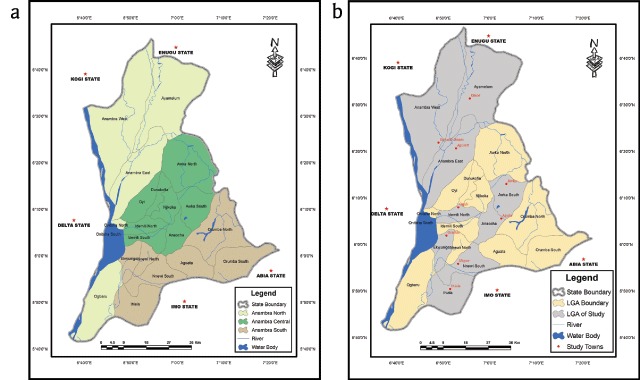
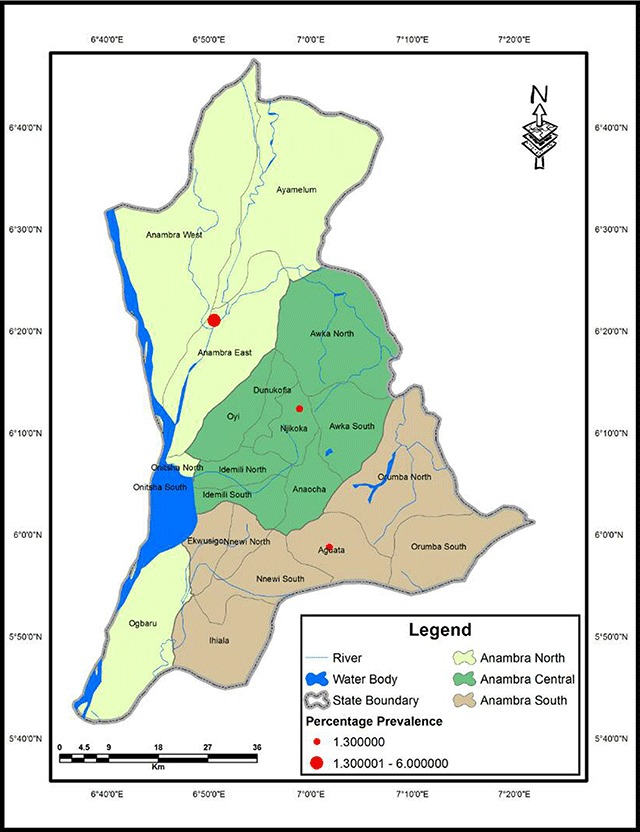
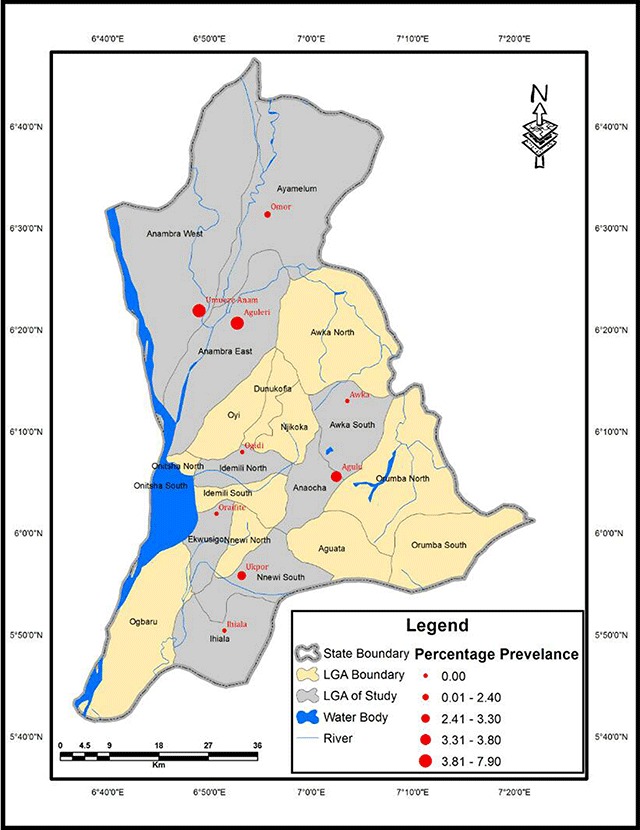
Sampling covered the three senatorial districts, Anambra North, Anambra Central and Anambra South. However, only nine of the 21 local government areas (LGAs) and one town in each LGA were covered. A geographic information system (GIS) was used to map the distribution of schistosomiasis in the state. With the aid of GIS, the distance of the towns to water bodies was calculated. A total of 450 urine samples collected from the nine LGAs were examined for haematuria and Schistosoma haematobium eggs. A questionnaire was used to assess exposure and risks status to infection. The urine samples were examined for haematuria using dipstick and microscopy.
Overall prevalence of infection in the study was 2.9% and 5.5% for microscopy and haematuria, respectively. Prevalence of schistosomiasis was different between the districts, and this was statistically significant (χ² = 7.763, p = 0.021). Prevalence of urinary schistosomiasis in the towns had a significant negative linear relationship with distance to water body (r = -0.767, p = 0.016). Based on infection status from microscopy, the adjusted odds of infection in fishers was over 103 times higher than in students; the difference was significant statistically (AOR = 103.0443, 95% CI = 4.6278-7093.972, p = 0.0114). People who washed things in stream had 12 times significantly greater odds of infection than those that did not (AOR = 12.4585, 95% CI = 1.9590-258.8108, p = 0.02542). The distance of respondents to stream was a major determinant of infection with urinary schistosomiasis in the state. Those who lived close to water were approximately 1131% more likely to be infected than those who lived far from water bodies (AOR = 11.3157, 95% CI 2.2473-90.6889, p = 0.00713).
Anambra State is endemic for urinary schistosomiasis. There is therefore a need for focal studies; and there may probably be a need to design a health program aimed at controlling the infection in focal areas in the state. The study also provides relevant information for designing a plan of action for the selective integrated and targeted control of urinary schistosomiasis in the LGAs.
绘制寄生虫病的时空分布图谱对于控制寄生虫病具有关键作用。
本研究对尼日利亚阿南布拉州的尿路血吸虫病进行了图谱绘制。
采样涵盖了该州的三个参议院区,即阿南布拉北、阿南布拉中和阿南布拉南,然而只覆盖了 21 个地方政府区(LGAs)中的 9 个和每个 LGA 中的一个城镇。利用地理信息系统(GIS)绘制了该州血吸虫病的分布图谱。借助 GIS,计算了城镇与水体之间的距离。从这 9 个 LGAs 采集了 450 份尿液样本,用于检查血尿和曼氏血吸虫卵。使用问卷评估了感染的暴露和风险状况。使用尿试纸和显微镜检查尿液样本是否存在血尿。
总体感染率为 2.9%,显微镜和尿试纸检查的感染率分别为 5.5%。各地区的血吸虫病患病率存在差异,且具有统计学意义(χ² = 7.763,p = 0.021)。城镇尿路血吸虫病的患病率与到水体的距离呈显著负线性关系(r = -0.767,p = 0.016)。基于显微镜检查的感染状况,渔民的感染调整后优势比(AOR)超过 103 倍,学生的感染调整后优势比(AOR)超过 103 倍,差异具有统计学意义(AOR = 103.0443,95% CI = 4.6278-7093.972,p = 0.0114)。在溪流中洗涤物品的人感染的可能性比不洗涤物品的人高 12 倍(AOR = 12.4585,95% CI = 1.9590-258.8108,p = 0.02542)。受访者与溪流的距离是该州尿路血吸虫病感染的主要决定因素。与居住在远离水体的人相比,居住在靠近水体的人感染的可能性大约高 1131%(AOR = 11.3157,95% CI 2.2473-90.6889,p = 0.00713)。
阿南布拉州流行尿路血吸虫病。因此,需要进行重点研究;并且可能需要设计一个卫生项目,旨在控制该州重点地区的感染。该研究还为设计针对 LGAs 的尿路血吸虫病选择性综合和有针对性的控制行动计划提供了相关信息。