School of Medical Laboratory Sciences, Jimma University, Jimma, Ethiopia.
Tropical and Infectious Diseases Research Center, Jimma University, Jimma, Ethiopia.
PLoS One. 2022 Jul 25;17(7):e0271569. doi: 10.1371/journal.pone.0271569. eCollection 2022.
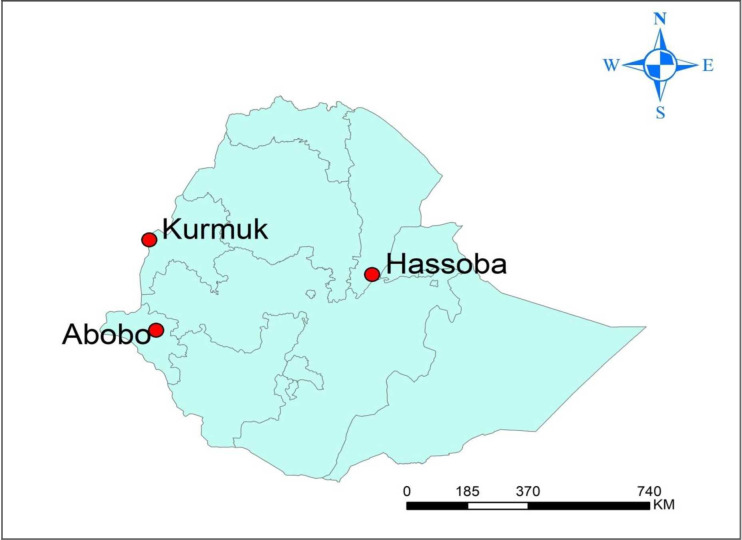
Urogenital schistosomiasis has been known to be endemic in several lowland areas of Ethiopia. It is caused by Schistosoma haematobium and causes considerable public health problems to schoolchildren. Ethiopia, after mapping the distribution of the disease (2013 to 2015), launched school-based mass deworming program to treat schoolchildren for schistosomiasis and soil-transmitted helminthiasis (STH) across the country since 2015. However, there is no recent information about the prevalence of the disease among schoolchildren in the current study areas. Diagnostic performance of urine filtration method and urinalysis reagent strip is also lacking. Therefore, this study aimed to determine the prevalence of urogenital schistosomiasis in schoolchildren, and to evaluate diagnostic performance of urine filtration and urinalysis reagent strip in Amibara, Kurmuk and Abobo districts, Ethiopia.
Across-sectional study was conducted involving 1,171 schoolchildren in Abobo, Amibara and Kurmuk districts from October, 2020 to January, 2021. The study participants were selected using random sampling technique. From each study participant, 10 ml urine samples were collected and examined using urine filtration method and urinalysis reagent strip. Data obtained from the survey were entered into Microsoft Excel 2010 and analysed with SPSS version 20.0. Data was summarized using descriptive statistics. Chi-square, bivariate and multivariable logistic regression and Pearson correlation test were used to measure associations between urogenital schistosomiasis, age, sex and haematuria. Odds ratio was used to measure strengths of association between variables. Agreement between urine filtration method and urinalysis reagent strip was determined using Kappa statistics. P-value < 0.05 at 95% CI was considered as statistically significant.
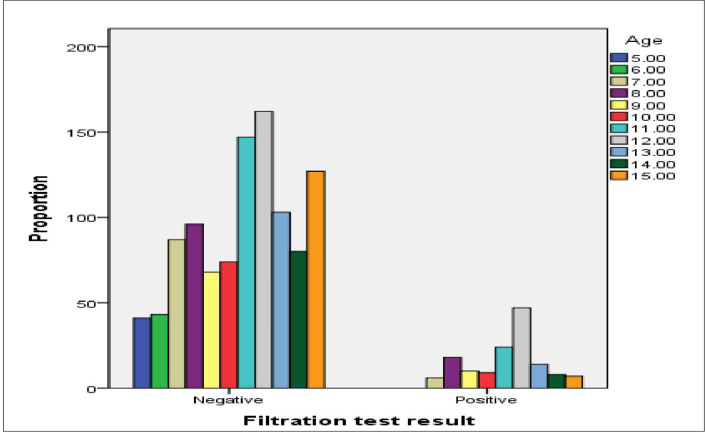
Among the 1,171 urine samples from schoolchildren examined by urine filtration method, 143 (12.2%) were S.haematobium egg positive. Out of 143 positive children 126(88.1%) were lightly infected and 17 (11.9%) were heavily infected. Among the total of 1,171 urine samples tested by dipstick, 264(22.5%) were positive for haematuria. Prevalence of urogenital schistosomiasis by both urine filtration and urinalysis reagent strip method was higher in Abobo than Hassoba (Amibara) and Kurmuk (P< 0.001). The number of egg counts (intensity of infections) were significantly correlated with intensity of haematuria (r = 0.6, P < 0.001). Egg-positive children had significantly higher risk of having haematuria compared to S. haematobium egg negative children (OR; 6.96; 95%CI: 4.98, 8.940). Compared to urine filtration method, the sensitivity, specificity, positive predictive value (PPV) and negative predictive values (NPV) of urinalysis reagent strip were 99.3%, 88.1%, 53.8% and 99.8%, respectively. Furthermore, its positive likelihood ratio (PLR) and negative likelihood ratio (NLR) were 8.34 and 0.008, respectively. The accuracy index and diagnostic odds ratio (DOR) of reagent strip were 0.89 and 1054, respectively. The agreement level between urine filtration methods and urinalysis reagent strip for detecting urogenital schistosomiasis was substantial (Kappa = 0.64).
This study showed that urogenital schistosomiasis was prevalent in schoolchildren in Abobo, Hassoba and Kurmuk districts. Urogenital schistosomiasis prevalence in Hassoba-bure and Kurmuk falls under low category whereas moderate in Abobo and is almost four times compared to Kurmuk and Hassoba-bure. Chemotherapy is needed in schoolchildren in such endemic areas and other measures like access to safe water, improved sanitation, hygiene, and health education should be implemented to control and prevent schistosomiasis effectively. The sensitivity, specificity, positive and negative predictive values of urinalysis reagent strip were higher and could serve as alternative for mass screening of urogenital schistosomiasis, for surveillance and evaluation of schistosomiasis intervention programs.
尿路血吸虫病在埃塞俄比亚几个低地地区流行。它是由埃及血吸虫引起的,给学童带来了相当大的公共卫生问题。埃塞俄比亚在绘制(2013-2015 年)疾病分布地图后,自 2015 年以来在全国范围内启动了针对学童的基于学校的大规模驱虫计划,以治疗血吸虫病和土壤传播性蠕虫病(STH)。然而,目前在当前研究区域内,没有关于学龄儿童疾病流行率的最新信息。尿液过滤法和尿液分析试剂条的诊断性能也缺乏。因此,本研究旨在确定阿博博、阿米巴拉和库尔穆克地区学龄儿童的尿路血吸虫病流行率,并评估尿液过滤法和尿液分析试剂条在该地区的诊断性能。
本研究于 2020 年 10 月至 2021 年 1 月在阿博博、阿米巴拉和库尔穆克区进行了一项横断面研究,涉及 1171 名学龄儿童。采用随机抽样技术选择研究参与者。从每个研究参与者收集 10 毫升尿液样本,使用尿液过滤法和尿液分析试剂条进行检查。从调查中获得的数据输入到 Microsoft Excel 2010 中,并使用 SPSS 版本 20 进行分析。使用描述性统计数据总结数据。使用卡方检验、双变量和多变量逻辑回归和皮尔逊相关检验来衡量尿路血吸虫病、年龄、性别和血尿之间的关联。使用优势比来衡量变量之间的关联强度。使用 Kappa 统计来确定尿液过滤法和尿液分析试剂条之间的一致性。95%CI 置信区间的 P 值<0.05 被认为具有统计学意义。
在对 1171 名学龄儿童的尿液样本进行尿液过滤法检查中,143 名(12.2%)样本的埃及血吸虫卵阳性。在 143 名阳性儿童中,126 名(88.1%)为轻度感染,17 名(11.9%)为重度感染。在总共 1171 份尿液样本中,使用尿液分析试剂条检测到 264 份(22.5%)为血尿阳性。阿博博的尿路血吸虫病患病率明显高于哈索巴(阿米巴拉)和库尔穆克(P<0.001)。尿液过滤法和尿液分析试剂条法检测到的尿路血吸虫病患病率在卵计数(感染强度)与血尿强度之间存在显著相关性(r=0.6,P<0.001)。与埃及血吸虫卵阴性儿童相比,埃及血吸虫卵阳性儿童患有血尿的风险显著更高(OR:6.96;95%CI:4.98,8.940)。与尿液过滤法相比,尿液分析试剂条的敏感性、特异性、阳性预测值(PPV)和阴性预测值(NPV)分别为 99.3%、88.1%、53.8%和 99.8%。此外,其阳性似然比(PLR)和阴性似然比(NLR)分别为 8.34 和 0.008。试剂条的准确度指数和诊断比值比(DOR)分别为 0.89 和 1054。尿液过滤法和尿液分析试剂条检测尿路血吸虫病的一致性水平较高(Kappa=0.64)。
本研究表明,阿博博、哈索巴和库尔穆克区的学龄儿童中存在尿路血吸虫病。哈索巴-布尔和库尔穆克的尿路血吸虫病流行率属于低类别,而阿博博的流行率属于中类别,几乎是库尔穆克和哈索巴-布尔的四倍。在这些流行地区,需要对学龄儿童进行化疗,还应采取安全用水、改善卫生设施、卫生和健康教育等其他措施,以有效控制和预防血吸虫病。尿液分析试剂条的敏感性、特异性、阳性和阴性预测值较高,可作为尿路血吸虫病大规模筛查的替代方法,用于监测和评估血吸虫病干预计划。