Sasajima Ryohei, Shibazaki Bunichiro, Iwamori Hikaru, Nishimura Takuya, Nakai Yoshihiko
International Institute of Seismology and Earthquake Engineering, Building Research Institute, Tsukuba, 305-0802, Japan.
Disaster Prevention Research Institute, Kyoto University, Uji, 611-0011, Japan.
Sci Rep. 2019 Apr 5;9(1):5726. doi: 10.1038/s41598-019-42169-y.
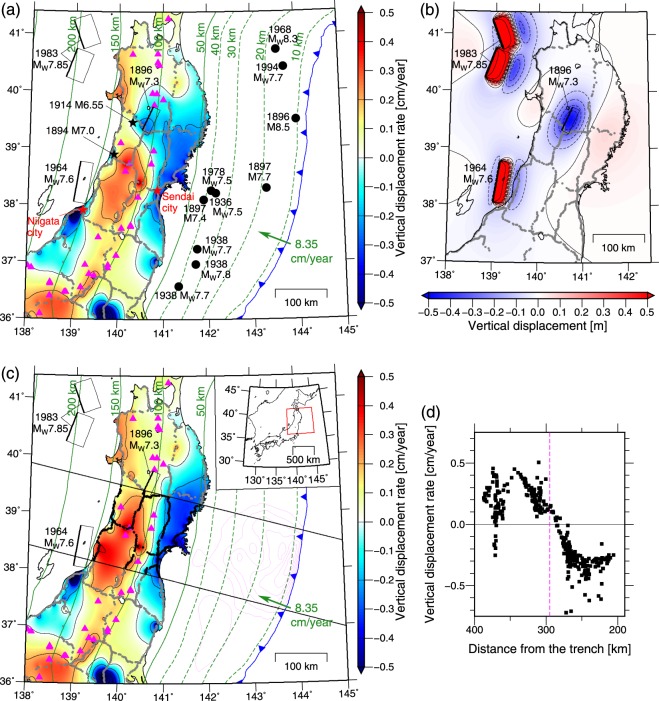
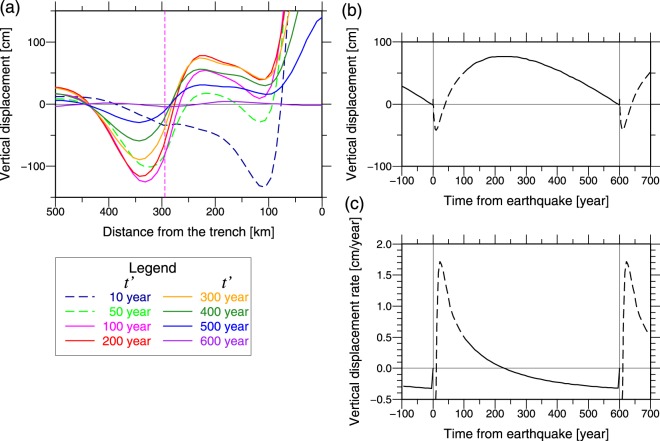
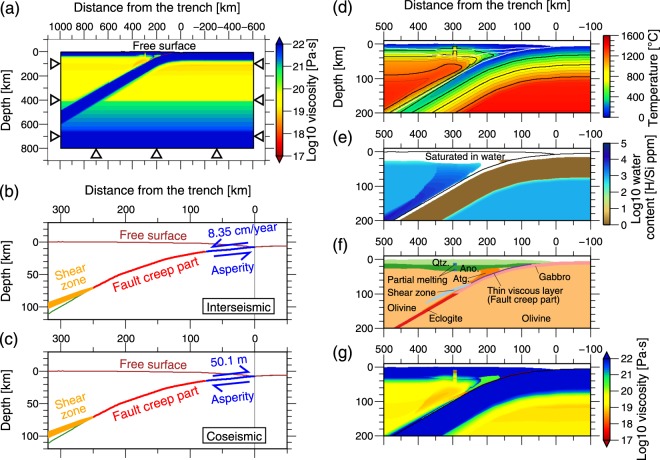
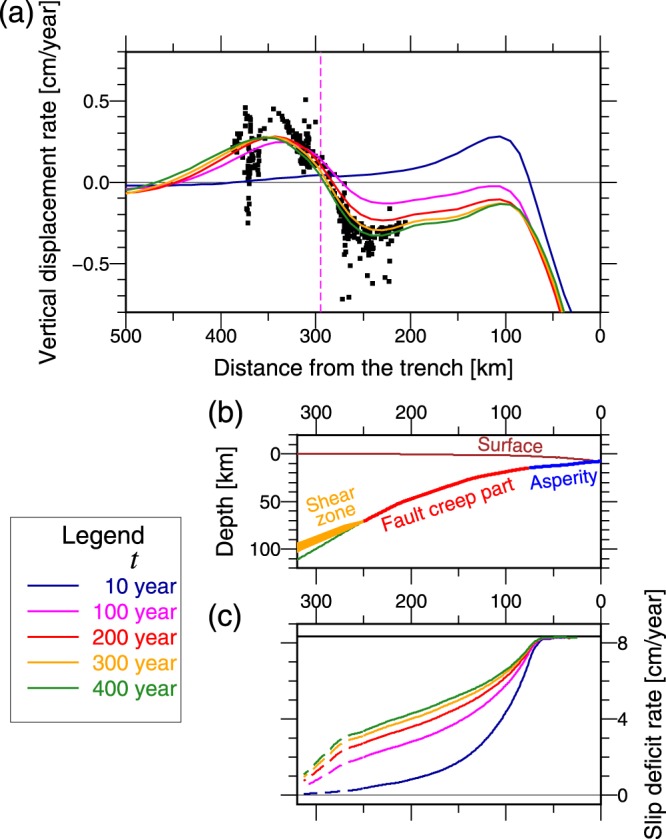
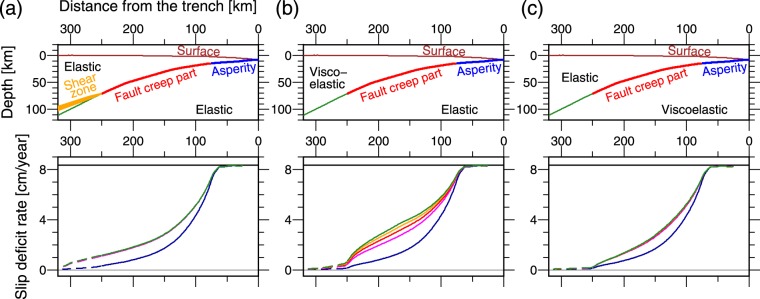
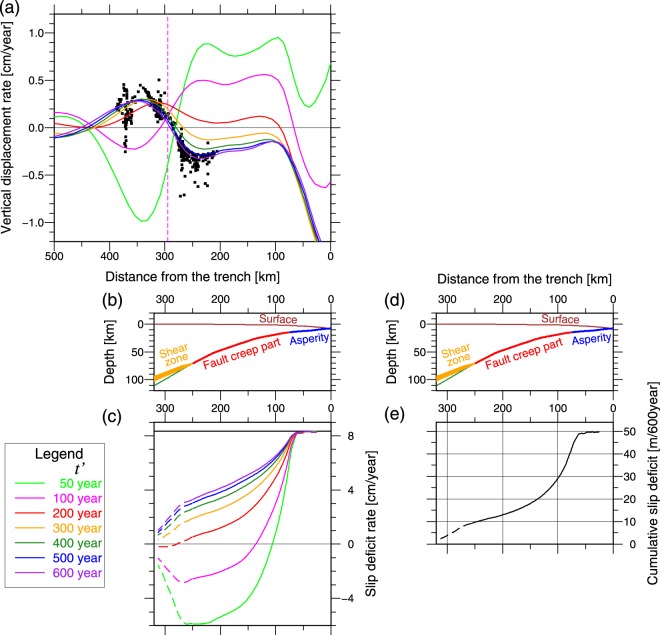
The forearc in Northeast Japan subsided (3-4 mm/year) in the interseismic ~100 years before the 2011 Tohoku earthquake (M9.1) just like it did during this event. This study attempts to understand the mechanism of the vertical displacement of the forearc during gigantic earthquake cycles via numerical modeling. The results suggest that the interseismic subsidence rate in the forearc increases with the duration of the locking of the asperity of the gigantic earthquake over several hundred years, due to the increasing slip deficit rate on the deeper parts of the plate interface. The increasing slip deficit rate is caused by both the decreasing the shear stress in the shear zone owing to the continuous locking of the asperity and the increasing the mobility of the continental lithosphere owing to the viscoelastic relaxation in the mantle wedge. The deep slip deficit rate extending to ~100 km depth of the plate interface is necessary to explain the observed interseismic forearc subsidence rate. The results also suggest hundreds of years of continuous locking of the asperities of a gigantic earthquake in the western Kuril subduction zone, where fast forearc subsidence has been observed as well.
日本东北部的弧前区在2011年东北地震(M9.1)前约100年的地震间歇期下沉(每年3 - 4毫米),就像在此次地震期间一样。本研究试图通过数值模拟来理解巨大地震周期中弧前区垂直位移的机制。结果表明,由于板块界面深部的滑动亏损率增加,弧前区的地震间歇期下沉速率随着巨大地震凹凸体锁定持续数百年而增加。滑动亏损率增加是由凹凸体持续锁定导致剪切带剪应力减小以及地幔楔中的粘弹性松弛导致大陆岩石圈流动性增加共同引起的。为了解释观测到的地震间歇期弧前区下沉速率,延伸至板块界面约100千米深度的深部滑动亏损率是必要的。结果还表明,在千岛俯冲带西部,也观测到了快速的弧前区下沉,那里巨大地震的凹凸体持续锁定了数百年。