Department of Surgery, The Johns Hopkins University School of Medicine, Baltimore, MD, USA.
Department of Surgery, Yale-New Haven Health, Yale University, School of Medicine, P.O. Box 208062, New Haven, CT, 06520-8062, USA.
Clin Epigenetics. 2019 Apr 5;11(1):59. doi: 10.1186/s13148-019-0650-0.
Despite improvements in cancer management, most pancreatic cancers are still diagnosed at an advanced stage. We have recently identified promoter DNA methylation of the genes ADAMTS1 and BNC1 as potential blood biomarkers of pancreas cancer. In this study, we validate this biomarker panel in peripheral cell-free tumor DNA of patients with pancreatic cancer.
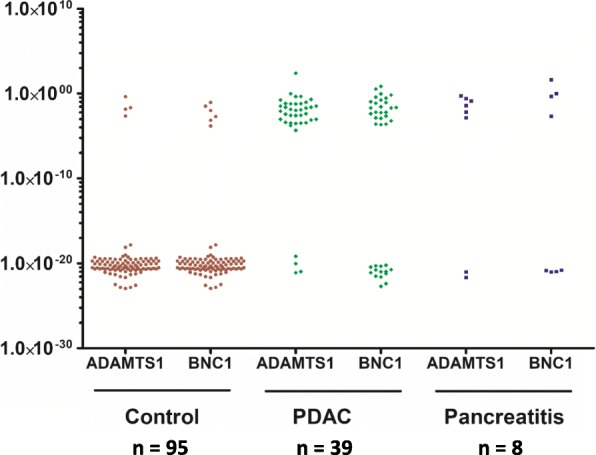
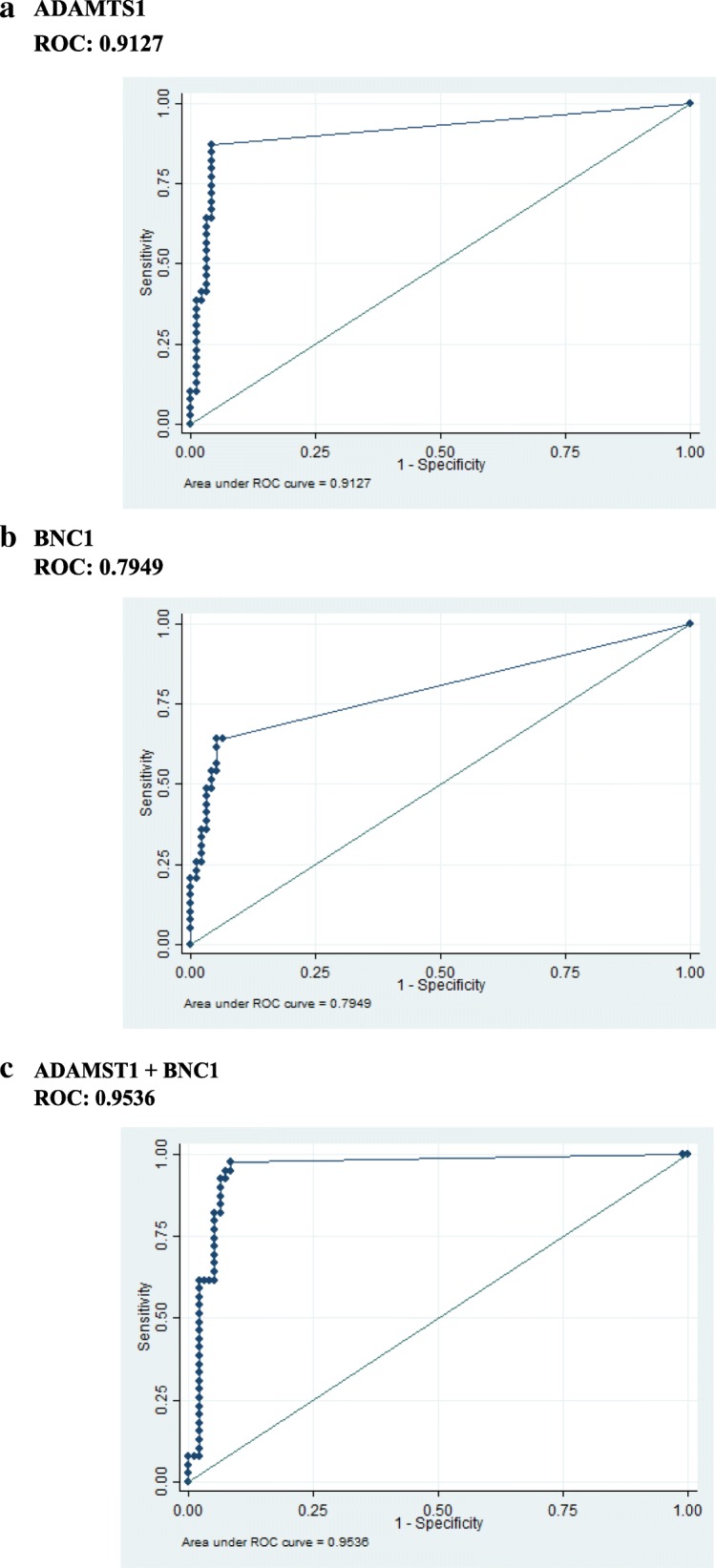
Sensitivity and specificity for each gene are as follows: ADAMTS1 87.2% and 95.8% (AUC = 0.91; 95% CI 0.71-0.86) and BNC1 64.1% and 93.7% (AUC = 0.79; 95% CI 0.63-0.78). When using methylation of either gene as a combination panel, sensitivity increases to 97.3% and specificity to 91.6% (AUC = 0.95; 95% CI 0.77-0.90). Adding pre-operative CA 19-9 values to the combined two-gene methylation panel did not improve sensitivity. Methylation of ADAMTS1 was found to be positive in 87.5% (7/8) of stage I, 77.8% (7/9) of stage IIA, and 90% (18/20) of stage IIB disease. Similarly, BNC1 was positive in 62.5% (5/8) of stage I patients, 55.6% (5/9) of stage IIA, and 65% (13/20) of patients with stage IIB disease. The two-gene panel (ADAMTS1 and/or BNC1) was positive in 100% (8/8) of stage I, 88.9% (8/9) of stage IIA, and 100% (20/20) of stage IIB disease. The sensitivity and specificity of the two-gene panel for localized pancreatic cancer (stages I and II), where the cancer is eligible for surgical resection with curative potential, was 94.8% and 91.6% respectively. Additionally, the two-gene panel exhibited an AUC of 0.95 (95% CI 0.90-0.98) compared to 57.1% for CA 19-9 alone.
The methylation status of ADAMTS1 and BNC1 in cfDNA shows promise for detecting pancreatic cancer during the early stages when curative resection of the tumor is still possible. This minimally invasive blood-based biomarker panel could be used as a promising tool for diagnosis and screening in a select subset of high-risk populations.
尽管癌症治疗有所改善,但大多数胰腺癌仍在晚期诊断。我们最近发现 ADAMTS1 和 BNC1 基因的启动子 DNA 甲基化是胰腺癌的潜在血液生物标志物。在这项研究中,我们在胰腺癌患者的外周无细胞肿瘤游离 DNA 中验证了这个生物标志物组合。
每个基因的灵敏度和特异性如下:ADAMTS1 为 87.2%和 95.8%(AUC=0.91;95%CI 0.71-0.86),BNC1 为 64.1%和 93.7%(AUC=0.79;95%CI 0.63-0.78)。当使用任一基因的甲基化作为组合面板时,灵敏度提高到 97.3%,特异性提高到 91.6%(AUC=0.95;95%CI 0.77-0.90)。将术前 CA 19-9 值添加到联合的双基因甲基化面板中并不能提高灵敏度。在 I 期的 8 例(7/8)、IIA 期的 7 例(7/9)和 IIB 期的 18 例(18/20)中均发现 ADAMTS1 甲基化呈阳性。同样,在 I 期患者的 5 例(5/8)、IIA 期的 5 例(5/9)和 IIB 期的 13 例(13/20)中 BNC1 呈阳性。双基因组(ADAMTS1 和/或 BNC1)在 I 期的 8 例(8/8)、IIA 期的 8 例(8/9)和 IIB 期的 20 例(20/20)中均为阳性。双基因组对有治愈潜力的局部性胰腺癌(I 期和 II 期)的灵敏度和特异性分别为 94.8%和 91.6%。此外,双基因组的 AUC 为 0.95(95%CI 0.90-0.98),而 CA 19-9 单独的 AUC 为 57.1%。
cfDNA 中 ADAMTS1 和 BNC1 的甲基化状态有望在肿瘤仍有可能进行根治性切除的早期阶段检测胰腺癌。这种微创性血液生物标志物组可能成为高危人群选择诊断和筛查的有前途的工具。