Department of General Practice, Erasmus MC, University Medical Center, Rotterdam, The Netherlands
Department of Orthopaedics and Sports Medicine, Erasmus MC, University Medical Center, Rotterdam, The Netherlands.
Br J Sports Med. 2019 Dec;53(23):1479-1485. doi: 10.1136/bjsports-2018-099744. Epub 2019 Apr 6.
To examine the effect of a multifactorial, online injury prevention programme on the number of running-related injuries (RRIs) in recreational runners.
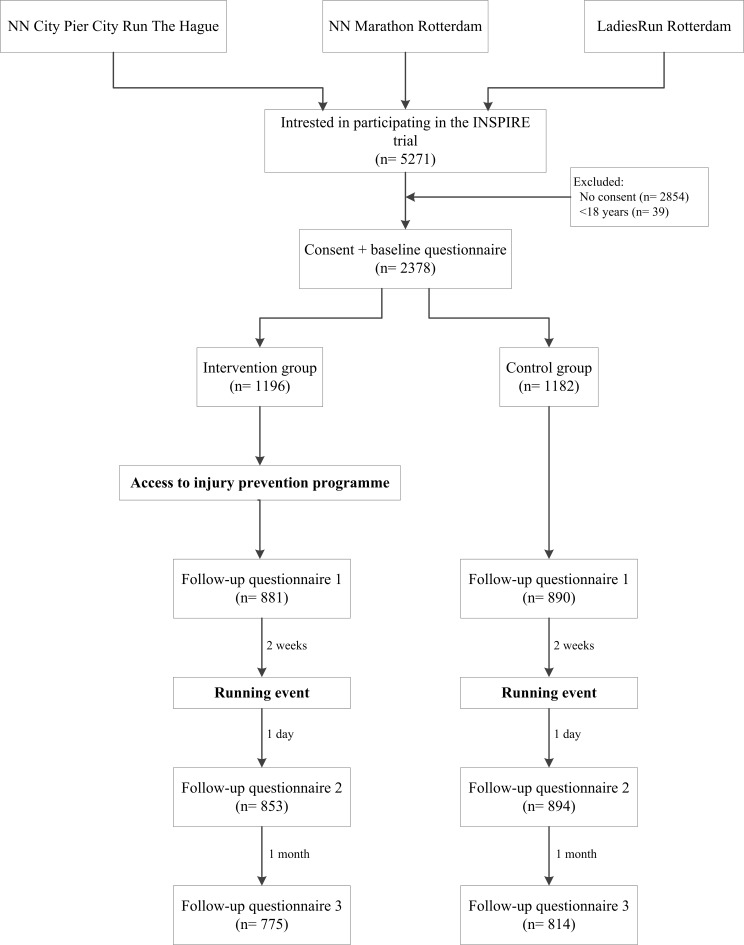
Adult recreational runners who registered for a running event (distances 5 km up to 42.195 km) were randomised into the intervention group or control group. Participants in the intervention group were given access to the online injury prevention programme, which consisted of information on evidence-based risk factors and advices to reduce the injury risk. Participants in the control group followed their regular preparation for the running event. The primary outcome measure was the number of self-reported RRIs in the time frame between registration for a running event and 1 month after the running event.
This trial included 2378 recreational runners (1252 men; mean [SD] age 41.2 [11.9] years), of which 1196 were allocated to the intervention group and 1182 to the control group. Of the participants in the intervention group 37.5% (95% CI 34.8 to 40.4) sustained a new RRI during follow-up, compared with 36.7% (95% CI 34.0 to 39.6) in the control group. Univariate logistic regression analysis showed no significant difference between the intervention and control group (OR 1.08; 95% CI 0.90 to 1.30). Furthermore, the prevention programme seemed to have a negative impact on the occurrence of new RRIs in the subgroup of runners with no injuries in the 12 months preceding the trial (OR 1.30; 95% CI 0.99 to 1.70).
A multifactorial, online injury prevention programme did not decrease the total number of RRIs in recreational runners.
NTR5998.
研究多因素、在线预防损伤方案对休闲跑者跑步相关损伤(RRIs)数量的影响。
注册参加跑步比赛(距离 5 公里至 42.195 公里)的成年休闲跑者被随机分为干预组或对照组。干预组的参与者可以访问在线预防损伤方案,其中包括基于证据的风险因素信息和降低损伤风险的建议。对照组的参与者按照常规准备参加跑步比赛。主要观察指标是从注册跑步比赛到比赛结束后 1 个月期间自我报告的 RRIs 数量。
本试验共纳入 2378 名休闲跑者(男性 1252 人;平均[标准差]年龄 41.2[11.9]岁),其中 1196 人被分配到干预组,1182 人被分配到对照组。在干预组的参与者中,37.5%(95%可信区间 34.8 至 40.4)在随访期间发生新的 RRI,而对照组为 36.7%(95%可信区间 34.0 至 39.6)。单变量逻辑回归分析显示,干预组与对照组之间无显著差异(比值比 1.08;95%可信区间 0.90 至 1.30)。此外,在试验前 12 个月无损伤的跑步者亚组中,预防方案似乎对新 RRIs 的发生产生了负面影响(比值比 1.30;95%可信区间 0.99 至 1.70)。
多因素、在线预防损伤方案并未降低休闲跑者 RRIs 的总数。
NTR5998。