NIHR MindTech MedTech Co-operative, Institute of Mental Health, University of Nottingham Innovation Park, Jubilee Campus, Triumph Road, Nottingham NG7 2TU, UK.
Bioengineering Research Group, Faculty of Engineering, University of Nottingham, Nottingham, UK.
Perspect Public Health. 2019 May;139(3):153-161. doi: 10.1177/1757913919835231. Epub 2019 Apr 8.
A 10-month project funded by the NewMind network sought to develop the specification of a visualisation toolbox that could be applied on digital platforms (web- or app-based) to support adults with lived experience of mental health difficulties to present and track their personal wellbeing in a multi-media format.
A participant co-design methodology, Double Diamond from the Design Council (Great Britain), was used consisting of four phases: Discover - a set of literature and app searches of wellbeing and health visualisation material; Define - an initial workshop with participants with lived experience of mental health problems to discuss wellbeing and visualisation techniques and to share personal visualisations; Develop - a second workshop to add detail to personal visualisations, for example, forms of media to be employed, degree of control over sharing; and Deliver - to disseminate the learning from the exercise.
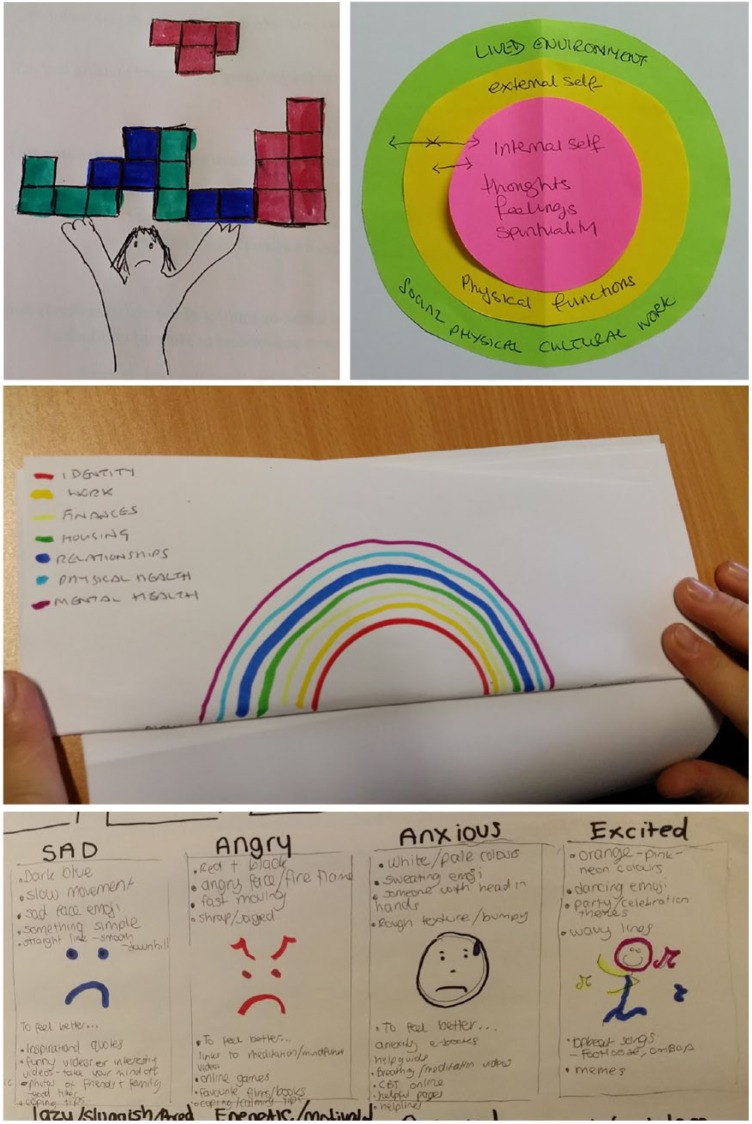
Two design workshops were held in December 2017 and April 2018 with 13 and 12 experts-by-experience involved, respectively, including two peer researchers (co-authors) and two individual-carer dyads in each workshop, with over 50% of those being present in both workshops. A total of 20 detailed visualisations were produced, the majority focusing on highly personal and detailed presentations of wellbeing.
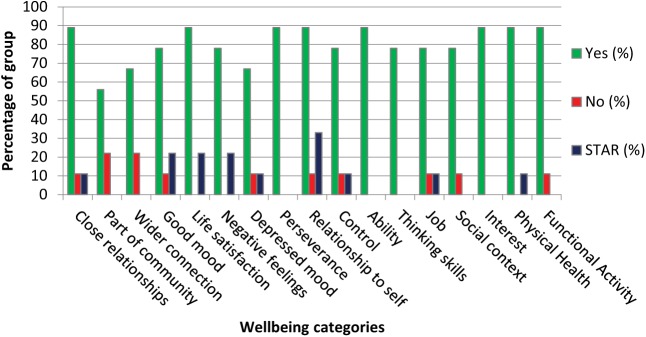
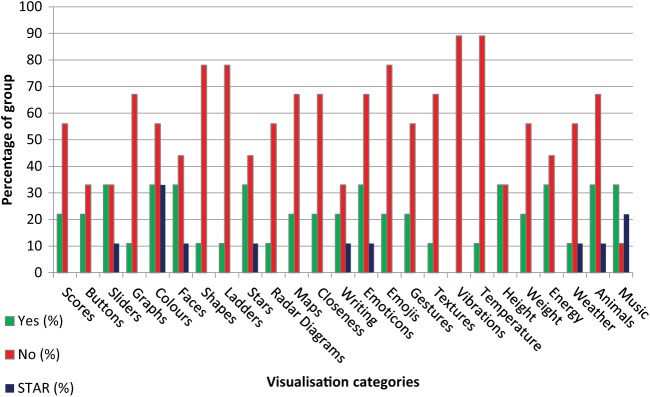
While participants concurred on a range of typical dimensions of wellbeing, the individual visualisations generated were in contrast to the techniques currently employed by existing digital wellbeing apps and there was a great diversity in preference for different visualisation types. Participants considered personal visualisations to be useful as self-administered interventions or as a step towards seeking help, as well as being tools for self-appraisal.
The results suggest that an authoring approach using existing apps may provide the high degree of flexibility required. Training on such tools, delivered via a module on a recovery college course, could be offered.
由 NewMind 网络资助的一个为期 10 个月的项目旨在开发一个可视化工具包的规范,该工具包可应用于数字平台(基于网络或应用程序),以支持有心理健康困难经历的成年人以多媒体格式呈现和跟踪他们的个人幸福感。
采用了来自英国设计委员会的参与者共同设计方法“双钻石”(Double Diamond),包括四个阶段:发现 - 对幸福感和健康可视化材料进行了一系列文献和应用程序搜索;定义 - 与有心理健康问题经历的参与者进行了一次初始研讨会,讨论幸福感和可视化技术,并分享个人可视化作品;开发 - 第二次研讨会,为个人可视化作品添加细节,例如要使用的媒体形式,分享的控制程度;以及交付 - 传播从该练习中获得的知识。
2017 年 12 月和 2018 年 4 月分别举行了两次设计研讨会,分别有 13 名和 12 名专家经验丰富的参与者参加,其中包括两名同行研究人员(共同作者)和每个研讨会中的两名个人照顾者对,两次研讨会都有超过 50%的人参加。总共制作了 20 个详细的可视化作品,其中大部分聚焦于高度个性化和详细的幸福感呈现。
虽然参与者就幸福感的一系列典型维度达成了一致,但生成的个人可视化作品与现有数字幸福感应用程序目前采用的技术形成了对比,并且对不同可视化类型的偏好存在很大差异。参与者认为个人可视化作品作为自我管理干预措施或寻求帮助的第一步很有用,也是自我评估的工具。
结果表明,使用现有应用程序的创作方法可能提供所需的高度灵活性。可以通过康复学院课程的模块提供此类工具的培训。