Lammerts van Bueren Edith T, Struik Paul C, van Eekeren Nick, Nuijten Edwin
Louis Bolk Institute, Kosterijland 3-5, 3981 AJ Bunnik, The Netherlands.
2Department of Plant Sciences, Wageningen UR Plant Breeding, Wageningen University and Research, P.O. Box 386, 6700 AJ Wageningen, The Netherlands.
Agron Sustain Dev. 2018;38(5):42. doi: 10.1007/s13593-018-0522-6. Epub 2018 Aug 22.
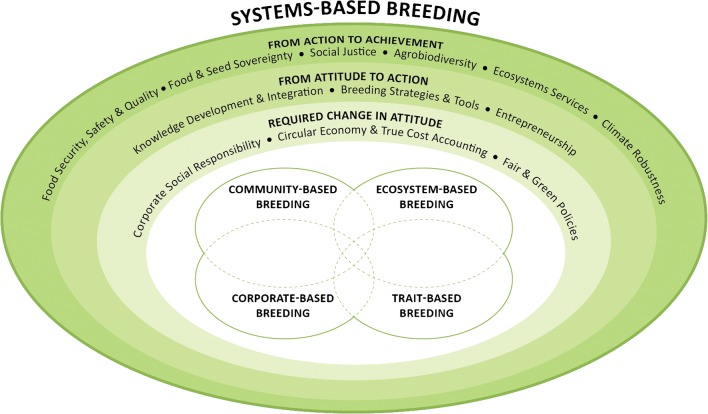
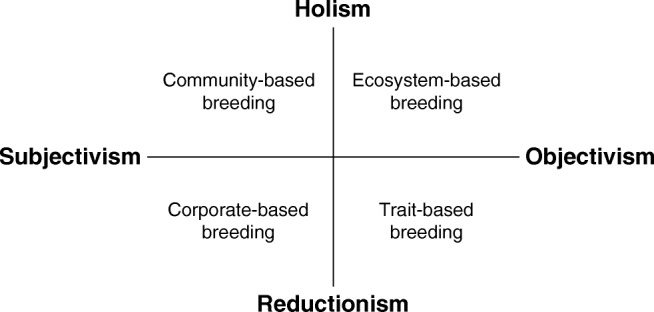
How the growing world population can feed itself is a crucial, multi-dimensional problem that goes beyond sustainable development. Crop production will be affected by many changes in its climatic, agronomic, economic, and societal contexts. Therefore, breeders are challenged to produce cultivars that strengthen both ecological and societal resilience by striving for six international sustainability targets: food security, safety and quality; food and seed sovereignty; social justice; agrobiodiversity; ecosystem services; and climate robustness. Against this background, we review the state of the art in plant breeding by distinguishing four paradigmatic orientations that currently co-exist: community-based breeding, ecosystem-based breeding, trait-based breeding, and corporate-based breeding, analyzing differences among these orientations. Our main findings are: (1) all four orientations have significant value but none alone will achieve all six sustainability targets; (2) therefore, an overarching approach is needed: "systems-based breeding," an orientation with the potential to synergize the strengths of the ways of thinking in the current paradigmatic orientations; (3) achieving that requires specific knowledge development and integration, a multitude of suitable breeding strategies and tools, and entrepreneurship, but also a change in attitude based on corporate responsibility, circular economy and true-cost accounting, and fair and green policies. We conclude that systems-based breeding can create strong interactions between all system components. While seeds are part of the common good and the basis of agrobiodiversity, a diversity in breeding approaches, based on different entrepreneurial approaches, can also be considered part of the required agrobiodiversity. To enable systems-based breeding to play a major role in creating sustainable agriculture, a shared sense of urgency is needed to realize the required changes in breeding approaches, institutions, regulations and protocols. Based on this concept of systems-based breeding, there are opportunities for breeders to play an active role in the development of an ecologically and societally resilient, sustainable agriculture.
不断增长的世界人口如何养活自己是一个至关重要的、多维度的问题,它超出了可持续发展的范畴。作物生产将受到其气候、农艺、经济和社会环境诸多变化的影响。因此,育种者面临着挑战,要通过努力实现六个国际可持续发展目标来培育出既能增强生态韧性又能增强社会韧性的品种:粮食安全、安全与质量;粮食和种子主权;社会正义;农业生物多样性;生态系统服务;以及气候稳健性。在此背景下,我们通过区分目前共存的四种范式取向来回顾植物育种的现状:基于社区的育种、基于生态系统的育种、基于性状的育种和基于企业的育种,并分析这些取向之间的差异。我们的主要发现是:(1)所有这四种取向都有重要价值,但没有一种能单独实现所有六个可持续发展目标;(2)因此,需要一种总体方法:“基于系统的育种”,这是一种有潜力将当前范式取向中的思维方式的优势协同起来的取向;(3)实现这一点需要特定的知识开发与整合、多种合适的育种策略和工具以及创业精神,还需要基于企业责任、循环经济和真实成本核算以及公平和绿色政策的态度转变。我们得出结论,基于系统的育种可以在所有系统组件之间创造强大的相互作用。虽然种子是公共利益的一部分和农业生物多样性的基础,但基于不同创业方法的育种方法多样性也可被视为所需农业生物多样性的一部分。为了使基于系统的育种能够在创造可持续农业方面发挥主要作用,需要有一种共同的紧迫感来实现育种方法、机构、法规和协议方面所需的变革。基于这种基于系统的育种概念,育种者有机会在发展生态和社会韧性强的可持续农业方面发挥积极作用。