de Sousa Kauê, van Etten Jacob, Manners Rhys, Abidin Erna, Abdulmalik Rekiya O, Abolore Bello, Acheremu Kwabena, Angudubo Stephen, Aguilar Amilcar, Arnaud Elizabeth, Babu Adventina, Barrios Mirna, Benavente Grecia, Boukar Ousmane, Cairns Jill E, Carey Edward, Daudi Happy, Dawud Maryam, Edughaen Gospel, Ellison James, Esuma Williams, Mohammed Sanusi Gaya, van de Gevel Jeske, Gomez Marvin, van Heerwaarden Joost, Iragaba Paula, Kadege Edith, Assefa Teshale M, Kalemera Sylvia, Kasubiri Fadhili Salum, Kawuki Robert, Kidane Yosef Gebrehawaryat, Kilango Michael, Kulembeka Heneriko, Kwadwo Adofo, Madriz Brandon, Masumba Ester, Mbiu Julius, Mendes Thiago, Müller Anna, Moyo Mukani, Mtunda Kiddo, Muzhingi Tawanda, Muungani Dean, Mwenda Emmanuel T, Nadigatla Ganga Rao V P R, Nanyonjo Ann Ritah, N'Danikou Sognigbé, Nduwumuremyi Athanase, Nshimiyimana Jean Claude, Nuwamanya Ephraim, Nyirahabimana Hyacinthe, Occelli Martina, Olaosebikan Olamide, Ongom Patrick Obia, Ortiz-Crespo Berta, Oteng-Fripong Richard, Ozimati Alfred, Owoade Durodola, Quiros Carlos F, Rosas Juan Carlos, Rukundo Placide, Rutsaert Pieter, Sibomana Milindi, Sharma Neeraj, Shida Nestory, Steinke Jonathan, Ssali Reuben, Suchini Jose Gabriel, Teeken Béla, Tengey Theophilus Kwabla, Tufan Hale Ann, Tumwegamire Silver, Tuyishime Elyse, Ulzen Jacob, Umar Muhammad Lawan, Onwuka Samuel, Madu Tessy Ugo, Voss Rachel C, Yeye Mary, Zaman-Allah Mainassara
Digital Inclusion, Bioversity International, Montpellier, France.
Department of Agricultural Sciences, Inland Norway University of Applied Sciences, Hamar, Norway.
Agron Sustain Dev. 2024;44(1):8. doi: 10.1007/s13593-023-00937-1. Epub 2024 Jan 25.
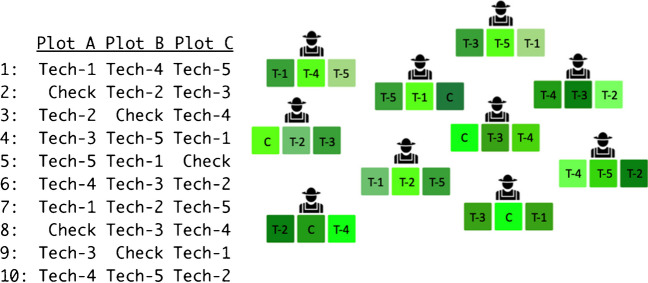
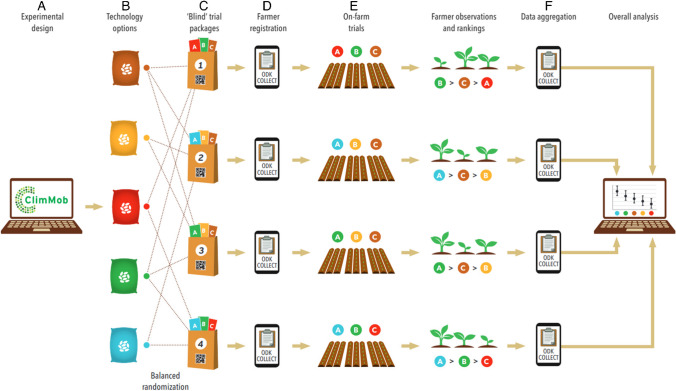
Matching crop varieties to their target use context and user preferences is a challenge faced by many plant breeding programs serving smallholder agriculture. Numerous participatory approaches proposed by CGIAR and other research teams over the last four decades have attempted to capture farmers' priorities/preferences and crop variety field performance in representative growing environments through experimental trials with higher external validity. Yet none have overcome the challenges of scalability, data validity and reliability, and difficulties in capturing socio-economic and environmental heterogeneity. Building on the strengths of these attempts, we developed a new data-generation approach, called (tricot). Tricot is a decentralized experimental approach supported by crowdsourced citizen science. In this article, we review the development, validation, and evolution of the tricot approach, through our own research results and reviewing the literature in which tricot approaches have been successfully applied. The first results indicated that tricot-aggregated farmer-led assessments contained information with adequate validity and that reliability could be achieved with a large sample. Costs were lower than current participatory approaches. Scaling the tricot approach into a large on-farm testing network successfully registered specific climatic effects of crop variety performance in representative growing environments. Tricot's recent application in plant breeding networks in relation to decision-making has (i) advanced plant breeding lines recognizing socio-economic heterogeneity, and (ii) identified consumers' preferences and market demands, generating alternative breeding design priorities. We review lessons learned from tricot applications that have enabled a large scaling effort, which should lead to stronger decision-making in crop improvement and increased use of improved varieties in smallholder agriculture.
使作物品种与其目标使用环境和用户偏好相匹配,是许多服务于小农户农业的植物育种项目所面临的一项挑战。在过去四十年里,国际农业研究磋商组织(CGIAR)和其他研究团队提出了许多参与式方法,试图通过具有更高外部效度的试验,在具有代表性的种植环境中捕捉农民的优先事项/偏好以及作物品种的田间表现。然而,没有一种方法能够克服可扩展性、数据有效性和可靠性方面的挑战,以及在捕捉社会经济和环境异质性方面的困难。基于这些尝试的优势,我们开发了一种新的数据生成方法,称为(tricot)。Tricot是一种由众包公民科学支持的分散式实验方法。在本文中,我们通过自己的研究结果并回顾成功应用tricots方法的文献,来审视tricots方法的发展、验证和演变。初步结果表明,由农民主导的tricots汇总评估包含有效性足够的信息,并且通过大样本可以实现可靠性。成本低于当前的参与式方法。将tricots方法扩展到一个大型的农场测试网络,成功记录了作物品种在代表性种植环境中的特定气候效应。Tricot最近在植物育种网络中与决策相关的应用,(i)推进了认识到社会经济异质性的植物育种系,(ii)确定了消费者的偏好和市场需求,产生了替代育种设计的优先事项。我们回顾了从tricots应用中吸取的经验教训,这些经验教训促成了大规模的推广努力,这应该会在作物改良方面带来更强有力的决策,并增加小农户农业中改良品种的使用。