Imperial College School of Medicine, London, UK.
NHLI Respiratory Sciences, Imperial College London, London, UK.
BMJ Open Respir Res. 2019 Mar 1;6(1):e000351. doi: 10.1136/bmjresp-2018-000351. eCollection 2019.
Assessment of performance status is an important component of clinical management of patients with pulmonary arteriovenous malformations (PAVMs). Usual methods are time-consuming and insensitive to variations within normal or supranormal exercise capacity.
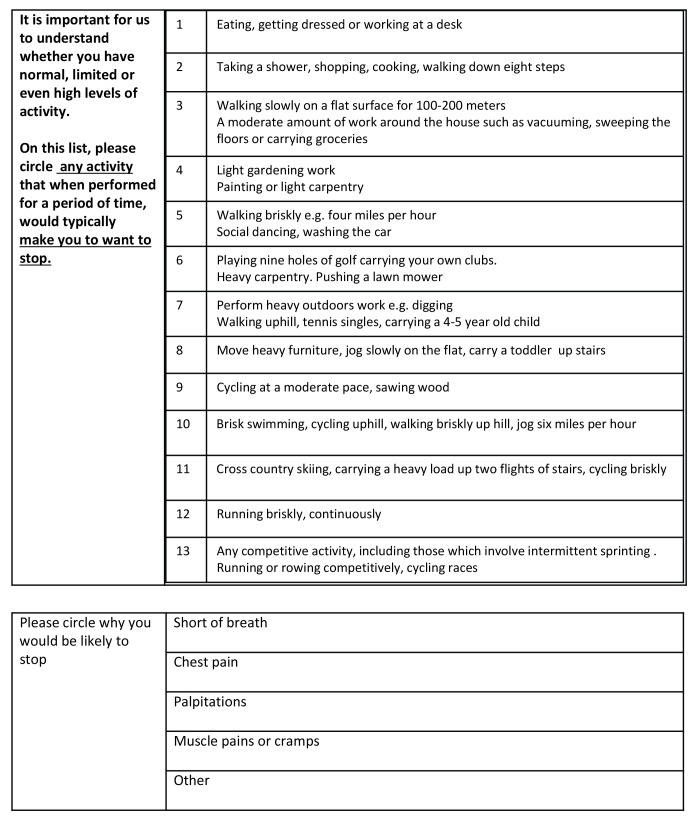
The Veterans Specific Activity Questionnaire (VSAQ) was modified to facilitate completion by patients independently. Patient-reported activity limitations were converted to the Medical Research Council (MRC) Dyspnoea Scale, New York Heart Association (NYHA) classification and metabolic equivalents (METs) in which 1 MET equals the consumption of 3.5 mL O per kilogram of body weight per minute.
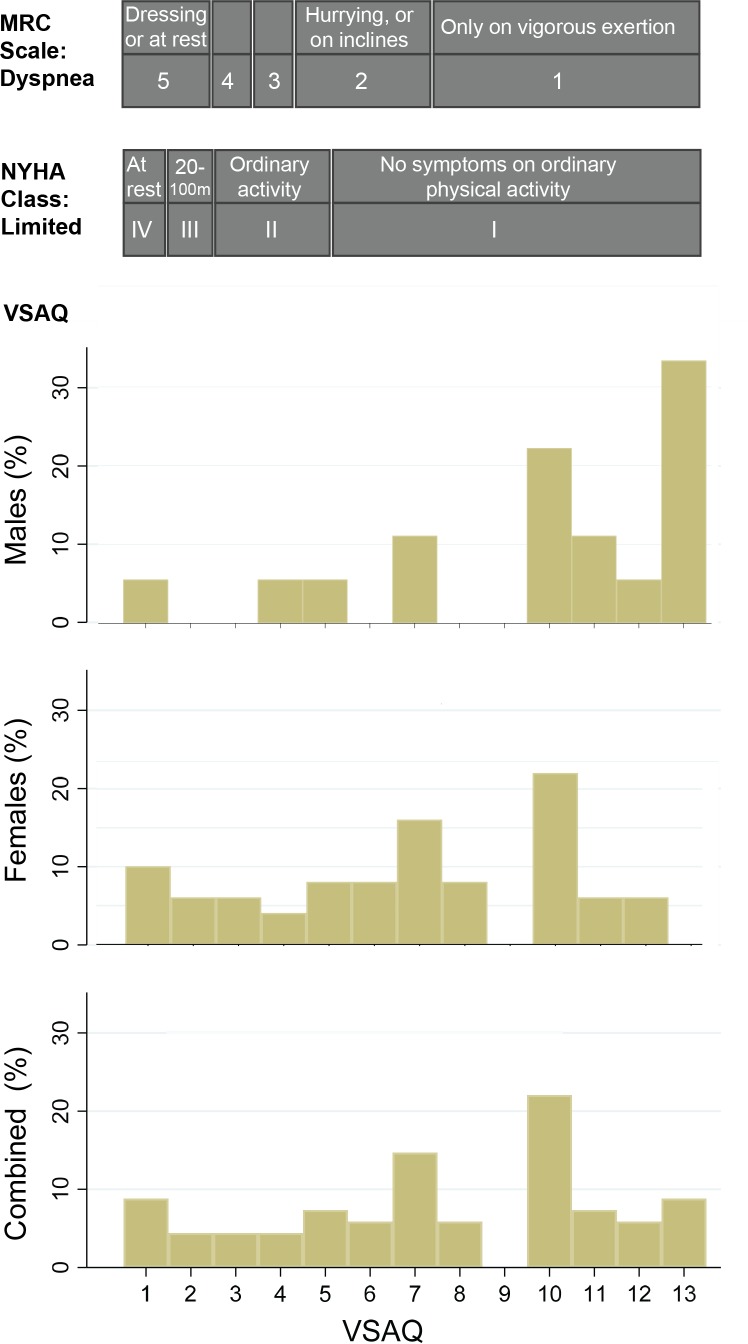
The study population consisted of 71 patients with PAVMs aged 20-85 (median 52) years. Oxygen saturation (SaO) was 80%-99.5 % (median 96%), and haemoglobin was 73-169 g/L in women and 123-197 g/L in men (p<0.0001). Arterial oxygen content (CaO) (1.34 × [haemoglobin × SaO]/100) was maintained unless iron deficiency was present. Most patients (49/71, 69%) did not need to stop until activities more energetic than walking briskly at 4 mph were achieved (6.4 km per hour, VSAQ >5, MRC Dyspnoea Scale 1 or 2, NYHA class I). SaO was inversely associated with the MRC Dyspnoea Scale and NYHA class, but not the VSAQ. Raw VSAQ scores captured a marked difference between men and women. METs were also higher in men at 3.97-15.55 (median 8.84) kcal/kg/min, compared with 1.33-14.4 (median 8.25) kcal/kg/min (p=0.0039). There was only a modest association between METs and SaO (p=0.044), but a stronger association between METs and haemoglobin (p =0.001). In crude and sex-adjusted regression, the CaO was more strongly associated with METs than either SaO or haemoglobin in isolation.
The VSAQ, capturing patient-reported outcome measures, is an efficient and quantifiable measure of exercise capacity that can be readily employed in clinical services particularly where patients have normal to high exercise tolerance. In the PAVM population, exercise capacity reflects haemoglobin and CaO more than SaO, even where SaO measurements are low.
评估体能状态是肺动静脉畸形(PAVM)患者临床管理的重要组成部分。常用方法耗时且对正常或高于正常运动能力范围内的变化不敏感。
对退伍军人专用活动问卷(VSAQ)进行了修改,以便患者能够独立完成。患者报告的活动受限情况转换为医学研究委员会(MRC)呼吸困难量表、纽约心脏协会(NYHA)分类和代谢当量(METs),其中 1 MET 等于每公斤体重每分钟消耗 3.5 毫升氧气。
研究人群包括 71 名年龄在 20-85 岁(中位数 52 岁)的 PAVM 患者。氧饱和度(SaO)为 80%-99.5%(中位数 96%),女性血红蛋白为 73-169g/L,男性血红蛋白为 123-197g/L(p<0.0001)。除非存在缺铁,否则动脉氧含量(CaO)(1.34×[血红蛋白×SaO]/100)将保持不变。大多数患者(49/71,69%)在达到比快走 4 英里/小时更剧烈的活动之前无需停止(6.4 公里/小时,VSAQ>5,MRC 呼吸困难量表 1 或 2,NYHA 心功能 I 级)。SaO 与 MRC 呼吸困难量表和 NYHA 分级呈负相关,但与 VSAQ 无关。原始 VSAQ 评分在男性和女性之间存在显著差异。男性的 MET 也较高,为 3.97-15.55(中位数 8.84)千卡/公斤/分钟,而女性为 1.33-14.4(中位数 8.25)千卡/公斤/分钟(p=0.0039)。MET 与 SaO 之间仅存在适度关联(p=0.044),但与血红蛋白之间存在更强的关联(p=0.001)。在未校正和校正性别后,与 SaO 或血红蛋白相比,CaO 与 MET 之间的相关性更强。
VSAQ 可捕获患者报告的结果测量指标,是一种高效且可量化的运动能力测量方法,可在临床服务中广泛应用,特别是在患者具有正常或较高运动耐量的情况下。在 PAVM 人群中,运动能力反映了血红蛋白和 CaO ,而不是 SaO ,即使 SaO 测量值较低。