Tan Cedric Chih Shen, Maurer-Stroh Sebastian, Wan Yue, Sessions October Michael, de Sessions Paola Florez
Genome Institute of Singapore (GIS), Agency for Science, Technology and Research (A*STAR), Singapore, Singapore.
A*STAR Graduate Academy, Singapore, Singapore.
AMB Express. 2019 Apr 8;9(1):45. doi: 10.1186/s13568-019-0772-y.
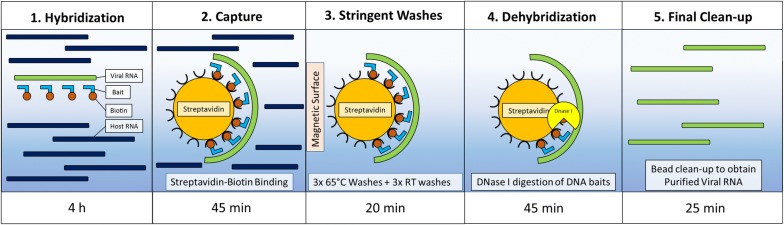
Current technologies for targeted characterization and manipulation of viral RNA primarily involve amplification or ultracentrifugation with isopycnic gradients of viral particles to decrease host RNA background. The former strategy is non-compatible for characterizing properties innate to RNA strands such as secondary structure, RNA-RNA interactions, and also for nanopore direct RNA sequencing involving the sequencing of native RNA strands. The latter strategy, ultracentrifugation, causes loss in genomic information due to its inability to retrieve unassembled viral RNA. To address this, we developed a novel application of current nucleic acid hybridization technologies for direct characterization of RNA. In particular, we modified a current enrichment protocol to capture whole viral native RNA genomes for downstream RNA assays to circumvent the abovementioned problems. This technique involves hybridization of biotinylated baits at 500 nucleotides (nt) intervals, stringent washes and release of free native RNA strands using DNase I treatment, with a turnaround time of about 6 h 15 min. RT-qPCR was used as the primary proof of concept that capture-based purification indeed removes host background. Subsequently, capture-based purification was applied to direct RNA sequencing as proof of concept that capture-based purification can be coupled with downstream RNA assays. We report that this protocol was able to successfully purify viral RNA by 561- to 791-fold. We also report that application of this protocol to direct RNA sequencing yielded a reduction in human host RNA background by 1580-fold, a 99.91% recovery of viral genome with at least 15× coverage, and a mean coverage across the genome of 120×. This report is, to the best of our knowledge, the first description of a capture-based purification method for assays that involve direct manipulation or characterisation of native RNA. This report also describes a successful application of capture-based purification as a direct RNA sequencing strategy that addresses certain limitations of current strategies in sequencing RNA viral genomes.
目前用于靶向表征和操纵病毒RNA的技术主要包括扩增或采用病毒颗粒的等密度梯度超速离心法,以降低宿主RNA背景。前一种策略不适用于表征RNA链固有的特性,如二级结构、RNA-RNA相互作用,也不适用于涉及天然RNA链测序的纳米孔直接RNA测序。后一种策略,即超速离心,由于无法获取未组装的病毒RNA,会导致基因组信息丢失。为了解决这个问题,我们开发了一种当前核酸杂交技术的新应用,用于直接表征RNA。具体而言,我们修改了当前的富集方案,以捕获完整的病毒天然RNA基因组,用于下游RNA分析,从而规避上述问题。该技术包括以500个核苷酸(nt)的间隔杂交生物素化诱饵,进行严格洗涤,并使用DNase I处理释放游离的天然RNA链,周转时间约为6小时15分钟。RT-qPCR被用作基于捕获的纯化确实能去除宿主背景的主要概念验证。随后,基于捕获的纯化被应用于直接RNA测序,作为基于捕获的纯化可以与下游RNA分析相结合的概念验证。我们报告称,该方案能够成功地将病毒RNA纯化561至791倍。我们还报告称,将该方案应用于直接RNA测序可使人类宿主RNA背景降低1580倍,病毒基因组回收率达到99.91%,至少有15倍覆盖度,全基因组平均覆盖度为120倍。据我们所知,本报告首次描述了一种用于涉及直接操纵或表征天然RNA的分析的基于捕获的纯化方法。本报告还描述了基于捕获的纯化作为一种直接RNA测序策略的成功应用,该策略解决了当前RNA病毒基因组测序策略的某些局限性。