Department of Emergency Medicine, School of Medicine, Kyungpook National University, Daegu, South Korea.
Department of Emergency Medicine, School of Medicine, Kyungpook National University, Kyungpook National University Hospital, Daegu, South Korea.
PLoS One. 2019 Apr 9;14(4):e0214205. doi: 10.1371/journal.pone.0214205. eCollection 2019.
This study aimed to show the epidemiological characteristics and the difference in the risk factors and types of collision between older and younger drivers in Korea.
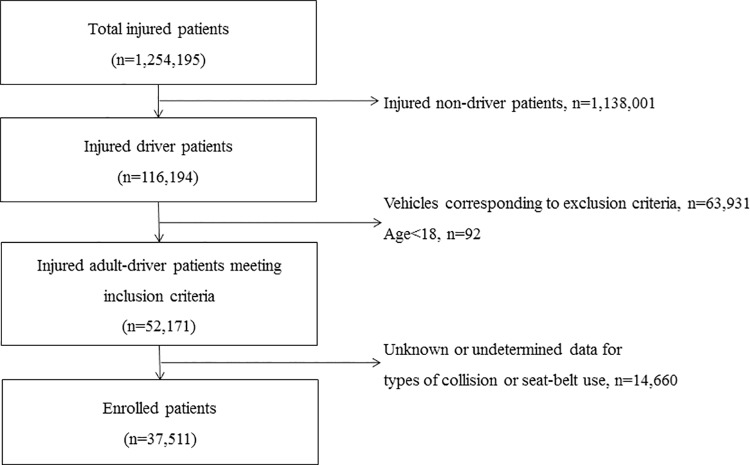
We collected data from the Emergency Department-based Injury In-depth Surveillance retrieved by the Korea Centers for Disease Control and Prevention from 2011 to 2015. We included injured drivers aged ≥ 18 years who were registered in the database, who were limited to drivers of four-wheeled vehicles. The enrolled patients were divided according to age into older (≥ 65 years) and younger (< 65 years) drivers. The total number of enrolled drivers was 37,511; 2,361 (6.3%) of them were older drivers. The epidemiological characteristics (e.g., age, sex, fatality rate) of traffic collision victims for 5 years were determined, and the risk factors (e.g., seat belt use) and types of collision (single- vs. multi-vehicle) between the two groups were compared.
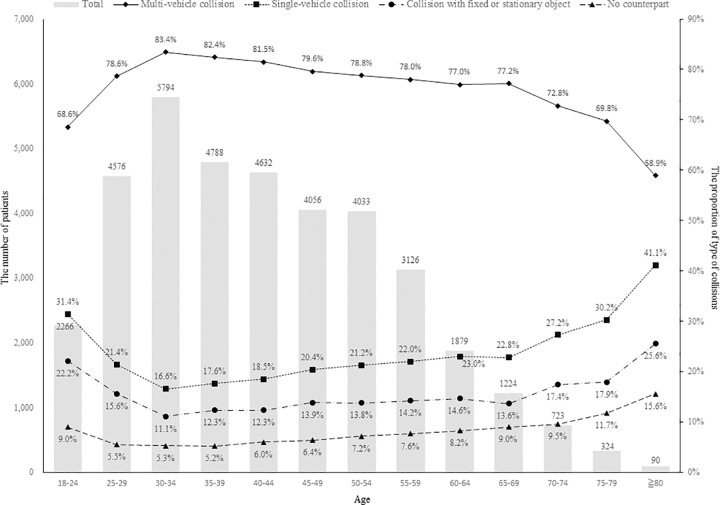
The median age and interquartile range (IQR; 25th and 75th percentiles) of all drivers were 41.0 (IQR, 32.0-52.0), and 24,544 (65.4%) of them were men. The median age increased from 40.0 (IQR, 31.0-50.0) to 43.0 (IQR, 33.0-54.0) between 2010 and 2015 (P < 0.001). The proportion of older drivers increased from 5.0% to 8.4% annually during the study period (P < 0.001). Between 2010 and 2015, the fatality rate decreased from 3.1% to 1.2% (P = 0.287) for older drivers and from 0.9% to 0.5% (P = 0.009) for younger drivers. The proportion of single-vehicle collision (25.9% vs. 20.3%) was higher in older than in younger drivers (P < 0.001). Older drivers had a lower rate of seat-belt use than younger drivers (79.0% vs. 83.0%, P < 0.001).
The proportion of older drivers increased annually during the study period, and older drivers experienced more single-vehicle collision and used seat belt less frequently than younger drivers. A national policy support to reduce traffic collision in older drivers and public relation activities to enhance their seat belt use should be strengthened in the future.
本研究旨在展示韩国老年和年轻驾驶员交通事故的流行病学特征,以及风险因素和碰撞类型的差异。
我们从韩国疾病控制和预防中心的急救部伤害深入监测数据库中收集了 2011 年至 2015 年的数据。我们纳入了数据库中登记的年龄≥18 岁的受伤驾驶员,这些驾驶员仅限于四轮车辆驾驶员。根据年龄将纳入的患者分为老年(≥65 岁)和年轻(<65 岁)驾驶员。共纳入 37511 名驾驶员;其中 2361 名(6.3%)为老年驾驶员。确定了 5 年内交通碰撞受害者的流行病学特征(例如年龄、性别、死亡率),并比较了两组之间的风险因素(例如安全带使用情况)和碰撞类型(单车对多车)。
所有驾驶员的中位年龄和四分位间距(IQR;25%和 75%分位数)为 41.0(IQR,32.0-52.0),其中 24544 名(65.4%)为男性。2010 年至 2015 年间,所有驾驶员的中位年龄从 40.0(IQR,31.0-50.0)增加到 43.0(IQR,33.0-54.0)(P<0.001)。老年驾驶员的比例从研究期间每年 5.0%增加到 8.4%(P<0.001)。2010 年至 2015 年间,老年驾驶员的死亡率从 3.1%降至 1.2%(P=0.287),年轻驾驶员的死亡率从 0.9%降至 0.5%(P=0.009)。与年轻驾驶员相比,老年驾驶员单车碰撞的比例更高(25.9%对 20.3%)(P<0.001)。老年驾驶员安全带使用率低于年轻驾驶员(79.0%对 83.0%)(P<0.001)。
研究期间老年驾驶员的比例逐年增加,与年轻驾驶员相比,老年驾驶员单车碰撞更多,安全带使用频率更低。未来应加强国家政策支持,减少老年驾驶员的交通事故,并开展公共关系活动,提高他们对安全带的使用意识。