Department of Internal Medicine, Tri-Service General Hospital Songshan Branch, Taipei, Taiwan, Republic of China.
Division of Family Medicine, Department of Family and Community Medicine, Tri-Service General Hospital, School of Medicine, National Defense Medical Center, Taipei, Taiwan, Republic of China.
PLoS One. 2019 Apr 9;14(4):e0214994. doi: 10.1371/journal.pone.0214994. eCollection 2019.
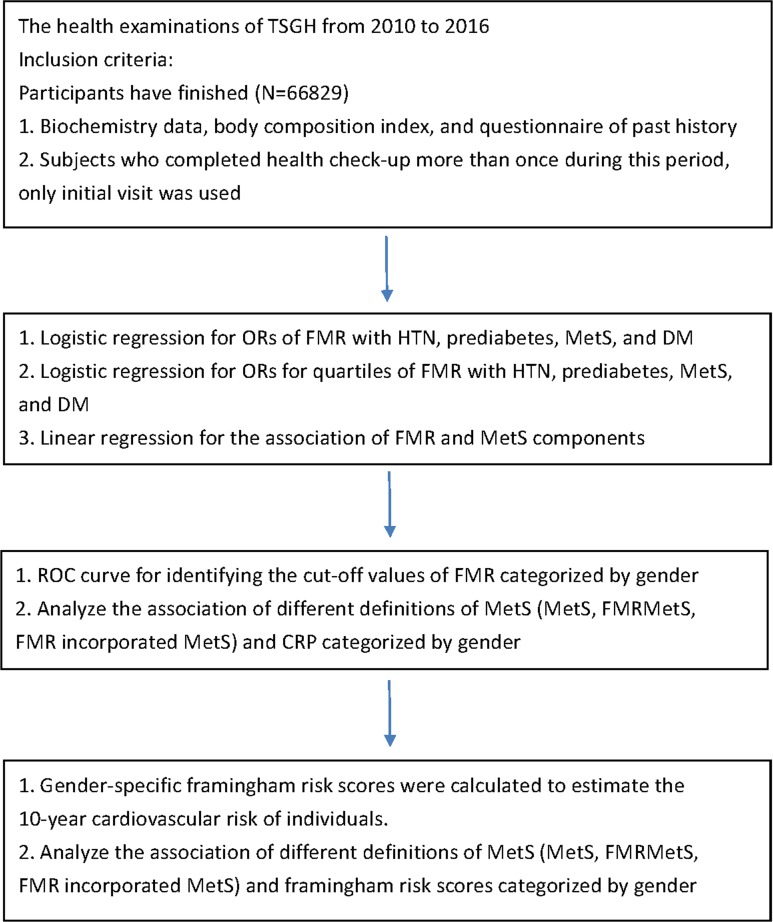
Metabolic disorders are prevalent worldwide and have recently become public health problems recently. Previous studies have proposed different body composition indices for predicting future cardiovascular risks. We hypothesized an association among fat-to-muscle ratio (FMR), metabolic syndrome (MetS), hypertension (HTN), prediabetes, type 2 diabetes mellitus (DM), and cardiovascular risk in an adult population. A total of 66829 eligible subjects composed of 34182 males and 32647 females aged 20 years or older were obtained from health examinations in the Tri-Service General Hospital from 2011 to 2017. The body composition indices included fat and muscle mass measured by bioelectrical impedance analysis. A multivariable regression model was performed in a large population-based cross-sectional study. FMR was significantly associated with MetS, prediabetes, DM and HTN in all models of both genders. Based on quartile analysis, higher FMR had higher predictive ability for adverse health outcomes. The association between different definitions of MetS and the Framingham risk score was analyzed, and FMR-incorporated MetS was more useful for predicting higher Framingham risk scores than traditional definitions. FMR was a useful indicator for the presence of adverse cardiometabolic risks. Compared to traditional definition of MetS, FMR-incorporated MetS had a greater ability to predict incident cardiovascular risks. FMR seemed to be a simple and effective index for the early prevention and management of cardiometabolic events.
代谢紊乱在全球范围内普遍存在,最近已成为公共卫生问题。先前的研究提出了不同的身体成分指数来预测未来的心血管风险。我们假设脂肪与肌肉比率(FMR)、代谢综合征(MetS)、高血压(HTN)、糖尿病前期、2 型糖尿病(DM)与成年人的心血管风险之间存在关联。从 2011 年至 2017 年,从三军总医院的健康检查中获得了总共 66829 名符合条件的受试者,其中包括 34182 名男性和 32647 名女性,年龄在 20 岁或以上。身体成分指数包括通过生物电阻抗分析测量的脂肪和肌肉量。在一项基于人群的大型横断面研究中进行了多变量回归模型。在所有性别模型中,FMR 与 MetS、糖尿病前期、DM 和 HTN 均显着相关。根据四分位分析,较高的 FMR 对不良健康结果具有更高的预测能力。分析了不同 MetS 定义与弗雷明汉风险评分之间的关系,并且 FMR 纳入的 MetS 比传统定义更有助于预测更高的弗雷明汉风险评分。FMR 是不良心脏代谢风险存在的有用指标。与 MetS 的传统定义相比,FMR 纳入的 MetS 具有更大的预测心血管风险的能力。FMR 似乎是心脏代谢事件早期预防和管理的简单有效指标。