Goseki Raita, Ito Shotaro, Matsuo Yuri, Higashihara Tomoya, Hirao Akira
Polymeric and Organic Materials Department, Graduate School of Science and Engineering, Tokyo Institute of Technology, 2-12-1, Ohokayama, Meguro-ku, Tokyo 152-8552, Japan.
Department of Chemical Science and Engineering, School of Materials Chemistry and Technology, Tokyo Institute of Technology, 2-12-1, Ohokayama, Meguro-ku, Tokyo 152-8552, Japan.
Polymers (Basel). 2017 Sep 25;9(10):470. doi: 10.3390/polym9100470.
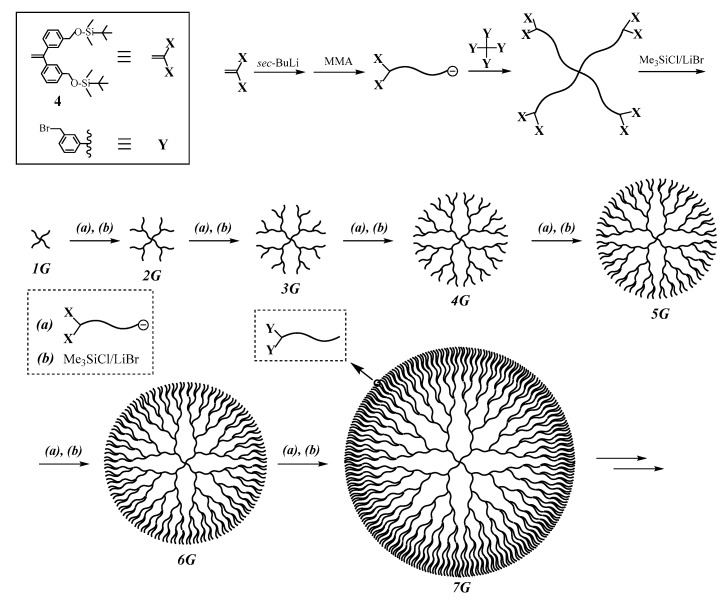
This article reviews the development of a novel all-around iterative methodology combining living anionic polymerization with specially designed linking chemistry for macromolecular architecture syntheses. The methodology is designed in such a way that the same reaction site is always regenerated after the polymer chain is introduced in each reaction sequence, and this "polymer chain introduction and regeneration of the same reaction site" sequence is repeatable. Accordingly, the polymer chain can be successively and, in principle, limitlessly introduced to construct macromolecular architectures. With this iterative methodology, a variety of synthetically difficult macromolecular architectures, i.e., multicomponent μ-star polymers, high generation dendrimer-like hyperbranched polymers, exactly defined graft polymers, and multiblock polymers having more than three blocks, were successfully synthesized.
本文综述了一种新型的全方位迭代方法的发展,该方法将活性阴离子聚合与专门设计的连接化学相结合用于高分子结构的合成。该方法的设计方式是,在每个反应序列中引入聚合物链后,相同的反应位点总是会再生,并且这种“聚合物链引入和相同反应位点再生”的序列是可重复的。因此,聚合物链可以连续地、原则上无限地引入以构建高分子结构。通过这种迭代方法,成功合成了多种合成难度较大的高分子结构,即多组分μ-星型聚合物、高代数树枝状超支化聚合物、精确确定的接枝聚合物以及具有三个以上嵌段的多嵌段聚合物。