Boden Sophia, Wagner Kristina G, Karg Matthias, Hartmann Laura
Institute of Organic Chemistry and Macromolecular Chemistry, Heinrich-Heine-University Düsseldorf, Universitätsstraße 1, 40225 Düsseldorf, Germany.
Institute of Physical Chemistry, Heinrich-Heine-University Düsseldorf, Universitätsstraße 1, 40225 Düsseldorf, Germany.
Polymers (Basel). 2017 Dec 14;9(12):716. doi: 10.3390/polym9120716.
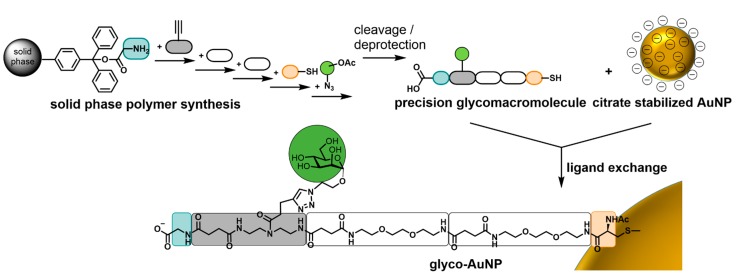
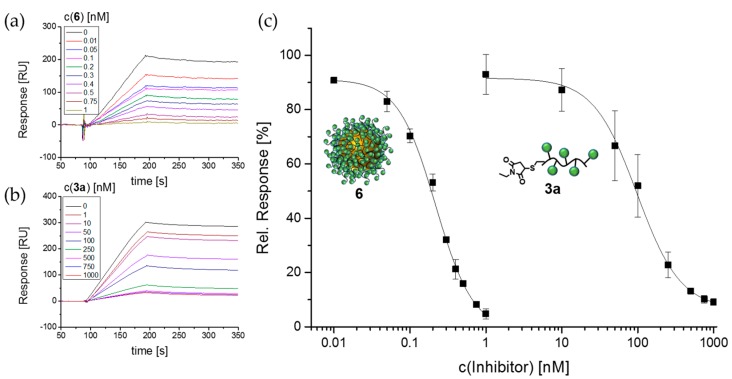
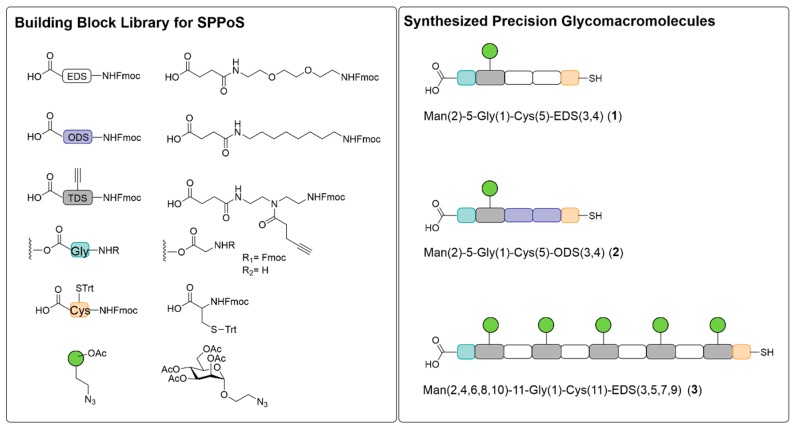
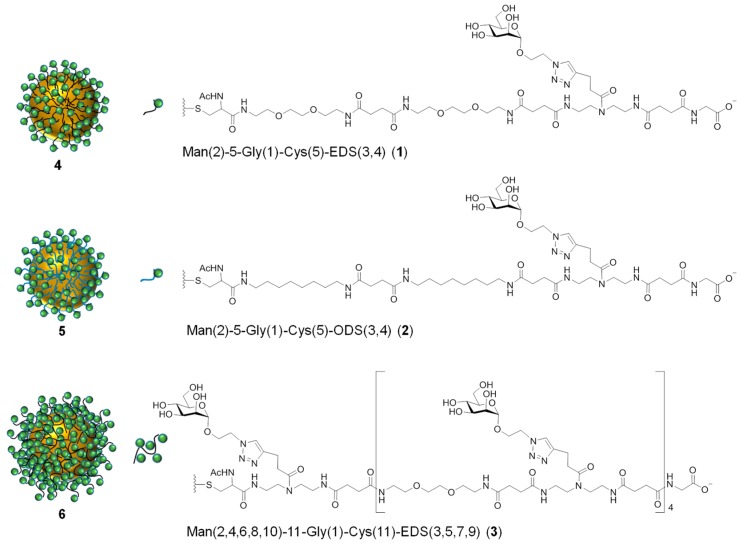
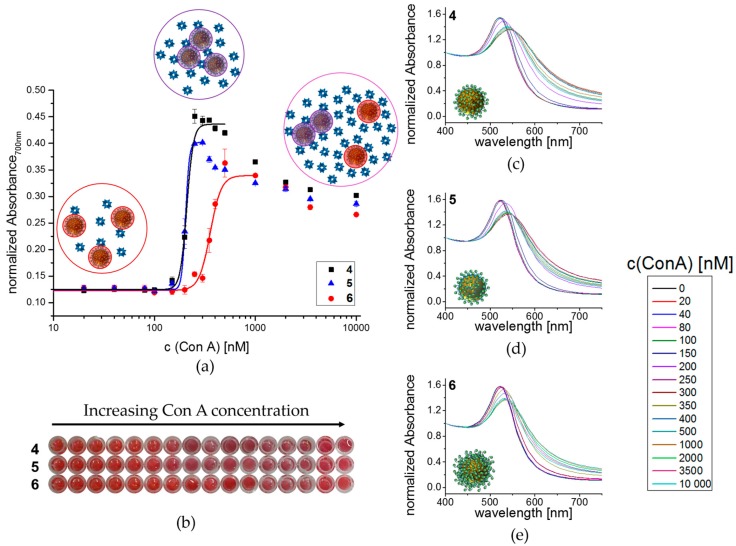
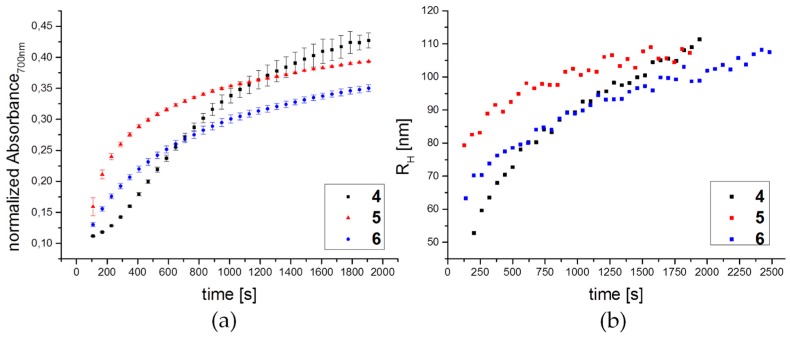
Glyco-functionalized gold nanoparticles have great potential as biosensors and as inhibitors due to their increased binding to carbohydrate-recognizing receptors such as the lectins. Here we apply previously developed solid phase polymer synthesis to obtain a series of precision glycomacromolecules that allows for straightforward variation of their chemical structure as well as functionalization of gold nanoparticles by ligand exchange. A novel building block is introduced allowing for the change of spacer building blocks within the macromolecular scaffold going from an ethylene glycol unit to an aliphatic spacer. Furthermore, the valency and overall length of the glycomacromolecule is varied. All glyco-functionalized gold nanoparticles show high degree of functionalization along with high stability in buffer solution. Therefore, a series of measurements applying UV-Vis spectroscopy, dynamic light scattering (DLS) and surface plasmon resonance (SPR) were performed studying the aggregation behavior of the glyco-functionalized gold nanoparticles in presence of model lectin Concanavalin A. While the multivalent presentation of glycomacromolecules on gold nanoparticles (AuNPs) showed a strong increase in binding compared to the free ligands, we also observed an influence of the chemical structure of the ligand such as its valency or hydrophobicity on the resulting lectin interactions. The straightforward variation of the chemical structure of the precision glycomacromolecule thus gives access to tailor-made glyco-gold nanoparticles (glyco-AuNPs) and fine-tuning of their lectin binding properties.
糖功能化金纳米颗粒作为生物传感器和抑制剂具有巨大潜力,因为它们与诸如凝集素等碳水化合物识别受体的结合能力增强。在这里,我们应用先前开发的固相聚合物合成方法来获得一系列精密糖大分子,这些分子能够直接改变其化学结构,并通过配体交换对金纳米颗粒进行功能化。引入了一种新型构建单元,使得在大分子支架内的间隔构建单元能够从乙二醇单元转变为脂肪族间隔基团。此外,糖大分子的价态和总长度也有所变化。所有糖功能化金纳米颗粒都表现出高度的功能化以及在缓冲溶液中的高稳定性。因此,我们进行了一系列运用紫外可见光谱、动态光散射(DLS)和表面等离子体共振(SPR)的测量,研究了糖功能化金纳米颗粒在模型凝集素伴刀豆球蛋白A存在下的聚集行为。虽然与游离配体相比,糖大分子在金纳米颗粒(AuNPs)上的多价呈现显示出结合力的显著增强,但我们也观察到配体的化学结构,如其价态或疏水性,对凝集素相互作用产生的影响。精密糖大分子化学结构的直接变化从而能够获得定制的糖金纳米颗粒(glyco-AuNPs),并对其凝集素结合特性进行微调。