Raik Sergei V, Andranovitš Stanislav, Petrova Valentina A, Xu Yingying, Lam Jenny Ka-Wing, Morris Gordon A, Brodskaia Alexandra V, Casettari Luca, Kritchenkov Andreii S, Skorik Yury A
Institute of Macromolecular Compounds of the Russian Academy of Sciences, Bolshoi pr. VO 31, St. Petersburg 199004, Russia.
Institute of Chemistry, St. Petersburg State University, Universitetskii pr. 26, Petrodvorets, St. Petersburg 198504, Russia.
Polymers (Basel). 2018 Apr 14;10(4):442. doi: 10.3390/polym10040442.
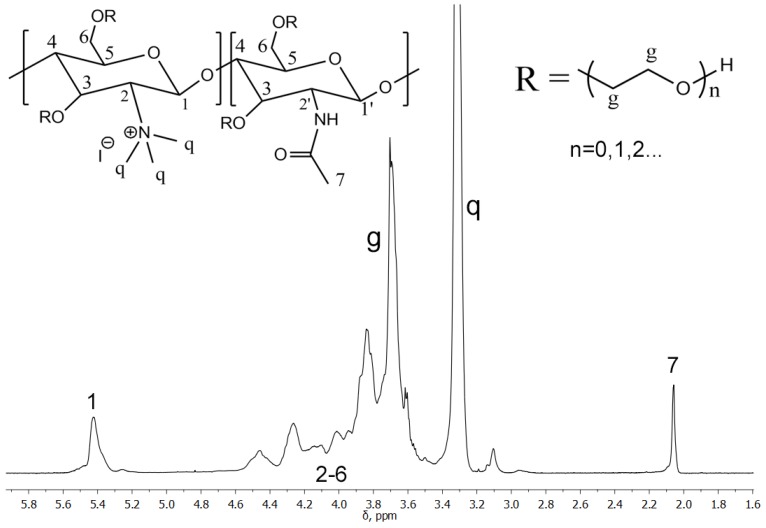
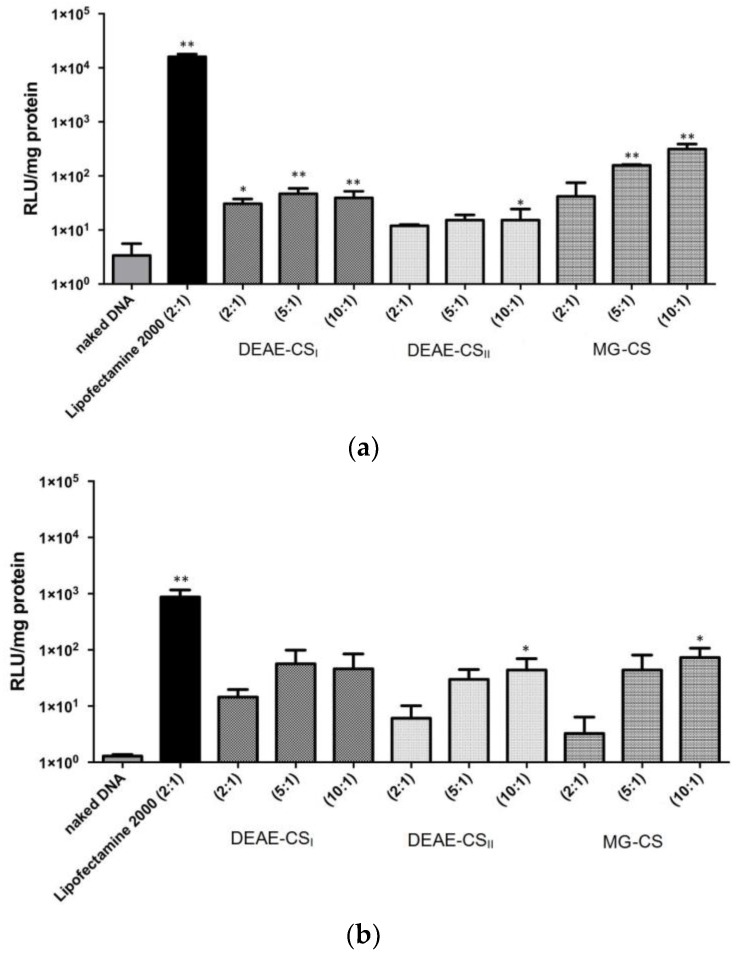
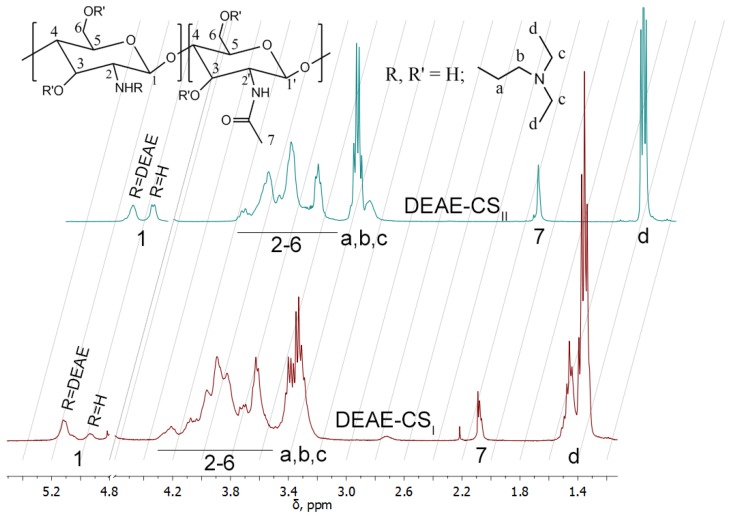
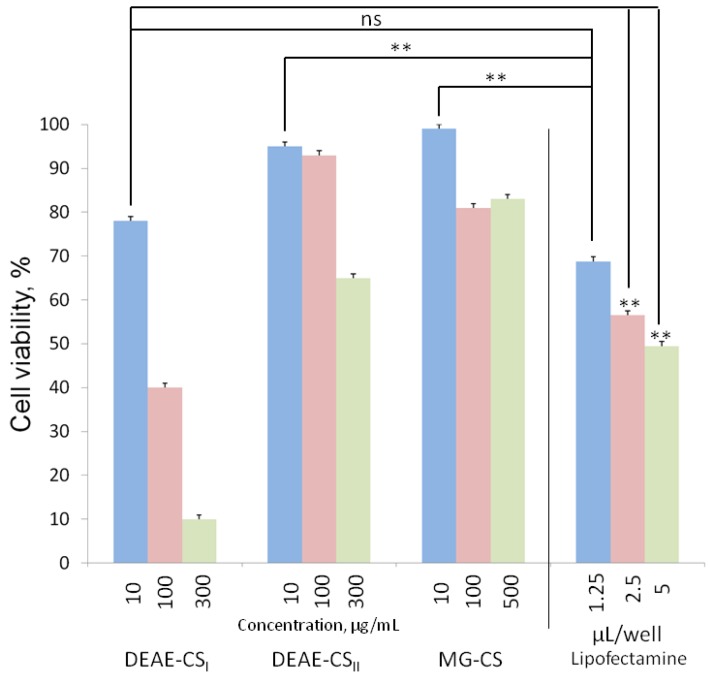
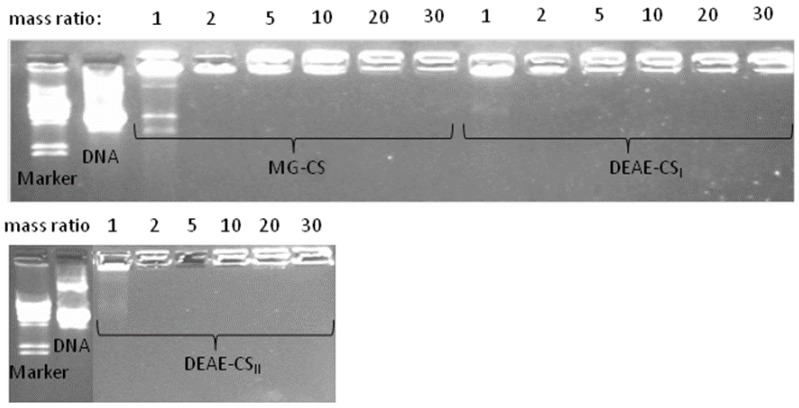
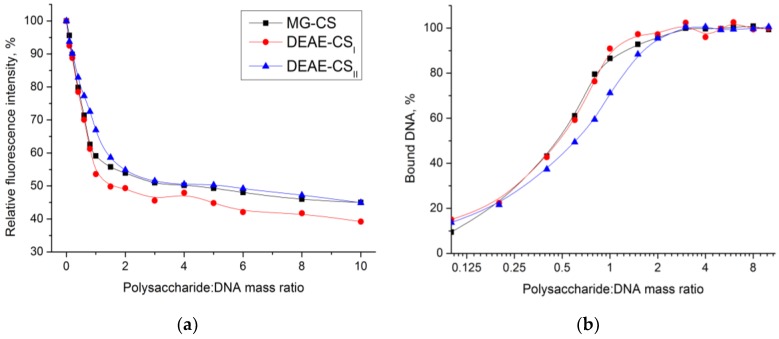
In this paper, we compared the transfection efficiency and cytotoxicity of methylglycol-chitosan (MG-CS) and diethylaminoethyl-chitosan (DEAE-CS and DEAE-CS with degrees of substitution of 1.2 and 0.57, respectively) to that of Lipofectamine (used as a reference transfection vector). MG-CS contains quaternary amines to improve DNA binding, whereas the DEAE-CS exhibits pH buffering capability that would ostensibly enhance transfection efficiency by promoting endosomal escape. Gel retardation assays showed that both DEAE-CS and MG-CS bound to DNA at a polysaccharide:DNA mass ratio of 2:1. In Calu-3 cells, the DNA transfection activity was significantly better with MG-CS than with DEAE-CS, and the efficiency improved with increasing polysaccharide:DNA ratios. By contrast, the efficiency of DEAE-CS and DEAE-CS was independent of the polysaccharide:DNA ratio. Conversely, in the transfection-recalcitrant JAWSII cells, both Lipofectamine and MG-CS showed significantly lower DNA transfection activity than in Calu-3 cells, whereas the efficiency of DEAE-CS and DEAE-CS was similar in both cell lines. The toxicity of DEAE-CS increased with increasing concentrations of the polymer and its degree of substitution, whereas MG-CS demonstrated negligible cytotoxicity, even at the highest concentration studied. Overall, MG-CS proved to be a more efficient and less toxic transfection agent when compared to DEAE-CS.
在本文中,我们将甲基乙二醇壳聚糖(MG-CS)和二乙氨基乙基壳聚糖(DEAE-CS,其取代度分别为1.2和0.57)的转染效率和细胞毒性与脂质体转染试剂(用作参考转染载体)进行了比较。MG-CS含有季铵盐以改善DNA结合,而DEAE-CS具有pH缓冲能力,表面上可通过促进内体逃逸来提高转染效率。凝胶阻滞试验表明,在多糖与DNA质量比为2:1时,DEAE-CS和MG-CS均能与DNA结合。在Calu-3细胞中,MG-CS的DNA转染活性明显优于DEAE-CS,且随着多糖与DNA比例的增加效率提高。相比之下,DEAE-CS的效率与多糖与DNA的比例无关。相反,在转染抗性的JAWSII细胞中,脂质体转染试剂和MG-CS的DNA转染活性均显著低于Calu-3细胞,而DEAE-CS在两种细胞系中的效率相似。DEAE-CS的毒性随着聚合物浓度及其取代度的增加而增加,而MG-CS即使在研究的最高浓度下也显示出可忽略不计的细胞毒性。总体而言,与DEAE-CS相比,MG-CS被证明是一种更高效且毒性更小的转染试剂。