Riley Michael K, Vermerris Wilfred
Graduate Program in Plant Cellular and Molecular Biology, University of Florida, Gainesville, FL 32611, USA.
UF Genetics Institute, University of Florida, Gainesville, FL 32611, USA.
Nanomaterials (Basel). 2017 Apr 28;7(5):94. doi: 10.3390/nano7050094.
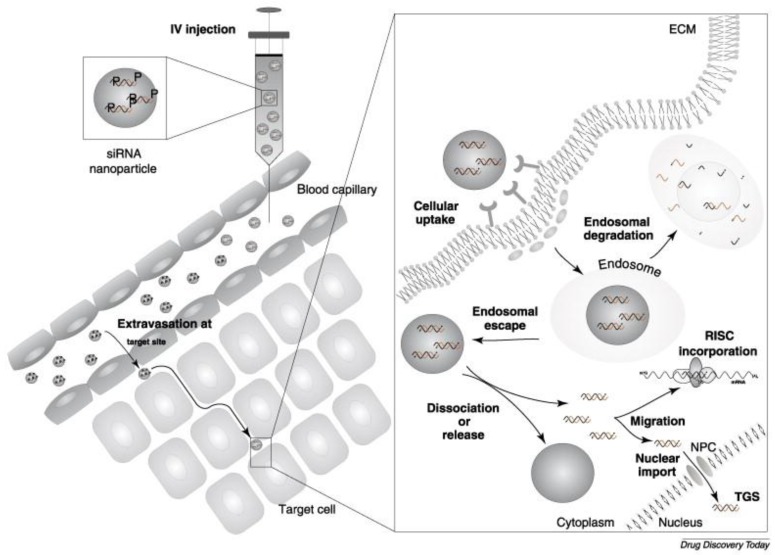
With the rapid development of nanotechnology in the recent decade, novel DNA and RNA delivery systems for gene therapy have become available that can be used instead of viral vectors. These non-viral vectors can be made of a variety of materials, including inorganic nanoparticles, carbon nanotubes, liposomes, protein and peptide-based nanoparticles, as well as nanoscale polymeric materials. They have as advantages over viral vectors a decreased immune response, and additionally offer flexibility in design, allowing them to be functionalized and targeted to specific sites in a biological system with low cytotoxicity. The focus of this review is to provide an overview of novel nanotechnology-based methods to deliver DNA and small interfering RNAs into biological systems.
近十年来,随着纳米技术的迅速发展,用于基因治疗的新型DNA和RNA递送系统已可用于替代病毒载体。这些非病毒载体可由多种材料制成,包括无机纳米颗粒、碳纳米管、脂质体、基于蛋白质和肽的纳米颗粒以及纳米级聚合物材料。它们相对于病毒载体具有免疫反应降低的优势,并且在设计上具有灵活性,使其能够被功能化并靶向生物系统中的特定部位,同时细胞毒性较低。本综述的重点是概述基于纳米技术的将DNA和小干扰RNA递送至生物系统的新方法。