Kulshrestha Vikas, Datta Barun, Mittal Gaurav, Kumar Santhosh
Joint Replacement Centre, Army Hospital Research and Referral, New Delhi, India.
Indian J Orthop. 2019 Mar-Apr;53(2):282-288. doi: 10.4103/ortho.IJOrtho_127_17.
There has been a gradual increase in the revision TKA (RTKA) workload due to expanding indications of total knee arthroplasty (TKA), coupled with improving patient longevity. Western countries are already looking at their data on RTKA to plan for the future heath care needs of these patients. Limited data is available on RTKA from developing countries. Our study attempts to fill this gap in knowledge.
We prospectively documented details of all RTKA performed at our centre for a period of six years (2011-16). We recorded the volume, causes and time to failure from index surgery of all RTKA and further recorded microbiological pattern in septic failures. We looked at the proportion of each cause of failure and time from index surgery.
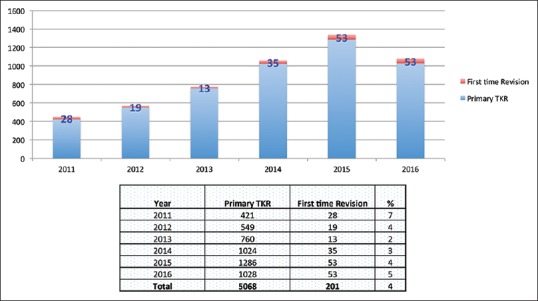
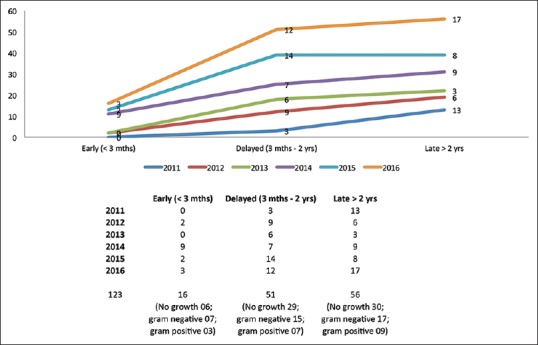
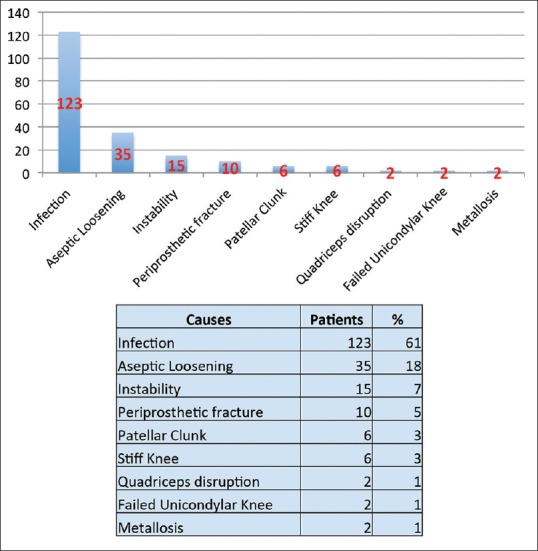
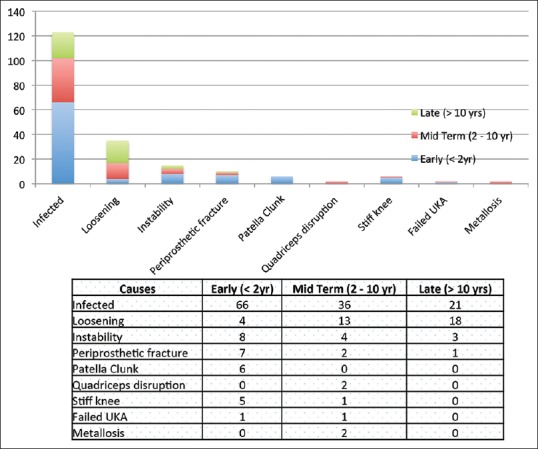
Of the 5068 TKA procedures performed from January 2011 to December 2016, 201 (4%) were first-time revisions. The predominant cause of revisions was prosthetic infection (61%) followed by aseptic loosening (18%) and instability (7%). In the early, mid term, and late-failure groups, prosthetic infection remained the main cause of failure. In 47% of the septic revisions, the offending organisms could be identified and of those identified most (67%) were Gram-negative.
The volume of first-time RTKA procedures (4%) at our center remained low compared with that of the Western countries. In Western countries, the incidence of late aseptic failures was higher than that of early-septic failures, whereas in our study, revisions were more commonly performed in the early-failure group (48%) and most failures were due to prosthetic infection (61%).
由于全膝关节置换术(TKA)的适应症不断扩大,加上患者寿命延长,翻修全膝关节置换术(RTKA)的工作量逐渐增加。西方国家已经在研究其RTKA数据,以规划这些患者未来的医疗保健需求。来自发展中国家的RTKA数据有限。我们的研究试图填补这一知识空白。
我们前瞻性地记录了在我们中心进行的为期六年(2011 - 16年)的所有RTKA的详细信息。我们记录了所有RTKA的手术量、失败原因以及初次手术后的失败时间,并进一步记录了感染性失败中的微生物模式。我们研究了每种失败原因的比例以及初次手术后的时间。
在2011年1月至2016年12月期间进行的5068例TKA手术中,201例(4%)是初次翻修。翻修的主要原因是假体感染(61%),其次是无菌性松动(18%)和不稳定(7%)。在早期、中期和晚期失败组中,假体感染仍然是主要的失败原因。在47%的感染性翻修病例中,可以确定致病微生物,其中大多数(67%)是革兰氏阴性菌。
与西方国家相比,我们中心初次RTKA手术的比例(4%)仍然较低。在西方国家,晚期无菌性失败的发生率高于早期感染性失败,而在我们的研究中,翻修更常见于早期失败组(48%),并且大多数失败是由于假体感染(61%)。